Situation Summary
Guinea-Bissau remains in a period of acute political instability following a military junta's assumption of control. The past week saw escalating consolidation of security apparatus authority, including disarmament of presidential-guard units loyal to exiled former President Umaro Sissoco Embaló and postponement of the December 6 presidential and legislative elections. The security environment is characterized by restricted political activity, internal military tension, and uncertainty around the electoral timeline, with risk concentrated in the northern and eastern regions.
Key Developments
- Bissau — October 7: Military authorities disarmed members of the presidential guard considered loyal to exiled former President Embaló and placed them under military supervision, signaling internal security apparatus fragmentation and junta consolidation efforts.[2][4]
- Bissau — October 7: Junta leader General Horta N'Tam issued an order for all remaining armed presidential-guard members to surrender weapons and equipment, with explicit warnings of consequences for non-compliance, indicating an intensifying power consolidation within the security establishment.[2][8]
- Bissau — October 8: The National Electoral Commission formally stated that technical and security-related conditions were insufficient to proceed with the December 6 presidential and legislative elections, marking the first official acknowledgment of electoral delay.[6][7]
- Guinea-Bissau — October 8: Prime Minister Ilídio Vieira Té confirmed that elections scheduled for December 6 would be postponed, though no replacement date was announced, creating uncertainty around the democratic transition timeline.[1][10]
- Guinea-Bissau — ongoing: Persistent restrictions on political and civil activity remain in force, with regional calls (notably from Senegal) for their removal unheeded as of the reporting period.[7]
Highest-Risk Areas
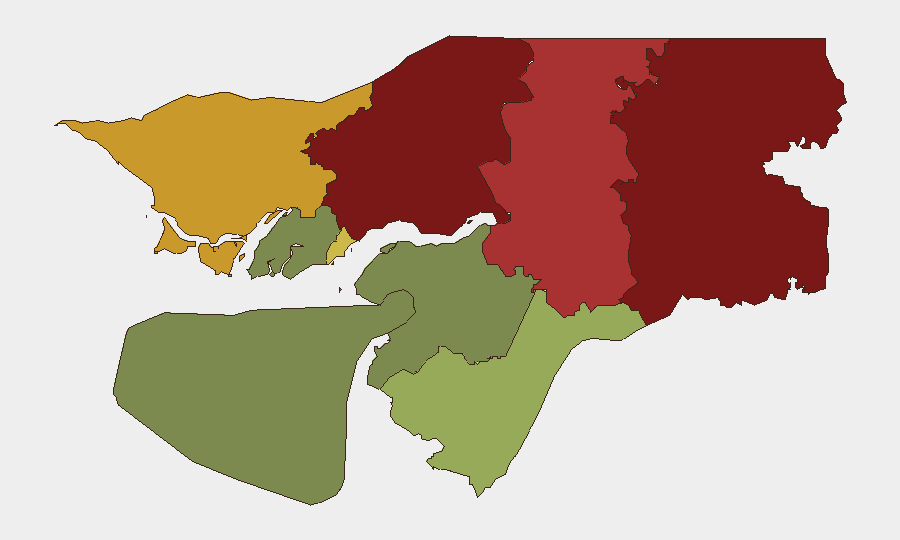
Gabu, Oio, and Bafatá regions in the north and east dominate the sub-national risk profile, with composite scores of 92, 85, and 78 respectively. These areas historically serve as recruitment and operational zones for armed groups and trafficking networks, and their remoteness from state authority limits government capacity for monitoring or intervention. Cacheu Region (72) and the Bissau Autonomous Sector (68) represent secondary concern zones; Bissau's elevated risk reflects the concentration of political actors, security forces, and potential flashpoints around government institutions. Southern and western regions show markedly lower threat profiles, suggesting geographic concentration of security risk.
How GeoBit Would Assist
Security teams should employ AOI Monitoring & Early Warning to maintain persistent watch on Bissau's political quarters and Gabu/Oio border areas for signs of factional military escalation or armed-group mobilization. Regime-Stability Search and Network & Actor Analysis capabilities would provide structured tracking of junta cohesion, Embaló loyalist networks, and competing armed-group activity across the north. Satellite & Imagery Analysis combined with GIS & Spatial Analysis enables monitoring of troop movements and security-force positioning in high-risk northern regions, while Election Monitoring tools should track the rescheduling process and associated civil-space restrictions.
7-Day Outlook
The election postponement and ongoing presidential-guard disarmament suggest consolidation will intensify over the near term, with heightened risk of internal security-force confrontation or attempts by Embaló loyalists to organize resistance. The absence of a rescheduled election date creates prolonged uncertainty and potential for political pressure or protest activity, particularly if the junta signals an extended hold on power. Northern regions remain the primary flashpoint for armed-group activity and trafficking exploitation of state fragmentation.
Highest-Risk Areas — Ranked
| # | State / Region | Risk |
|---|---|---|
| 1 | Gabu Region | 92 |
| 2 | Oio Region | 85 |
| 3 | Bafatá Region | 78 |
| 4 | Cacheu Region | 72 |
| 5 | Bissau Autonomous Sector | 68 |
| 6 | Tombali Region | 45 |
| 7 | Quinara Region | 38 |
| 8 | Biombo Region | 32 |
| 9 | Bolama Region | 15 |
Sources
Previous Weekly Briefs
A new Guinea-Bissau brief is written every Monday, covering the week — each with its own risk map and downloadable CSV. Use the calendar to go further back.
- October 5, 2026
- September 28, 2026
- September 21, 2026
- September 14, 2026
- September 7, 2026
- September 1, 2026
- August 30, 2026
📅 Browse past briefs by calendar →
Highlighted days have a brief. Tap a day for that day's map & analysis, or “csv” for that day's dataset ($5).
Atlas — our AI intelligence desk — emails them this snapshot personally. Nothing else, no list.