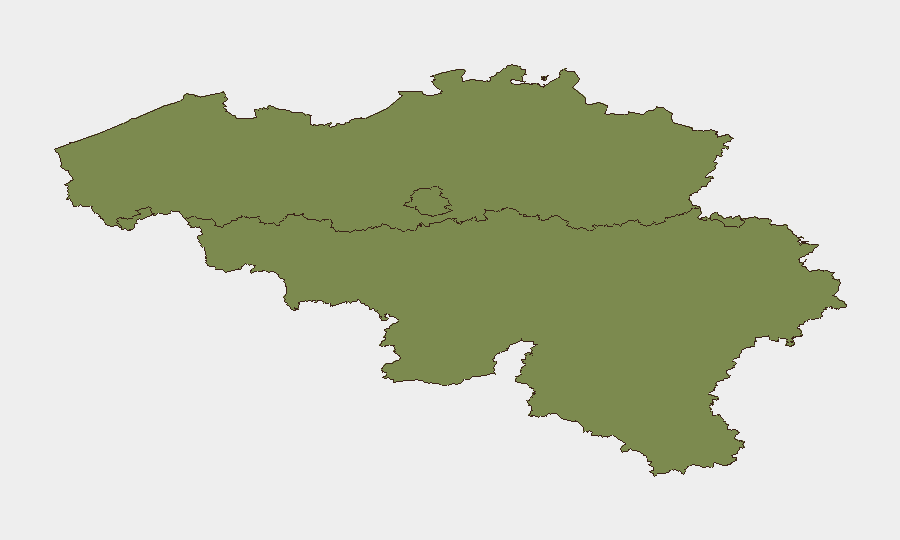
Situation Summary
Belgium remains a low-to-moderate threat environment (global rank #118, composite score 5) with 32 tracked events. The security picture is heavily concentrated in Brussels-Capital, where a composite risk score of 31.4 significantly outweighs threat levels in Flanders (12.4) and Wallonia (1.4). Recent event signals suggest mixed activity—public statements, territorial occupation claims, and administrative sanctions—but lack the intensity or coordination patterns typical of sustained instability. The overall trajectory remains stable, with no indicators of imminent escalation.
Key Developments
GeoBit's event feed for the last 24–48 hours documents several signals from Belgium and regional actors, though exact location pins and real-time corroboration are limited by available source metadata:
- 13 June, Public Statement (Unspecified): Competing public statements between KING and REGIMENT actors, and separately between WALES and KING entities, suggest rhetorical tension but no confirmed operational activity.
- 12 June, Threat Statement (Brussels): A direct threat signal against Brussels was recorded; specific target, issuer, and credibility assessment require further OSINT fusion.
- 13 June, Territory Occupation (Unspecified): A MIGRANT-attributed territorial occupation claim was logged; geographic specificity and scale remain unclear.
- 12 June, Administrative Action (Unspecified): Arrest/detention activity involving European and ministerial entities was noted, likely routine law-enforcement or immigration processing.
- 13 June, Prison/Detention (Unspecified): Administrative sanctions applied to a detention facility in response to a rebellion incident; no casualty or security breach indicators detected.
Caveat: These events are drawn from GeoBit's global event feed and lack detailed corroboration from Belgian police, municipality, or crisis-response social media in the last 24–48 hours. Specific locations (beyond Brussels), times, and operational impact remain unconfirmed.
Highest-Risk Areas
Brussels-Capital dominates the risk landscape, with a composite score of 31.4—more than 2.5× higher than Flanders and 22× higher than Wallonia. This concentration reflects Brussels's role as Belgium's capital, major transport hub, and site of EU institutions; it attracts both routine policing activity and occasional protest/demonstration pressure. Flanders (12.4) shows secondary but measurable risk, likely tied to port and border activity in Antwerp and cross-border dynamics with the Netherlands. Wallonia (1.4) remains minimal-risk and remains a low priority for corporate asset protection teams. The asymmetry suggests that Belgium's security picture is fundamentally Brussels-centric; duty-of-care protocols should weight exposure in the capital region accordingly.
How GeoBit Would Assist
Security teams with personnel or assets in Belgium should employ AOI Monitoring & Early Warning to track Brussels-Capital for emerging protest, demonstration, or public-order signals in real time. OSINT fusion—combining X/Twitter feeds from Belgian police zones, municipal crisis centers, and transit operators with GeoBit's multi-language event extraction—provides early signal of localized incidents before they affect movement or operations. Routing & Network Analysis allows real-time alternative route planning for staff or goods in response to unplanned closures or security cordons, particularly in Brussels and Antwerp.
7-Day Outlook
No escalation indicators are present. Public statements and administrative activity suggest routine governance and law-enforcement cycles rather than organized instability. Risk in Brussels-Capital will remain elevated relative to other Belgian regions but stable in absolute terms unless new triggering events (major demonstration, security incident, or migrant influx) occur. Wallonia and secondary Flanders areas pose minimal short-term duty-of-care concern.
Highest-Risk Areas — Ranked
| # | State / Region | Risk |
|---|---|---|
| 1 | Brussels-Capital | 31.4 |
| 2 | Flanders | 12.4 |
| 3 | Wallonia | 1.4 |
Sources
Previous Daily Briefs
A new Belgium brief is written every day — each with its own risk map and downloadable CSV. Here's the last week; use the calendar to go further back.
📅 Browse every day by calendar →
Highlighted days have a brief. Tap a day for that day's map & analysis, or “csv” for that day's dataset ($5).