Situation Summary
Cambodia faces elevated bilateral tension with Thailand along a shared border that remains under a fragile ceasefire established in late December 2025 following armed clashes. Multiple public statements and military posturing by both countries over the last 48 hours—coupled with reports of Chinese military deliveries to Cambodia—have intensified regional concern about miscalculation, though both governments are publicly committed to peaceful resolution ahead of Cambodia's upcoming elections. Internally, displacement of civilians in border-adjacent Banteay Meanchey and ongoing law-enforcement pressure on organized-crime networks add secondary instability factors. Overall threat trajectory is elevated but containable if current de-escalation messaging holds.
Key Developments
- Thai–Cambodia border (Banteay Meanchey), 9 June 2026: Acting Head of State Hun Sen visited government temporary housing for families recently evacuated due to border security concerns, confirming that civilian displacement remains unresolved and populations are under continued assistance protocols.
- Thailand–Cambodia frontier (Thai National Security Council), 10 June 2026: Thailand's NSC chief publicly characterized the border situation as "delicate," explicitly citing reports of new Chinese military equipment deliveries to Cambodia as a driver of elevated threat assessment.
- Thai military (9–10 June 2026): Thailand's military announced heightened monitoring posture along the border and reaffirmed that military force would be used only as a last resort, signaling controlled but elevated readiness.
- Cambodian government (9 June 2026): Hun Sen issued public statements vowing Cambodia will not choose war and will resolve disputes with Thailand peacefully, while also explicitly linking this stance to Cambodia's upcoming electoral schedule.
- Thai–Cambodia ceasefire (9–10 June 2026): Regional analysis confirms the December 27, 2025 ceasefire remains technically in force but is widely assessed as fragile and under strain from current tensions.
- Thai–Cambodia border (9 June 2026): Cambodian arrest of a Thai national reported, adding to incident frequency along the frontier during the current tension cycle.
- Cambodia (transnational crime), 9–10 June 2026: Ongoing crackdown on cyber-scam and human-trafficking compounds continues to displace criminal syndicates to alternative regional locations, indicating sustained law-enforcement operations but ongoing organized-crime activity.
Highest-Risk Areas
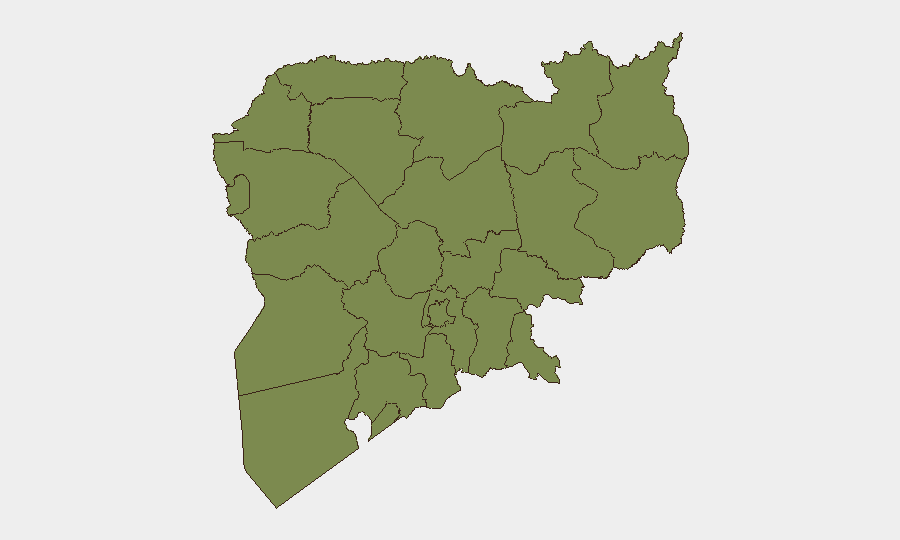
Kampong Thom and Phnom Penh account for the majority of tracked risk, with Kampong Thom's score (31.3) substantially exceeding all other provinces. Kampong Thom's elevation reflects proximity to Thai border tensions and recent displacement activity; Phnom Penh's risk (21.0) derives from concentration of national government, foreign diplomatic presence, and incident clustering associated with political activity ahead of elections. Remaining provinces carry minimal composite scores (1.3 each), indicating that border-zone and capital-region dynamics are the primary drivers of current national risk. Organizations with operations or personnel in Kampong Thom or along the Thai frontier should maintain heightened situational awareness.
How GeoBit Would Assist
Security teams would deploy AOI Monitoring & Early Warning on border crossing points and displacement zones to generate real-time alerts on renewed military activity or civilian movement. Conflict & Military force structure and weapons-capability tracking would support assessment of Chinese arms deliveries and Thai military readiness signaling. OSINT fusion and multi-language search across Cambodian, Thai, and regional outlets would provide continuous corroboration of de-escalation rhetoric versus underlying military posture, enabling duty-of-care teams to distinguish political messaging from operational risk.
7-Day Outlook
The ceasefire is expected to hold through the near term given mutual public de-escalation commitments and electoral calendars, but fragility remains high if either side interprets the other's military monitoring as provocation. Displacement in Banteay Meanchey is unlikely to be fully resolved within 7 days, prolonging humanitarian strain and access complications. Organized-crime displacement activity will continue but is unlikely to directly threaten foreign business operations unless transnational-trafficking networks expand into areas where foreign nationals are present.
Highest-Risk Areas — Ranked
| # | State / Region | Risk |
|---|---|---|
| 1 | Kampong Thom | 31.3 |
| 2 | Phnom Penh | 21 |
| 3 | Koh Kong | 1.3 |
| 4 | Kampong Speu | 1.3 |
| 5 | Kandal | 1.3 |
| 6 | Prey Veng | 1.3 |
| 7 | Khaet Preah Sihanouk | 1.3 |
| 8 | Kampot | 1.3 |
| 9 | Kep | 1.3 |
| 10 | Takeo | 1.3 |
| 11 | Svay Rieng | 1.3 |
| 12 | Oddar Meanchey | 1.3 |
Sources
Previous Daily Briefs
A new Cambodia brief is written every day — each with its own risk map and downloadable CSV. Here's the last week; use the calendar to go further back.
📅 Browse every day by calendar →
Highlighted days have a brief. Tap a day for that day's map & analysis, or “csv” for that day's dataset ($5).