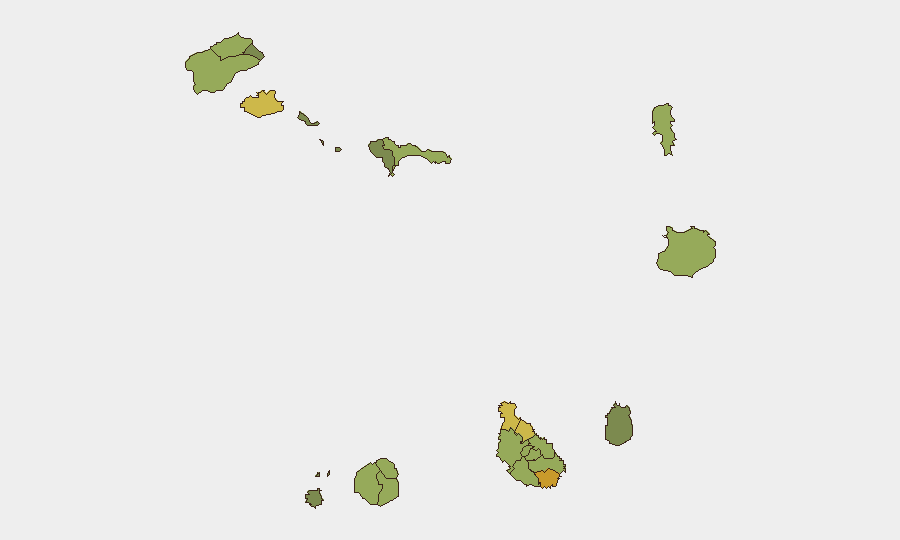
Situation Summary
Cape Verde remains a low-threat environment with no confirmed security incidents, civil unrest, or infrastructure disruptions reported in the last 24–48 hours. Open-source monitoring has identified no credible reports of violence, protests, criminal spikes, or political instability across the archipelago's major islands or municipalities. Composite threat scoring and event tracking remain minimal, reflecting the country's historically stable security posture.
Key Developments
- No discrete security events confirmed in Cape Verde (2026-06-11 to 2026-06-13). Open-source search, social-media OSINT, and news feeds have not surfaced any reports of protests, riots, crime incidents, or infrastructure failures in Praia, Mindelo, Sal, Boa Vista, or other major population centers.
- Routine tropical-weather monitoring mentions the Cabo Verde region in standard Atlantic outlooks; however, no active storm advisory or disruptive weather event is currently impacting the islands or affecting travel/port operations (as of 2026-06-13).
- No airport, port, or telecommunications disruptions reported. Domestic and international connectivity and transport remain operational.
- No credible reports of political or regime instability. National governance and administrative functions continue without reported friction or procedural breakdown.
- Intelligence gap note: Open-source channels provide limited real-time visibility into localized petty crime, minor civil disputes, or informal-sector labor unrest. Private law-enforcement bulletins, embassy cables, or industry-specific feeds may hold additional context not visible in public search.
Highest-Risk Areas
Praia (capital, risk score 72) and São Miguel (68) register the highest composite risk, likely reflecting concentration of population, commercial activity, and associated crime density—typical of major urban centers in the sub-region. Secondary concern zones include São Vicente (Mindelo; 65) and Tarrafal (62), both transit and commerce hubs. These rankings reflect structural vulnerabilities (informal settlements, port activity, migrant populations) rather than acute current incidents. Risk scores across all municipalities remain modest in absolute terms, consistent with Cape Verde's regional security profile.
How GeoBit Would Assist
AOI Monitoring & Early Warning would provide persistent watch over Praia, Mindelo, and secondary towns, with alert triggers for civil unrest, crime spikes, or infrastructure failures signaled via social-media OSINT and local news feeds. Intel Sweep and multi-language web research enable continuous baseline tracking of political stability, labor disputes, and port/airport operational status. Maritime & Aviation tracking supports real-time awareness of transport bottlenecks or diversions affecting personnel and supply movement.
7-Day Outlook
No acute security deterioration is forecast for the next seven days. Routine tropical-weather monitoring should continue; current low-probability disturbance outlooks do not suggest material disruption to operations. Risk posture remains stable, with monitoring emphasis on urban crime trends in Praia and labor/political sentiment in secondary cities.
Report Date: 2026-06-13 | Confidence: Medium–High (open-source); Limited (on localized, non-publicized crime)
Highest-Risk Areas — Ranked
| # | State / Region | Risk |
|---|---|---|
| 1 | Praia | 72 |
| 2 | São Miguel | 68 |
| 3 | São Vicente | 65 |
| 4 | Tarrafal | 62 |
| 5 | São Filipe | 58 |
| 6 | Santa Catarina | 58 |
| 7 | Santa Cruz | 55 |
| 8 | Mosteiros | 52 |
| 9 | São Salvador do Mundo | 52 |
| 10 | Ribeira Grande | 50 |
| 11 | Porto Novo | 48 |
| 12 | Sal | 48 |
Sources
Previous Daily Briefs
A new Cape Verde brief is written every day — each with its own risk map and downloadable CSV. Here's the last week; use the calendar to go further back.
📅 Browse every day by calendar →
Highlighted days have a brief. Tap a day for that day's map & analysis, or “csv” for that day's dataset ($5).