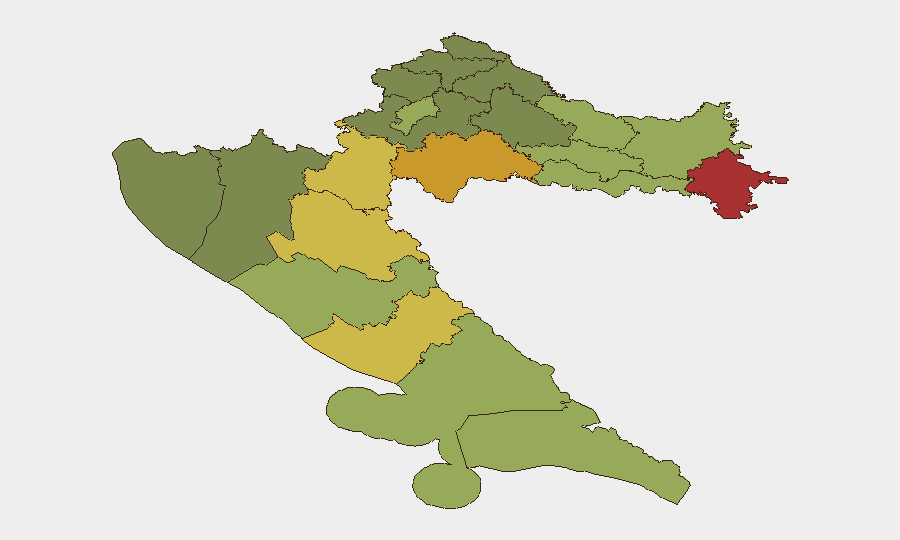
Situation Summary
Croatia remains a low-threat environment globally (rank #158, composite score 7) with no discrete security incidents recorded in the current tracking window. However, the country faces elevated internal political tension stemming from a major environmental scandal and consequent civic mobilization, alongside persistent underlying vulnerabilities in border security and property crime in rural areas. The security posture is stable but dependent on government responsiveness to public demands and continued police operational effectiveness.
Key Developments
- Mass environmental protest in Zagreb (5 September): Tens of thousands of demonstrators rallied in central Zagreb over 30,000+ tonnes of illegally dumped hazardous waste near Gospić (Lika-Senj County), demanding government remediation within 20 days and complete removal within three months. Organizers issued an explicit ultimatum, raising risk of renewed or escalated protests if demands are unmet. One minor incident involved right-wing activists shouting threats at other participants, though the gathering remained largely peaceful.
- "Walk for Lika, Walk for Croatia" civic march (5 September): Coordinated mobilization under the "Gospić je naš dom" initiative moved from King Tomislav Square to Ban Jelačić Square, framing the waste scandal as state corruption and environmental injustice. The organized nature and political messaging suggest sustained civic pressure on government institutions.
- Traffic-safety enforcement operation in Zagreb (2–3 September, reported 6 September): Police recorded 114 traffic offences, including 94 helmet-safety violations among e-scooter and motorcycle users, indicating active urban enforcement and institutional attention to personal-transport risks.
- Public-order prosecution in Bjelovar (3 September): An 18-year-old motorcycle rider is being prosecuted for gesturing at a speed camera, illustrating strict enforcement of public-order statutes and low institutional tolerance for perceived disrespect toward police authority.
- Elderly home burglaries in Biljani Donji (investigation completed 2–3 September): Police arrested a 21-year-old suspect for two burglaries targeting elderly residents (1 August and 24 August), with estimated losses exceeding €2,000. The case reflects ongoing property crime targeting vulnerable populations in rural areas.
- Cross-border migrant arrests near Bosnia–Croatia border (4–5 September): Bosnian police reported 96 migrant arrests, including 18 Afghans, along the frontier, signaling continued irregular-migration flows and sustained pressure on border-security operations in both nations.
- Media revisit of 2022 drone crash in Zagreb (7 September): News reporting highlighted the March 2022 Tu-141 drone incident (Soviet-era, explosive-laden) that damaged ~40 vehicles. While no new incident occurred, the coverage reflects enduring public sensitivity to airspace violations.
Highest-Risk Areas
Vukovar-Srijem, Sisak-Moslavina, and Karlovac counties (risk scores 78, 72, 68 respectively) anchor the sub-national risk profile, reflecting historical legacies of conflict, infrastructure fragility, and demographic stressors in Croatia's interior. Lika-Senj County (risk 65) has risen in prominence due to the hazardous-waste scandal, which now serves as a focal point for civic grievance and government accountability scrutiny. Zagreb (risk 50) remains the administrative and population center, with capacity for large-scale protest mobilization. Rural and border-adjacent regions (Zadar, Brod-Posavina, Osijek-Baranja) show persistent mid-range vulnerability, linked to property crime and irregular-migration transit patterns.
How GeoBit Would Assist
Security teams would use AOI Monitoring & Early Warning to track civic mobilizations and protest escalation in Zagreb and Lika, with sentiment & temporal analysis to forecast likelihood of renewed demonstrations if government deadlines are missed. Network & Actor Analysis would help identify organizers, funding, and ideological factions within protest movements to assess radicalization risk. Border & Disputed-Territory Search and maritime/aviation tracking would support continuous monitoring of cross-border migrant flows and irregular entry routes in vulnerable regions.
7-Day Outlook
If the government meets or credibly commits to the 20-day remediation deadline issued by protest organizers, civic tension is likely to stabilize. Conversely, failure to engage substantively may trigger renewed large-scale mobilization by mid-to-late September. Border-security operations will remain routine, with no indication of imminent external threats.
Highest-Risk Areas — Ranked
| # | State / Region | Risk |
|---|---|---|
| 1 | Vukovar-Srijem County | 78 |
| 2 | Sisak-Moslavina County | 72 |
| 3 | Karlovac County | 68 |
| 4 | Lika-Senj County | 65 |
| 5 | Šibenik-Knin County | 62 |
| 6 | Brod-Posavina County | 58 |
| 7 | Zadar County | 55 |
| 8 | Osijek-Baranja County | 52 |
| 9 | City of Zagreb | 50 |
| 10 | Split-Dalmatia County | 48 |
| 11 | Požega-Slavonia County | 45 |
| 12 | Virovitica-Podravina County | 42 |
Sources
Previous Weekly Briefs
A new Croatia brief is written every Monday, covering the week — each with its own risk map and downloadable CSV. Use the calendar to go further back.
- September 3, 2026
- August 31, 2026
- August 28, 2026
- August 26, 2026
- August 24, 2026
- August 22, 2026
- August 20, 2026
📅 Browse past briefs by calendar →
Highlighted days have a brief. Tap a day for that day's map & analysis, or “csv” for that day's dataset ($5).
Atlas — our AI intelligence desk — emails them this snapshot personally. Nothing else, no list.