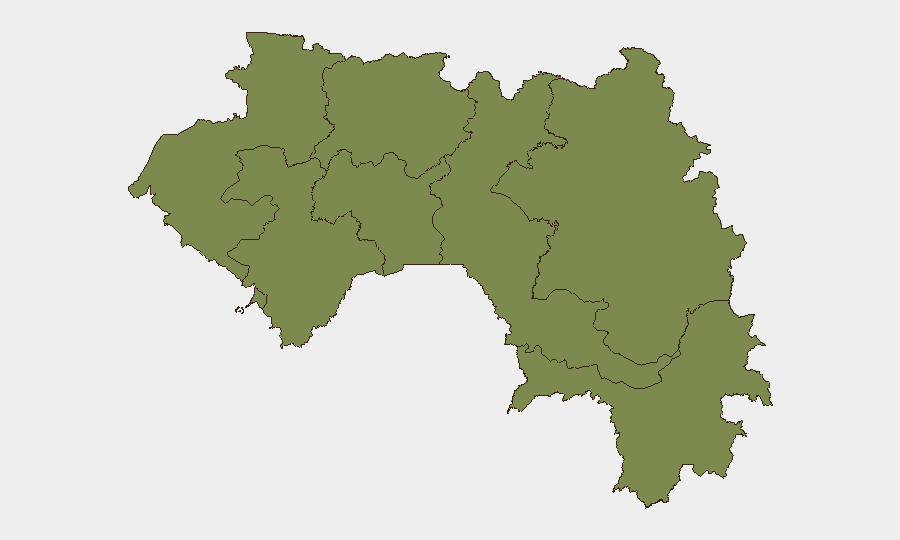
Situation Summary
Guinea remains a stable but fragile operating environment with composite threat score 8.1 (rank #47 globally) and 72 tracked events in the current monitoring cycle. The security picture is heavily concentrated in the eastern Kankan Region, where risk scores are 4.5× higher than the national baseline, reflecting ongoing border instability and mineral-sector tensions. No major new security incidents have entered international reporting in the past 24–48 hours; routine governance friction and civil-society activity continue at low to moderate levels across the capital and mining zones.
Key Developments
Absence of Verified Recent Incidents
Open-source reporting for the past 24–48 hours does not contain credible, time-stamped accounts of new security, civil unrest, crime spikes, or infrastructure disruption in Guinea. Event signals in the GeoBit platform include a 2026-06-11 demonstration/rally (location and specifics pending clarification from regional feeds) and historical detentions/arrests dating to 2026-06-09 and 2026-06-10, but no corroborating incident detail is available from international or regional media at this hour. Monitoring should continue for French-language reporting and local social-media signals that may precede English-language coverage.
Highest-Risk Areas
Kankan Region dominates the threat landscape, with a composite risk score of 35.7—more than 4× the national average and 6× the risk in Conakry. This eastern border zone is a nexus of illicit cross-border trade, mineral smuggling, and informal armed-group activity tied to regional instability in Mali, Côte d'Ivoire, and Liberia. Boké Region (risk 8.0) ranks second, reflecting mining-sector labor disputes, land-tenure conflicts, and periodic clashes between artisanal and industrial extractive operations. Conakry (risk 7.6), the capital, experiences routine street crime, occasional labor protests, and governance-related civil unrest, but large-scale political or security crises remain unlikely in the near term. Kindia, Labé, Mamou, Faranah, and Nzérékoré all cluster at 5.7, indicating baseline instability without acute acute flashpoints.
How GeoBit Would Assist
A corporate security team with personnel or assets in Guinea should employ persistent area-of-interest (AOI) monitoring on Kankan and Boké regions with alerting thresholds set for arrest/detention, unconventional violence, and economic-disruption keywords. Multi-language OSINT (French, Susu, Maninka) across X, Telegram, local radio, and YouTube will provide early warning of labor unrest or border incidents before they reach international outlets. Network and actor analysis can map informal leadership and dispute-resolution nodes in mining areas, while alternative-route and journey-planning tools support contingency logistics if Kankan or main transport corridors become unstable.
7-Day Outlook
Guinea is not forecast to experience major political or security escalation in the next 7 days. Kankan Region will likely remain the primary focus for security intelligence; any spike in arrests, disappearances, or cross-border incident reporting there should prompt immediate duty-of-care review for field teams. Mining-sector tensions in Boké may produce labor actions or community clashes, but these typically remain localized and negotiable.
Highest-Risk Areas — Ranked
| # | State / Region | Risk |
|---|---|---|
| 1 | Kankan Region | 35.7 |
| 2 | Boké Region | 8 |
| 3 | Conakry | 7.6 |
| 4 | Labé Region | 5.7 |
| 5 | Kindia Region | 5.7 |
| 6 | Mamou Region | 5.7 |
| 7 | Faranah Region | 5.7 |
| 8 | Nzérékoré Region | 5.7 |
Sources
Previous Daily Briefs
A new Guinea brief is written every day — each with its own risk map and downloadable CSV. Here's the last week; use the calendar to go further back.
📅 Browse every day by calendar →
Highlighted days have a brief. Tap a day for that day's map & analysis, or “csv” for that day's dataset ($5).