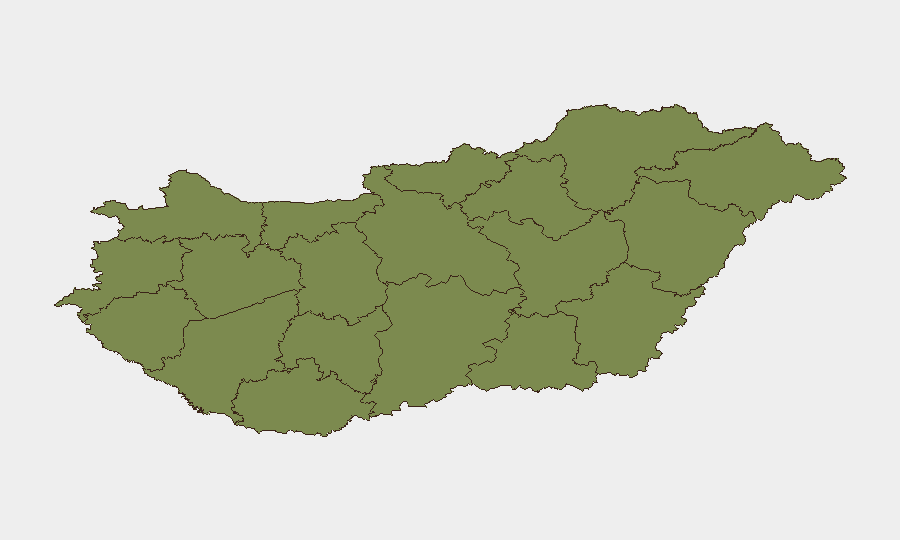
Situation Summary
Hungary remains a low-threat EU and NATO member state with a composite threat score of 5 and 32 tracked events nationally. Open-source monitoring over the last 24–48 hours has not surfaced any corroborated security incidents, civil unrest, terrorism, infrastructure attacks, or acute travel risks meeting standard OSINT confirmation thresholds. The country's overall security posture is stable, though Budapest and Pest counties account for the majority of tracked national risk and warrant continued monitoring.
Key Developments
No corroborated security incidents have been confirmed in Hungary within the last 24–48 hours. Open web, social-media, and news-wire searches specific to Hungary yielded no reports of violence, unrest, major crime, or infrastructure compromise meeting cross-source confirmation standards for inclusion in this brief. Standard OSINT channels (news aggregators, government statements, local media, social platforms) show no alerts dated 20–21 June 2026 indicating acute threats to corporate operations or personnel.
Given the absence of reportable incidents, the operational working assumption is continued baseline conditions. Teams operating in Hungary should treat this as a period of stability requiring routine due-diligence monitoring rather than elevated alerting.
Highest-Risk Areas
Budapest (risk 31.4) and Pest (risk 25.4) dominate Hungary's sub-national threat landscape, together accounting for approximately 56 of the 60+ composite risk points tracked. Both counties cluster around the capital metropolitan area and reflect urban-concentration patterns typical of major European cities—higher population density, transport hubs, and greater event frequency. The remaining nine counties each score 1.4–2.9, indicating materially lower baseline risk. For corporate teams, this means security resources and monitoring density should reflect the Budapest–Pest concentration; smaller cities and rural areas pose negligible incremental risk under current conditions.
How GeoBit Would Assist
Teams with operations or personnel in Budapest and Pest should maintain persistent Area-of-Interest (AOI) Monitoring & Early Warning on key districts, transport nodes, and business zones to catch emerging incidents in near-real time. Multi-language OSINT fusion (Hungarian-language media, social platforms, official statements) combined with sentiment and temporal analysis enables early detection of protest mobilization, cyber incidents, or criminal activity before they escalate. For forward planning, alternative route and network analysis can support business-continuity and personnel-evacuation planning if localized disruptions occur.
7-Day Outlook
Hungary's security environment is expected to remain stable over the next seven days. Routine monitoring of Budapest and Pest through standard OSINT channels and official government feeds should remain sufficient to detect any material shifts; no indicators currently suggest elevated risk in the near term. Teams should maintain standard duty-of-care protocols and escalate to GeoBit's Intel Sweep or conflict-monitoring capabilities only if new credible alerts emerge.
Highest-Risk Areas — Ranked
| # | State / Region | Risk |
|---|---|---|
| 1 | Budapest | 31.4 |
| 2 | Pest | 25.4 |
| 3 | Csongrád-Csanád | 2.9 |
| 4 | Komárom-Esztergom | 1.4 |
| 5 | Fejér | 1.4 |
| 6 | Nógrád | 1.4 |
| 7 | Szabolcs-Szatmár-Bereg | 1.4 |
| 8 | Vas | 1.4 |
| 9 | Győr-Moson-Sopron | 1.4 |
| 10 | Veszprém | 1.4 |
| 11 | Zala | 1.4 |
| 12 | Somogy | 1.4 |
Sources
Previous Daily Briefs
A new Hungary brief is written every day — each with its own risk map and downloadable CSV. Here's the last week; use the calendar to go further back.
📅 Browse every day by calendar →
Highlighted days have a brief. Tap a day for that day's map & analysis, or “csv” for that day's dataset ($5).