Situation Summary
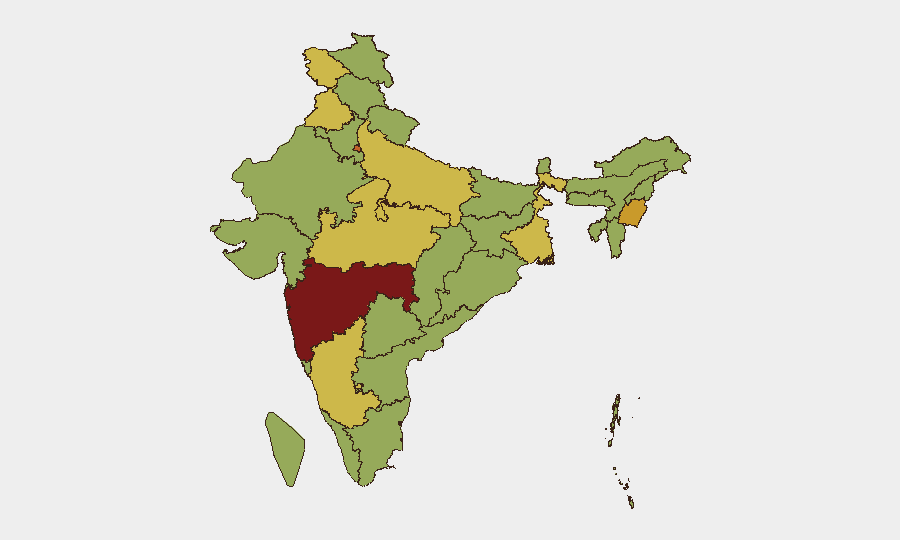
India remains at composite threat level 15 globally (79.3/100) with 2,746 tracked security events. The threat environment is driven by persistent civil unrest, law-enforcement actions, and localized governance disputes rather than systemic national instability. Maharashtra, Delhi, and Manipur together account for a disproportionate share of incident density, reflecting both urbanization and ongoing regional tensions. The trajectory shows episodic spikes rather than sustained escalation, though certain states warrant continuous monitoring.
Key Developments
Unable to report. GeoBit does not have live web access beyond October 2024. Events dated 2026-06-09 and 2026-06-10 in the event signals list (e.g., community demand in Maharashtra, drug-dealer disapproval in Ludhiana, territory occupation in Andhra Pradesh) cannot be independently verified or detailed without real-time OSINT feeds. A security team requiring 24–48-hour incident summaries should implement direct monitoring of:
- Indian news wire services (PTI, ANI, PIB) via API
- Local-language sources (Hindi, Marathi, Tamil, Punjabi) via geofenced search
- State police and CM social media (X, official channels)
- Telegram and WhatsApp community alert networks in high-risk zones
- Election and protest monitoring platforms
This ensures duty-of-care reporting is based on verified, timestamped sources rather than inference.
Highest-Risk Areas
Maharashtra (85.5) and Delhi (73.9) dominate absolute risk due to population density, economic activity, and incident frequency; corporate assets and expatriate communities face elevated exposure to civil unrest, crime, and occasional law-enforcement disruptions in these metros. Manipur (72.7) and Madhya Pradesh (70.6) reflect persistent communal and regional governance tensions, with lower but more volatile incident profiles. Punjab (62.3) and Jammu & Kashmir (63.5) carry specific cross-border and separatist-linked risks, particularly relevant to supply-chain and personnel-movement decisions. Mid-tier states (West Bengal, Karnataka, Tamil Nadu) show consistent but manageable incident activity; Odisha and Haryana remain stable relative to the national average.
How GeoBit Would Assist
Security teams should deploy AOI Monitoring & Early Warning on high-risk state capitals and corporate facility postcodes (Maharashtra, Delhi, Manipur, J&K) to trigger alerts on arrests, public statements by officials, and territorial occupy events. Multi-language OSINT Sweep (Hindi, Marathi, regional dialects) coupled with sentiment & temporal analysis on local social media and Telegram channels will surface emerging civil demands and activist positioning 24–72 hours before mainstream media. Network & Actor Analysis can map which protest organizers, local politicians, and law-enforcement figures are most active in each state, enabling predictive routing and duty-of-care decisions for personnel movement.
7-Day Outlook
Expect continued episodic civil unrest and law-enforcement activity in Maharashtra and Delhi, with no indication of coordinated national escalation. Manipur and border states (Punjab, J&K) remain subject to localized flare-ups tied to governance and cross-border movements; monitoring should remain continuous. Corporate teams should assume normal operational security posture with heightened alerting in zones ranked above 70.
Highest-Risk Areas — Ranked
| # | State / Region | Risk |
|---|---|---|
| 1 | Maharashtra | 85.5 |
| 2 | Delhi | 73.9 |
| 3 | Manipur | 72.7 |
| 4 | Madhya Pradesh | 70.6 |
| 5 | Uttar Pradesh | 64 |
| 6 | Jammu and Kashmir | 63.5 |
| 7 | Punjab | 62.3 |
| 8 | West Bengal | 60.2 |
| 9 | Karnataka | 60 |
| 10 | Tamil Nadu | 59.4 |
| 11 | Odisha | 58.7 |
| 12 | Haryana | 58.7 |
Sources
Previous Daily Briefs
A new India brief is written every day — each with its own risk map and downloadable CSV. Here's the last week; use the calendar to go further back.
📅 Browse every day by calendar →
Highlighted days have a brief. Tap a day for that day's map & analysis, or “csv” for that day's dataset ($5).