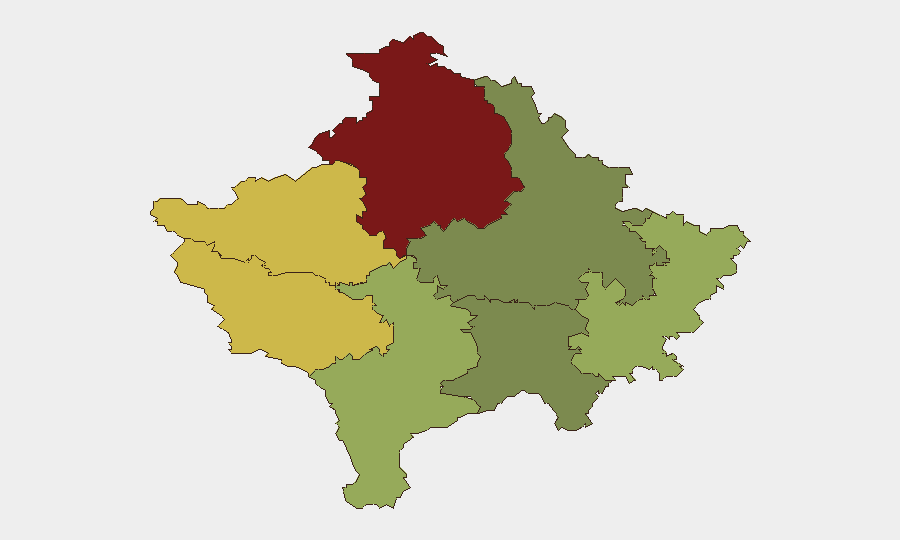
Situation Summary
Kosovo remains broadly stable with a composite threat score of 7/100 and no tracked major security events in the current window. NATO's announcement of a planned KFOR troop reduction over the coming year—framed as a response to an "improved security environment"—signals international confidence in the current trajectory, though the drawdown is explicitly conditioned on low tension levels. The security picture is defined by routine institutional cooperation and NATO posture optimization rather than acute crises or deterioration.
Key Developments
- Kosovo-wide (NATO/KFOR posture) – mid-June 2026
NATO Supreme Headquarters Allied Powers Europe announced a planned gradual reduction of KFOR troop levels over the next year, citing a "largely stable" security environment. Reductions will occur through national rotation cycles and are described as reversible if conditions worsen. Current KFOR strength is approximately 5,000 troops.
- Kosovo-wide (KFOR force composition clarification) – mid-June 2026
KFOR spokesperson Antonio Petralia clarified to local media that reserve forces were already withdrawn earlier in 2026 and that the announced "optimization" concerns the broader KFOR force structure, reinforcing that NATO will remain operationally present with carefully measured adjustments.
- Pristina (KFOR command engagement) – recent days
KFOR Commander Major General Özkan Ulutaş held a meeting with regional security partners in Pristina, reiterating KFOR's commitment to maintaining a safe environment and freedom of movement for all communities. The engagement underscores routine strategic dialogue rather than crisis response.
- Pristina (US–Kosovo military cooperation) – recent days
US European Command reported the first "Command and Control Interoperability Board" meeting between EUCOM and the Kosovo Security Force (KSF), focusing on enhanced coordination and interoperability. This represents institutional military advancement and ongoing security partnership deepening.
- Kosovo-wide (governance/anti-corruption) – recent days
UNDP Kosovo convened the first "Combating Corruption and Financial Crimes" platform meeting, emphasizing follow-up steps on financial crime. International actors view anti-corruption progress as a stabilizing factor for long-term political stability.
- Kosovo-wide (economic stability indicators) – June 2026
The OECD released the SME Policy Index 2026 for Kosovo, documenting continued progress in economic and governance indicators. Donor and diplomatic communities cite such economic progress as a structural support for political stability and reduced conflict risk.
Highest-Risk Areas
Mitrovica District (risk 92) remains the primary concern, historically driven by intercommunal tensions and organized crime networks; Peja (68) and Gjakova (65) follow with elevated risk profiles. Risk concentration in northern and western districts reflects legacy community divisions, informal economy activity, and proximity to sensitive borders. By contrast, Prishtina (28) and Ferizaj (38) show significantly lower composite risk, correlating with greater international presence, institutional capacity, and economic integration.
How GeoBit Would Assist
Security teams should employ AOI Monitoring & Early Warning to track Mitrovica, Peja, and Gjakova for any resurgence of organized crime, intercommunal activity, or political flashpoints as KFOR strength declines. OSINT Fusion & Corroboration across X/Telegram and local media will provide early signal of grassroots instability or criminal activity before escalation. Network & Actor Analysis can map ongoing criminal and intercommunal networks in high-risk districts to support asset protection and movement planning.
7-Day Outlook
No acute deterioration is expected over the next week; the security environment should remain stable pending the formal commencement of KFOR reductions. Monitor for any political or community statements responding to NATO's drawdown announcement, as messaging from Mitrovica or Peja actors may indicate anxiety or planned activity. Routine institutional cooperation and NATO posture management are likely to dominate reporting.
Highest-Risk Areas — Ranked
| # | State / Region | Risk |
|---|---|---|
| 1 | District of Mitrovica | 92 |
| 2 | District of Peja | 68 |
| 3 | District of Gjakova | 65 |
| 4 | District of Prizren | 55 |
| 5 | District of Gjilan | 52 |
| 6 | District of Ferizaj | 38 |
| 7 | District of Prishtina | 28 |
Sources
Previous Daily Briefs
A new Kosovo brief is written every day — each with its own risk map and downloadable CSV. Here's the last week; use the calendar to go further back.
📅 Browse every day by calendar →
Highlighted days have a brief. Tap a day for that day's map & analysis, or “csv” for that day's dataset ($5).