Situation Summary
Luxembourg maintains a low and stable security environment, ranked #174 globally with a composite threat score of 4 across 23 tracked events. No credible, multi-sourced reports of significant security incidents, civil unrest, crime, political instability, or infrastructure disruption have been confirmed in the past 24–48 hours. Current indicators support routine operations and standard duty-of-care protocols for corporate assets and personnel.
Key Developments
- No verified civil unrest or demonstrations reported in Luxembourg City, Esch-sur-Alzette, or other major centres in the past 24–48 hours by national media, police channels, or local social-media feeds.
- No major crime or public-safety incidents (terror alerts, violent crime clusters, mass-casualty events) flagged by Luxembourg national or local authorities in the last 24–48 hours.
- No infrastructure disruptions (airport/border closures, motorway blockages, utility outages) reported by transport authorities or service providers; scheduled events (e.g., Asteroid Day programming) remain focused on outreach activities.
- No new political-instability developments (government crises, snap elections, corruption scandals) dated to the last 24–48 hours visible in mainstream European or Luxembourg-focused news feeds.
- No updated travel advisories for Luxembourg issued by major foreign ministries or embassies in the past 24–48 hours; Luxembourg does not appear in current alerts from major diplomatic services.
- Routine EU administrative and economic activity continues; no acute security events embedded in recent institutional or staff-related reporting.
Highest-Risk Areas
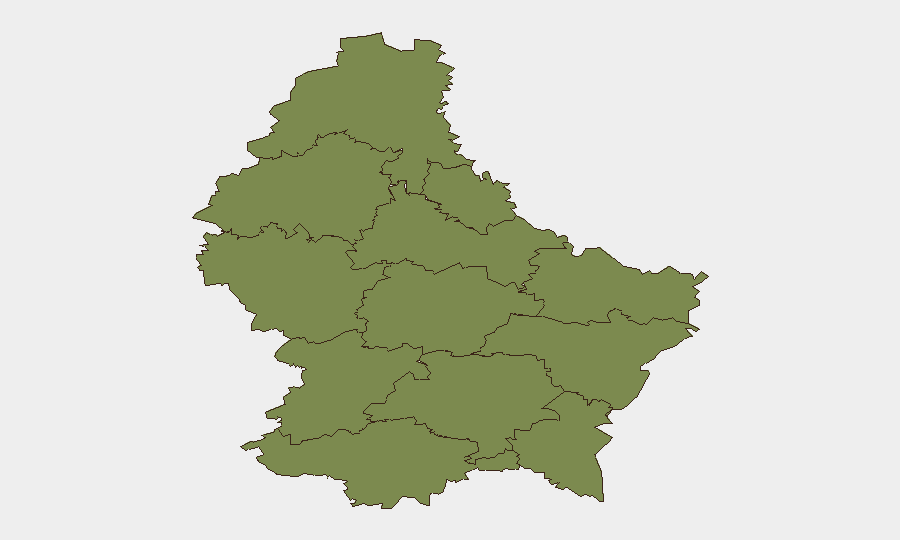
Mersch Canton significantly outranks all other sub-national areas, with a composite risk score of 31.8—approximately 18 times higher than any other canton. The remaining 11 cantons (Wiltz, Clervaux, Diekirch, Vianden, Redange, Capellen, Luxembourg, Esch, Remich, Echternach, and Grevenmacher) cluster at an identical risk score of 1.8, suggesting either concentrated events or indicators in Mersch or a data-collection anomaly. Security teams should prioritize monitoring of Mersch Canton for workforce deployments, asset locations, or supply-chain nodes; however, the absence of corroborating open-source incidents in the past 48 hours suggests risk may be historical, sectoral, or non-acute.
How GeoBit Would Assist
Intel Sweep and X/Twitter & Telegram OSINT would enable continuous monitoring of Luxembourg's cantons—particularly Mersch—for emerging civil unrest, crime, or infrastructure signals that precede mainstream reporting. AOI Monitoring & Early Warning with persistent geographic alerting on Mersch and border crossing points would provide 24/7 situational awareness for personnel and asset protection teams. Risk & Threat Assessment modules would synthesize canton-level event feeds and sentiment analysis to refine deployment decisions and incident-response protocols.
7-Day Outlook
No acute near-term escalation is forecast over the next seven days based on current event clustering and open-source indicators. Standard security postures and routine cross-border mobility protocols remain appropriate. Continued daily monitoring of Mersch Canton and weekly risk-ranking updates are recommended to detect any shift in sub-national threat distribution.
Highest-Risk Areas — Ranked
| # | State / Region | Risk |
|---|---|---|
| 1 | Mersch Canton | 31.8 |
| 2 | Wiltz Canton | 1.8 |
| 3 | Clervaux Canton | 1.8 |
| 4 | Diekirch Canton | 1.8 |
| 5 | Vianden Canton | 1.8 |
| 6 | Redange Canton | 1.8 |
| 7 | Capellen Canton | 1.8 |
| 8 | Luxembourg Canton | 1.8 |
| 9 | Esch Canton | 1.8 |
| 10 | Remich Canton | 1.8 |
| 11 | Echternach Canton | 1.8 |
| 12 | Grevenmacher Canton | 1.8 |
Sources
Previous Daily Briefs
A new Luxembourg brief is written every day — each with its own risk map and downloadable CSV. Here's the last week; use the calendar to go further back.
📅 Browse every day by calendar →
Highlighted days have a brief. Tap a day for that day's map & analysis, or “csv” for that day's dataset ($5).