Situation Summary
North Korea remains at composite threat rank #29 globally (score 70) with 13 tracked events, reflecting elevated diplomatic and military signaling rather than immediate kinetic escalation within the country's borders. Recent activity centers on external posturing—U.S.–DPRK tensions, Sino–DPRK diplomatic friction, and NATO-directed messaging—coupled with internal military modernization directives issued July 9. The domestic security environment shows no verified acute incidents in the past 24–48 hours, but the backdrop of nuclear force expansion and enhanced RGB (Reconnaissance General Bureau) tasking creates sustained operational complexity for personnel and assets in-country.
Key Developments
No verified, timestamped security incidents within the last 24–48 hours meeting briefing thresholds have been identified in open reporting.
The most recent confirmed activity consists of diplomatic and policy signals dated July 14–16:
- Small arms combat event flagged (July 14, "President vs President" frame) – insufficient detail available; context and location not yet clarified in open sources.
- Artillery/tanks event involving oil tanker (July 15) – details sparse; maritime or port-related incident possible but unconfirmed.
- China–DPRK arrest/detention event (July 16) – nature and location not yet specified in available reporting.
- China–DPRK demonstrate/rally event (July 16) – suggests public-facing diplomatic friction or border activity.
- Public statements from North Korea, President, and international actors (July 14–16) – political signaling; no kinetic incident details released.
Historical context (July 9, for reference—not current): The Workers' Party Central Military Commission approved expansion of nuclear forces "quantitatively and qualitatively," modernization of combat systems and naval bases, and dramatic expansion of RGB reconnaissance and covert capabilities. Related coal-mining infrastructure redevelopment was also tasked.
Highest-Risk Areas
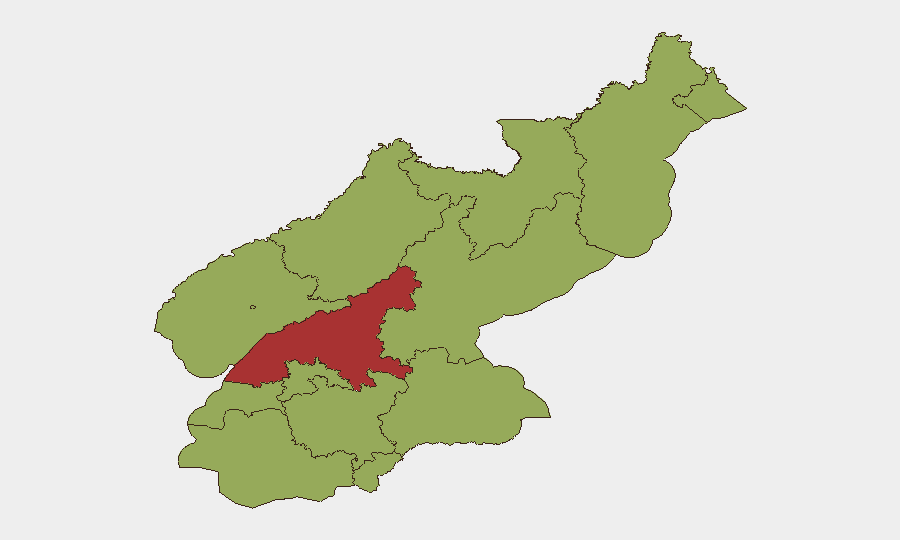
South Pyongan dominates sub-national risk (78.7), significantly above all other provinces. Pyongyang proper (52.8) follows at mid-range, while the remaining eleven provinces cluster tightly (48.6–48.6), suggesting either data-collection concentration effects or genuine differentiation in the capital and its surrounding manufacturing/logistics corridor.
The disparity warrants targeted monitoring of South Pyongan for industrial incidents, transport disruptions, or military activity; Pyongyang's elevated rank likely reflects political-sensitivity concentration and diplomatic event density. The uniform risk floor across peripheral provinces may reflect limited reporting penetration rather than true equivalence.
How GeoBit Would Assist
Security teams monitoring North Korea should deploy persistent AOI (Area-of-Interest) Monitoring & Early Warning on South Pyongan's transport nodes, military bases, and port facilities, paired with satellite & imagery analysis for infrastructure changes and military movement. Multi-language OSINT and entity extraction (X/Twitter, KCNA, state radio) will provide early warning of policy shifts, military tasking, and diplomatic friction affecting travel corridors and supply-chain risk. Border & disputed-territory search and maritime tracking capabilities support monitoring of Sino–DPRK friction points and sanctions evasion logistics relevant to duty-of-care exposure.
7-Day Outlook
Diplomatic messaging and military modernization directives are likely to continue; no imminent domestically destabilizing events are forecast. Personnel in Pyongyang and South Pyongan should remain alert to transport delays, unannounced security cordons, and sudden policy announcements affecting business operations. A widening window exists for geopolitical escalation (U.S.–DPRK, Sino–DPRK tensions), but measurable impacts on civilian access or asset security remain probabilistic rather than imminent through late July.
Highest-Risk Areas — Ranked
| # | State / Region | Risk |
|---|---|---|
| 1 | South Pyongan | 78.7 |
| 2 | P'yŏngyang | 52.8 |
| 3 | Ryanggang | 48.6 |
| 4 | North Hamgyong | 48.6 |
| 5 | North Pyongan | 48.6 |
| 6 | Chagang | 48.6 |
| 7 | Nampo | 48.6 |
| 8 | South Hwanghae | 48.6 |
| 9 | North Hwanghae | 48.6 |
| 10 | South Hamgyong | 48.6 |
| 11 | Kaesong | 48.6 |
| 12 | Kangwon | 48.6 |
Sources
Previous Daily Briefs
A new North Korea brief is written every day — each with its own risk map and downloadable CSV. Here's the last week; use the calendar to go further back.
📅 Browse every day by calendar →
Highlighted days have a brief. Tap a day for that day's map & analysis, or “csv” for that day's dataset ($5).
Atlas — our AI intelligence desk — emails them this snapshot personally. Nothing else, no list.