Situation Summary
Tajikistan remains classified as a low–threat country (#173 globally), with no major security incidents reported in the last 24 hours. However, structural risks persist in border regions and restricted areas: terrorism and militant spillover from Afghanistan, residual Tajik–Kyrgyz border tensions despite 2025 agreements, unexploded ordnance hazards, and authoritarian governance that constrains civil liberties and creates latent unrest. The security environment is stable but fragmented by geography, with acute risks concentrated in remote and border-adjacent regions rather than urban centers.
Key Developments
- Afghan border regions (Khatlon, GBAO) – elevated terrorism and spillover risk – U.S. State Department advisory reiterates Level 3 ("Reconsider Travel") status due to militant presence just across the Afghan border and unpredictable security conditions in northern Afghanistan, creating persistent danger of cross-border militant activity, especially in Gorno-Badakhshan Autonomous Oblast (GBAO).
- GBAO – restricted zone with history of armed clashes – Authorities maintain restrictions on foreign entry, requiring permits subject to suspension; advisories confirm that violent clashes between security forces and armed groups have occurred in recent years, signaling continued tension and risk of renewed unrest in this highest-risk region.
- Tajik–Kyrgyz border (Isfara, Vorukh enclave, key crossings) – skirmish risk despite agreements – Multiple armed skirmishes between border guards recorded over five years; March 2025 agreements eased movement at Guliston–Kyzyl-Bel and Madaniyat–Kayragach crossings, but residual friction and territorial disputes remain, warranting continued caution among travelers.
- Vakhsh and Rasht valleys; Afghan and Uzbek borders – landmine and cluster-munition hazard – Unexploded ordnance remains an active physical-security threat along multiple border zones; official guidance advises against off-road travel, roadside ditches, and unmarked trails, presenting latent risk to any personnel operating outside controlled corridors.
- Nationwide – political repression and civil-liberties constraints – Freedom House's 2024 assessment rates Tajikistan as "Not Free" (5/100); President Emomali Rahmon's authoritarian rule since 1992 includes severe restrictions on political rights and civil liberties, creating structural conditions for politically motivated detention, suppression of dissent, and latent unrest.
Highest-Risk Areas
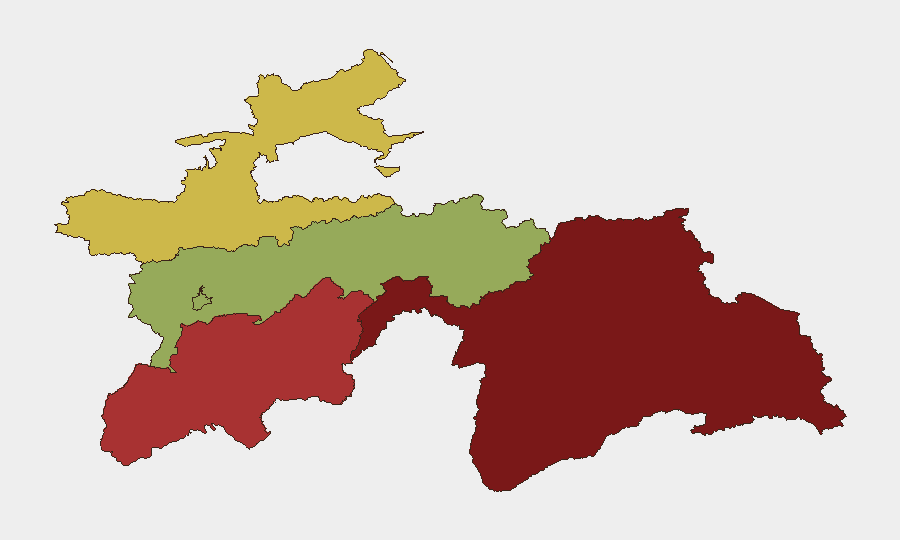
Gorno-Badakhshan Autonomous Oblast (risk 92) and Khatlon Region (risk 78) drive the national threat profile, both defined by proximity to Afghanistan and militant presence, combined with limited state control and history of armed clashes. Sughd Region (risk 65) follows as a secondary concern, reflecting broader border instability. These three regions account for the majority of actionable security risk; Dushanbe (risk 42) and the Districts of Republican Subordination (risk 58) remain lower-risk but subject to underlying political repression. Risk is overwhelmingly geographic and border-driven rather than incident-based.
How GeoBit Would Assist
Security teams operating in or with personnel in Tajikistan should employ AOI (Area of Interest) Monitoring & Early Warning to track GBAO, Afghan border regions, and Tajik–Kyrgyz flashpoints for sudden escalation signals. OSINT Fusion (multi-language search, X/Telegram intelligence, and local media monitoring) would detect politically motivated detention trends or cross-border militant activity before official advisories update. GIS & Spatial Analysis and Routing & Network Analysis enable alternative route planning that avoids landmine-prone zones and restricted regions, strengthening duty-of-care protocols for field operations.
7-Day Outlook
No major escalation is expected in the near term; the security environment should remain stable but fragmented. Continued monitoring of the Afghan–Tajik border and GBAO is warranted, particularly for signs of renewed militant activity or security-force operations. Border incidents with Kyrgyzstan remain possible but low-probability given the March 2025 agreements.
Highest-Risk Areas — Ranked
| # | State / Region | Risk |
|---|---|---|
| 1 | Gorno-Badakhshan Autonomous Region | 92 |
| 2 | Khatlon Region | 78 |
| 3 | Sughd Region | 65 |
| 4 | Districts of Republican Subordination | 58 |
| 5 | Dushanbe | 42 |