Situation Summary
Uruguay remains a low-threat country globally (rank #154, composite score 2.1), but is experiencing a convergence of cyber and conventional security pressures in early June 2026. A high-profile cyber-attack on the civil aviation authority, coupled with a suspected 8–10-fold spike in attacks on the national digital-ID platform and ongoing street crime in urban centers, has elevated operational risk for corporate personnel and digital infrastructure. Political tension—evident in recent Treasury statements and U.S. disapproval signals—compounds the environment, though large-scale instability remains unlikely.
Key Developments
- Montevideo | DINACIA cyber-attack (06-04): The National Directorate of Civil Aviation website was defaced by actors identifying as "La Pampa Leaks," exposing personal data of President Orsi and officials alongside political allegations; investigation ongoing by national police cybercrime unit and AGESIC.
- Nationwide | Cross-border attribution signals: Uruguayan media report alleged Argentine origin and involvement of regional actors ("BogotaLeaks," "Uruguayo1337"); authorities have not publicly confirmed attribution; regional cyber-tension implications present.
- Montevideo & nationwide | Antel TuID platform under siege: The state digital-identity platform experienced an 8–10× increase in cyberattacks in recent days; 163 early users (primarily Antel staff and vendors, 2020 enrollees) have suspected fingerprint minutiae compromise; core credentials remain uncompromised to date.
- Montevideo, Canelones, Maldonado, Rivera | Violent street crime ongoing: U.S. State Department reiterates Level 2 (Exercise Increased Caution) advisory; armed robberies, carjackings, and motorcycle-borne assaults on pedestrians and businesses remain the primary threat vector in highest-risk departments.
- Nationwide | Political statements and U.S. disapproval (06-04): President and Treasury Secretary issued public statements; U.S. expressed disapproval of Treasury Chief; Treasury rejected settlement proposals—signals of policy friction relevant to corporate governance and compliance risk.
- Nationwide | Cybercrime legal framework in force: Uruguay's Cybercrime Law No. 20,327 (recently enacted) expands enforcement definitions, establishes cybercriminal registers, and aligns with Budapest Convention; directly shapes state response capacity and corporate liability exposure.
Highest-Risk Areas
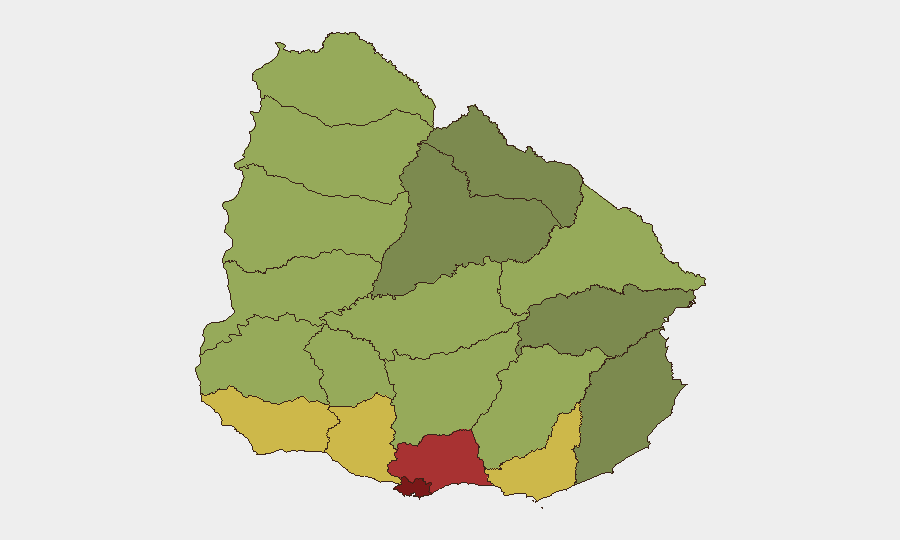
Montevideo (risk 92) and Canelones (risk 78) drive the national threat profile, driven by density of financial/government targets, higher volumes of street crime, and concentration of critical digital infrastructure. Maldonado (68), San José (64), and Colonia (62) follow, reflecting border-zone vulnerabilities and tourism-sector crime exposure. Street-level violent crime dominates conventional threat; cyber-intrusions and state political friction are concentrated in Montevideo but have national-infrastructure implications.
How GeoBit Would Assist
Security teams would deploy AOI Monitoring & Early Warning on Montevideo and Canelones to track protest activity, law-enforcement responses, and incident clustering in real time. Network & Actor Analysis and OSINT fusion & corroboration capabilities are essential to track the La Pampa Leaks collective, cross-border cyber-actor attribution, and potential follow-on targeting of financial or energy infrastructure. Intel Sweep, X/Twitter & Telegram OSINT, and multi-language search enable continuous monitoring of both cyber-threat forums and local crime reporting to detect escalation patterns before they impact personnel or operations.
7-Day Outlook
The DINACIA investigation is likely to dominate government bandwidth and media focus through the week; attribution confirmation may increase regional diplomatic friction. Antel's TuID platform will remain a target of opportunity for both financially motivated and politically motivated actors. Street-crime risk in Montevideo and border areas is expected to remain elevated and stable; corporate personnel should maintain baseline situational awareness and avoid large gatherings as per U.S. Embassy guidance.
Highest-Risk Areas — Ranked
| # | State / Region | Risk |
|---|---|---|
| 1 | Montevideo | 92 |
| 2 | Canelones | 78 |
| 3 | Maldonado | 68 |
| 4 | San José | 64 |
| 5 | Colonia | 62 |
| 6 | Soriano | 58 |
| 7 | Río Negro | 56 |
| 8 | Salto | 54 |
| 9 | Artigas | 52 |
| 10 | Paysandú | 50 |
| 11 | Florida | 48 |
| 12 | Flores | 46 |