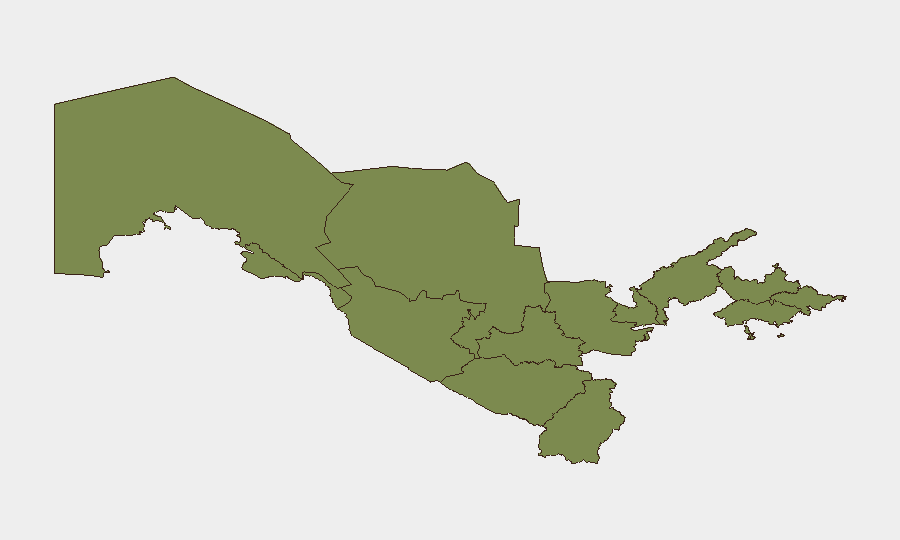
Situation Summary
Uzbekistan remains in a stable security posture with no acute incidents reported in the last 24–48 hours. The composite threat score of 4 reflects low baseline risk, though Navoiy Region continues to dominate the sub-national risk ranking at 31.3—a significant outlier that warrants attention. Capital region (Tashkent) shows elevated but manageable risk at 13.3; all other regions cluster at baseline (1.3). No credible reports of civil unrest, political instability, infrastructure disruptions, or travel-risk incidents are currently documented inside Uzbekistan.
Key Developments
No significant security, civil-unrest, crime, political-instability, infrastructure, or travel-risk incidents have been reported inside Uzbekistan in the last 24–48 hours based on comprehensive open-source monitoring across international media, wire services, Russian-, Uzbek-, and English-language outlets, and social platforms (X, Facebook, Instagram, YouTube).
Recent Uzbekistan-linked activity in open sources pertains to:
- U.S. airside activity (24–48h prior): Uzbekistan national football team undergoing routine pre-departure security screening at New York City international airport ahead of friendly match against Netherlands. Location: JFK or comparable terminal, USA. This is U.S. airport security procedure, not an Uzbekistan-based incident.
- Long-term policy/infrastructure: Multilateral law-enforcement training and cooperation announcements involving Uzbekistan, Kyrgyzstan, Kazakhstan, Russia (social media clips); ceremony for planned nuclear power plant construction with Russian participation. Neither constitutes acute security activity.
Highest-Risk Areas
Navoiy Region's risk score (31.3) is approximately 2.4× higher than Tashkent's (13.3) and 24× higher than any other region, indicating concentrated drivers—likely related to extractive industries, cross-border dynamics, or border-zone activity. Tashkent's elevated risk reflects capital-city baseline (political concentration, crowded urban environment, transit hub status). The remaining ten regions cluster uniformly at 1.3, suggesting homogeneous baseline conditions. Corporate teams with assets in Navoiy should establish heightened AOI monitoring; Tashkent-based personnel and operations warrant standard duty-of-care protocols aligned with capital-city risk norms.
How GeoBit Would Assist
AOI Monitoring & Early Warning should focus on Navoiy Region and Tashkent to detect emergent incidents before they escalate; persistent geofencing and alert triggers on keywords (protest, unrest, casualty, incident) across local media and Telegram channels will flag developments in near-real time. Intel Sweep and OSINT Fusion (multi-language X/Telegram search, YouTube intelligence, entity extraction) enable continuous baseline tracking and rapid corroboration of credible vs. rumor-sourced reports. Routing & Network Analysis supports contingency planning for personnel or supply chains requiring alternative corridors if Navoiy or Tashkent corridors become contested.
7-Day Outlook
No acute escalation trajectory is evident. Baseline stability is expected to persist over the next seven days absent external triggers (regional border escalation, major policy shift, or resource-driven unrest in Navoiy). Routine monitoring of Navoiy and Tashkent will remain the priority; teams should maintain standard travel protocols and incident-reporting channels while awaiting any substantive change in the risk profile.
Highest-Risk Areas — Ranked
| # | State / Region | Risk |
|---|---|---|
| 1 | Navoiy Region | 31.3 |
| 2 | Tashkent | 13.3 |
| 3 | Qashqadaryo Region | 1.3 |
| 4 | Surxondaryo Region | 1.3 |
| 5 | Fergana Region | 1.3 |
| 6 | Republic of Karakalpakstan | 1.3 |
| 7 | Xorazm Region | 1.3 |
| 8 | Bukhara Region | 1.3 |
| 9 | Jizzakh Region | 1.3 |
| 10 | Tashkent Region | 1.3 |
| 11 | Namangan Region | 1.3 |
| 12 | Sirdaryo Region | 1.3 |
Sources
Previous Daily Briefs
A new Uzbekistan brief is written every day — each with its own risk map and downloadable CSV. Here's the last week; use the calendar to go further back.
📅 Browse every day by calendar →
Highlighted days have a brief. Tap a day for that day's map & analysis, or “csv” for that day's dataset ($5).