Situation Summary
Armenia remains at composite threat level 8 (global rank #81), with political instability and border-security concerns as primary drivers following the 7 June parliamentary election. Post-election contestation, Russian diplomatic and economic pressure, and unresolved territorial disputes with Azerbaijan dominate the current risk landscape. The security environment is currently non-violent but highly polarized, with escalation risk concentrated in Yerevan and along southern border zones.
Key Developments
- Yerevan, 13 June: Six opposition political forces issued a joint statement rejecting the official results of the 7 June parliamentary election, alleging fraud and refusing to recognize the outcome. This raises the risk of sustained political standoffs and potential demonstrations in the capital.
- National, 13–14 June: Russian state actors are amplifying election-fraud narratives via information channels and have signaled stricter trade restrictions on Armenian fish exports as economic leverage on the new government, intensifying geopolitical pressure on Yerevan.
- Yerevan, 13–14 June: OSCE/ODIHR observers conducted public briefings confirming the election was generally well-administered but marked by confrontational rhetoric, vote-buying allegations, and voter pressure, particularly targeting opposition activists. These events remain peaceful.
- Online/Armenia-wide, 13–14 June: Heightened social-media polarization over Armenia's geopolitical alignment, with Russian-aligned voices portraying the election as Western-engineered and pro-Western analysts characterizing it as a sovereign, pro-EU choice. This narrative contest may serve as a trigger for future demonstrations or counter-mobilization.
- Yerevan, 13–14 June: International and local media presence remains concentrated in the capital for post-election analysis and legal/political contestation, sustaining high political visibility and intensity.
- Syunik Province, timing uncertain (claim circulated 24–48h ago): An Armenian military figure asserted via Instagram that Azerbaijani forces are present on Armenian territory near a village in Syunik. The underlying deployment status is unclear; this appears to be a reiteration of an existing border concern rather than a newly initiated incursion.
Highest-Risk Areas
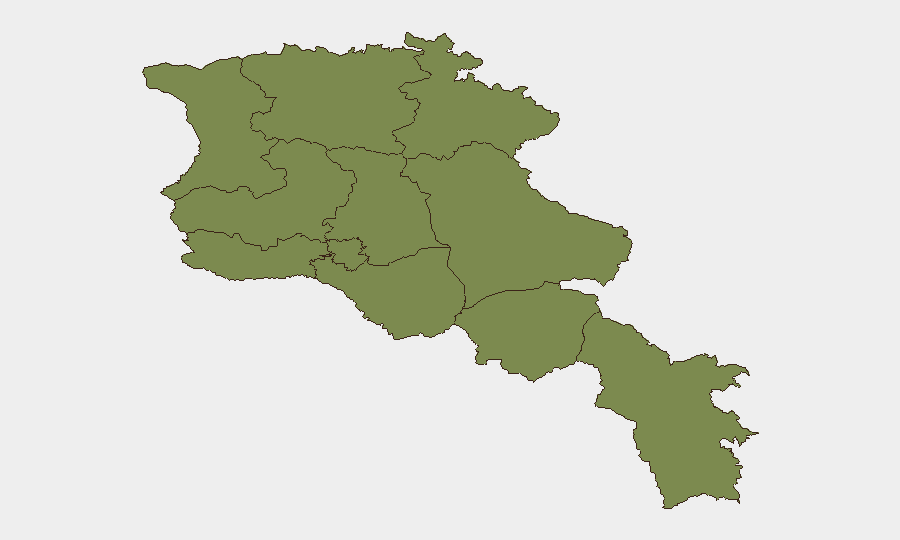
Yerevan dominates the risk ranking (31.4) due to concentration of political institutions, opposition activity, media, and international attention in the wake of the disputed election. Ararat Province (30.2) similarly reflects post-election political mobilization and administrative activity. All other provinces score substantially lower (1.4–3.9), indicating that kinetic and structural risk remain confined to the capital and immediate surrounding areas, while the southern border provinces (Vayots Dzor, Syunik) carry elevated but modest scores tied to ongoing Azerbaijani territorial claims and sporadic military posturing rather than active hostilities.
How GeoBit Would Assist
Security teams should deploy AOI Monitoring & Early Warning on Yerevan's political districts and Syunik's border villages to detect protest assembly, military movement, or rhetoric escalation in real time. OSINT fusion (X/Twitter, Telegram, Instagram, local media) combined with sentiment & temporal analysis will track the velocity and geographic spread of opposition narratives and Russian counter-narratives, enabling early detection of protest calls or coordination. Election monitoring and regime-stability assessment capabilities provide structured tracking of political contestation, legal challenges, and elite fracture, allowing duty-of-care teams to anticipate secondary lockdowns, travel restrictions, or civil unrest.
7-Day Outlook
Opposition legal and political challenges to the election outcome are expected to continue, maintaining elevated political tension in Yerevan but without immediate kinetic escalation. Russian economic and information pressure will likely persist as a chronic stressor on Armenia's new government. Border incidents in Syunik or Vayots Dzor remain possible but are not signaled as imminent by current open-source reporting.
Highest-Risk Areas — Ranked
| # | State / Region | Risk |
|---|---|---|
| 1 | Yerevan | 31.4 |
| 2 | Ararat Province | 30.2 |
| 3 | Vayots Dzor Province | 3.9 |
| 4 | Syunik Province | 3.9 |
| 5 | Lori Province | 1.4 |
| 6 | Tavush Province | 1.4 |
| 7 | Kotayk Province | 1.4 |
| 8 | Gegharkunik Province | 1.4 |
| 9 | Shirak Province | 1.4 |
| 10 | Aragatsotn Province | 1.4 |
| 11 | Armavir Province | 1.4 |
Sources
Previous Daily Briefs
A new Armenia brief is written every day — each with its own risk map and downloadable CSV. Here's the last week; use the calendar to go further back.
📅 Browse every day by calendar →
Highlighted days have a brief. Tap a day for that day's map & analysis, or “csv” for that day's dataset ($5).