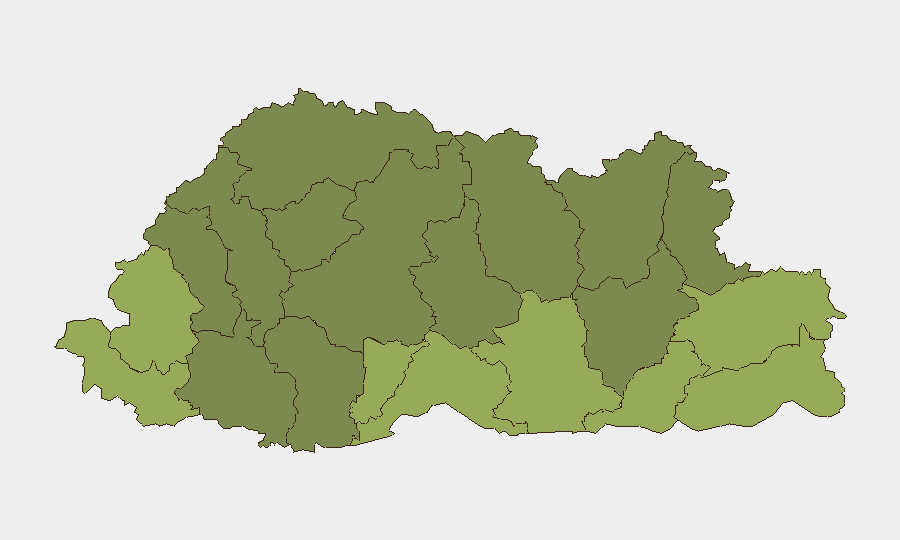
Situation Summary
Bhutan remains a low-threat environment with no documented security incidents, armed conflict, or civil unrest in the last 24–48 hours. The country's composite threat score of 7 reflects its position among the most stable in South Asia, though structural risks—including a marked decline in press freedom (ranked 150/180 globally in 2026, down from 33 in 2022) and ongoing border security management with neighboring regions—warrant baseline monitoring. Current event signals relate primarily to domestic governance and policy communications rather than acute security incidents.
Key Developments
No new security, conflict, civil-unrest, or travel-risk incidents have been independently verified within Bhutan during the last 24–48 hours. Open-source reporting focuses on governance, digital-identity platform rollout (Bhutan NDI), and routine policy statements; none are dated to the immediate window or corroborated across multiple sources as discrete incidents. Background monitoring should track ongoing press-freedom constraints and regional border-stability dynamics, but these are structural conditions rather than current developments.
Highest-Risk Areas
Southern border districts—Samtse (risk 58), Sarpang (55), and Haa (52)—carry the highest composite risk scores, driven primarily by proximity to India and historical cross-border trafficking, smuggling, and irregular-migration pathways. Eastern districts including Samdrup Jongkhar (48) and Trashigang (40) face similar pressure from porous borders and limited state capacity in remote terrain. These rankings reflect endemic border-security challenges and organized-crime transit routes rather than active conflict or instability; the risk profile is chronic rather than acute. Central and northern districts (Thimphu, Lhuntse, Gasa) remain substantially lower-risk.
How GeoBit Would Assist
Organizations with personnel or assets in Bhutan should employ AOI Monitoring & Early Warning on southern border districts to detect trafficking spikes, irregular migration events, or cross-border crime patterns; Network & Actor Analysis to map smuggling and organized-crime nodes active in high-risk districts; and OSINT fusion & corroboration (Intel Sweep, multi-language search, Telegram/X monitoring) to catch emerging governance crises, press-freedom incidents, or political instability before they escalate. GIS & Spatial Analysis and Routing & Network Analysis support alternative-route planning for field teams operating in remote or border-proximate areas.
7-Day Outlook
No acute escalation is expected in the next seven days. Baseline attention should remain on press-freedom developments, border-management announcements, and regional spillover from India or Myanmar; however, Bhutan's institutional stability and geographic isolation suggest low probability of rapid security deterioration. Monitoring should focus on structural indicators (media controls, migration policy, cross-border crime reporting) rather than imminent incident response.
Highest-Risk Areas — Ranked
| # | State / Region | Risk |
|---|---|---|
| 1 | Samtse District | 58 |
| 2 | Sarpang District | 55 |
| 3 | Haa District | 52 |
| 4 | Pemagatshel District | 50 |
| 5 | Samdrup Jongkhar District | 48 |
| 6 | Tsirang District | 45 |
| 7 | Zhemgang District | 42 |
| 8 | Trashigang District | 40 |
| 9 | Mongar District | 38 |
| 10 | Gasa District | 35 |
| 11 | Lhuntse District | 32 |
| 12 | Wangdue Phodrang District | 30 |
Sources
Previous Daily Briefs
A new Bhutan brief is written every day — each with its own risk map and downloadable CSV. Here's the last week; use the calendar to go further back.
📅 Browse every day by calendar →
Highlighted days have a brief. Tap a day for that day's map & analysis, or “csv” for that day's dataset ($5).