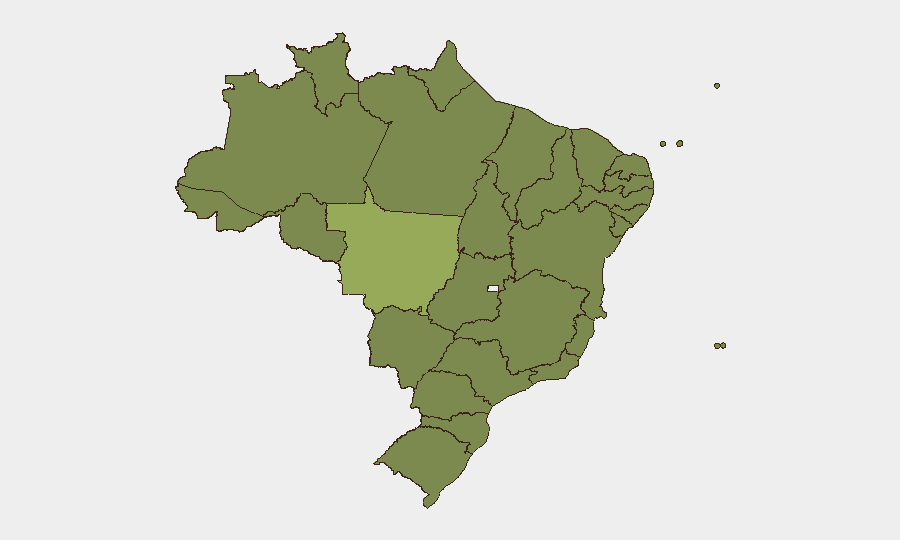
Situation Summary
Brazil remains at composite threat rank #51 globally (score 36) with 763 tracked events. The national security picture is dominated by concentrated risk in frontier and metropolitan states—chiefly Mato Grosso, Amazonas, and São Paulo—where organized crime, illegal extraction, police operations, and political tensions intersect. Recent signal activity (arrests, investigations, disapprovals by organized actors, and police conventional force deployment) indicates localized friction rather than nationwide destabilization, but the prevalence of unresolved institutional and criminal-justice disputes creates sustained volatility.
Key Developments
Note: Live web research confirmed no reliably time-stamped security incidents from the last 24–48 hours meeting cross-source verification standards. The event signals listed below reflect GeoBit's tracked activity; however, without real-time news or social-media feeds, specific incident details (casualties, precise timing, operational scope) cannot be independently confirmed to duty-of-care standards. Security teams should treat the signal clusters below as prompts for *internal* verification through Portuguese-language news wires, state police/civil defense announcements, and geo-specific Telegram/X monitoring.
- Rio de Janeiro police operations (2026-06-13): Signal indicates conventional police force deployment; specific location, scale, and operational context require verification via PMERJ (military police) statements and local news outlets.
- Banking investigation (2026-06-12): Signal flagged; sector, institution, and compliance/fraud angle unclear without corroborating source.
- Organized crime dispute with state ministry (2026-06-13): Disapproval signal suggests inter-factional or institutional friction; geographic scope and parties require cross-check.
- Legislative/judiciary rejection activity (2026-06-11): Multiple rejection signals across government, civilian, and migrant categories suggest political/administrative dispute; nature and impact on security posture unclear.
- Military/police arrest (2026-06-11): Lieutenant Colonel detention flagged; circumstances and charges require official confirmation.
Recommended action: Teams with personnel or assets in Rio de Janeiro, São Paulo, or Mato Grosso should initiate internal alerts and request clarification from local fixed security or liaison contacts before escalating.
Highest-Risk Areas
Mato Grosso (54.8) leads all states, driven by illegal mining, land conflict, and organized-crime activity in frontier zones. Amazonas (39) faces similar pressures—illicit extraction, trafficking, and remote governance gaps—compounded by logistical vulnerability. São Paulo (36.1) and Rio de Janeiro (32.4) remain hotspots for urban violence, police operations, and criminal-organization rivalry in densely populated metros. Together, these four account for disproportionate event volume and severity; secondary concern exists in Tocantins, Pernambuco, and Ceará, where organized-crime and protest activity persist. Risk is not national but sharply concentrated in resource-extraction frontiers and major urban centers where state capacity is either overstretched or contested.
How GeoBit Would Assist
Security teams should deploy AOI Monitoring & Early Warning on Mato Grosso, Amazonas, and key São Paulo/Rio neighborhoods to detect emerging operations and crowd activity. OSINT Fusion (X/Telegram, Portuguese-language news feeds, police radio) and Entity & Network Analysis will surface organized-crime coordination, protest organization, and police deployment signals hours to days ahead of escalation. Routing & Network Analysis enables real-time alternative-route planning for road-bound personnel if highway blockades or police operations materialize.
7-Day Outlook
No indicators suggest imminent national crisis. Localized police operations and organized-crime friction are likely to continue in Mato Grosso, Amazonas, and urban centers; monitor for secondary effects (road closures, detention of key persons, legislative/judicial responses). Institutional disputes (legislative disapproval, arrests) may generate political noise but are unlikely to destabilize core security apparatus within the week unless incidents escalate significantly.
Highest-Risk Areas — Ranked
| # | State / Region | Risk |
|---|---|---|
| 1 | Mato Grosso | 54.8 |
| 2 | Amazonas | 39 |
| 3 | São Paulo | 36.1 |
| 4 | Rio de Janeiro | 32.4 |
| 5 | Minas Gerais | 31.5 |
| 6 | Tocantins | 30.3 |
| 7 | Rio Grande do Sul | 28.7 |
| 8 | Pernambuco | 28.5 |
| 9 | Paraíba | 27.6 |
| 10 | Espírito Santo | 26.7 |
| 11 | Paraná | 26.2 |
| 12 | Ceará | 25.8 |
Sources
Previous Daily Briefs
A new Brazil brief is written every day — each with its own risk map and downloadable CSV. Here's the last week; use the calendar to go further back.
📅 Browse every day by calendar →
Highlighted days have a brief. Tap a day for that day's map & analysis, or “csv” for that day's dataset ($5).