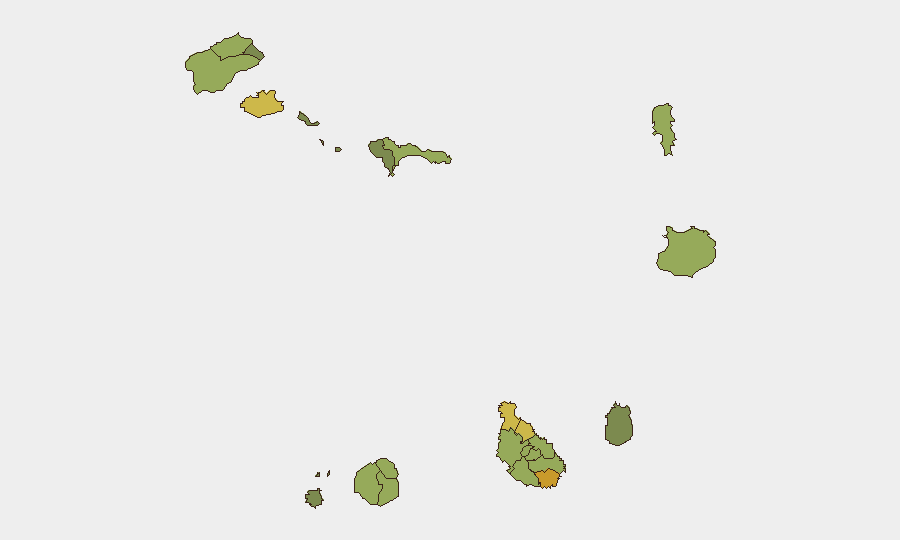
Situation Summary
Cape Verde remains a low-threat jurisdiction (global rank #177, composite score 3) with no tracked security events in the current reporting window. The country maintains relative stability, though urban crime concentrates in the capital region and secondary cities. No active conflict, civil unrest, or political instability is reported. Risk assessment reflects localized street crime and petty theft patterns rather than systemic security deterioration.
Key Developments
- Porto Inglês, Maio — 7 August 2026: CV Interilhas announced additional ferry sailings (11 and 14 August) on the Santiago–Maio route to manage transport demand. This is a service adjustment, not a disruption or incident.
- National — Recent: The Judicial Police announced a new chief and a stated commitment to intensify operations against drug trafficking and transnational crime. This represents a security-sector management change rather than a response to a specific recent incident.
- National — Recent: Civil-society and political-leadership discussion has surfaced regarding candidacy declaration and presidential duty suspension requirements. No unrest or destabilizing event is associated with this development.
No discrete security, crime, conflict, or travel-disruption events were verified in Cape Verde for the 24–48 hour window preceding this brief.
Highest-Risk Areas
Praia (risk 72) and São Miguel (risk 68) drive the country's composite risk profile and merit primary focus. Both are urban centers where street crime, robbery, and property theft are concentrated; Praia, the capital, hosts the densest population and highest transient populations. São Vicente (risk 65) and the secondary cities of Tarrafal and São Filipe (risk 62 and 58) follow, reflecting similar urban-crime patterns. Tourist areas and commercial districts in Praia and São Vicente warrant elevated situational awareness. The outlying and less-populated regions show lower risk; rural and island communities present minimal security concern for corporate operations.
How GeoBit Would Assist
Intel Sweep and multi-language OSINT would establish persistent detection of crime reports, political developments, and transport disruptions across Cape Verdean media and social platforms—critical in a low-event environment where early signals matter. AOI Monitoring & Early Warning on Praia and São Vicente would flag emerging crime clusters or civil unrest before they escalate, enabling proactive duty-of-care responses. Routing & Network Analysis would support security and logistics teams in identifying safe transit corridors and alternative pathways in high-risk urban zones, reducing exposure during street-level incidents.
7-Day Outlook
No material deterioration in the security environment is anticipated over the next seven days. Ferry service continuity and judicial-sector activity suggest normal operational tempo. Corporate and personnel security postures in Praia and São Miguel should remain calibrated to baseline street-crime risk—avoiding isolated movement, securing valuables, and maintaining situational awareness in commercial and tourist districts—with no requirement for elevated alert levels at this time.
Highest-Risk Areas — Ranked
| # | State / Region | Risk |
|---|---|---|
| 1 | Praia | 72 |
| 2 | São Miguel | 68 |
| 3 | São Vicente | 65 |
| 4 | Tarrafal | 62 |
| 5 | São Filipe | 58 |
| 6 | Santa Catarina | 58 |
| 7 | Santa Cruz | 55 |
| 8 | Mosteiros | 52 |
| 9 | São Salvador do Mundo | 52 |
| 10 | Ribeira Grande | 50 |
| 11 | Porto Novo | 48 |
| 12 | Sal | 48 |
Sources
Previous Daily Briefs
A new Cape Verde brief is written every day — each with its own risk map and downloadable CSV. Here's the last week; use the calendar to go further back.
📅 Browse every day by calendar →
Highlighted days have a brief. Tap a day for that day's map & analysis, or “csv” for that day's dataset ($5).
Atlas — our AI intelligence desk — emails them this snapshot personally. Nothing else, no list.