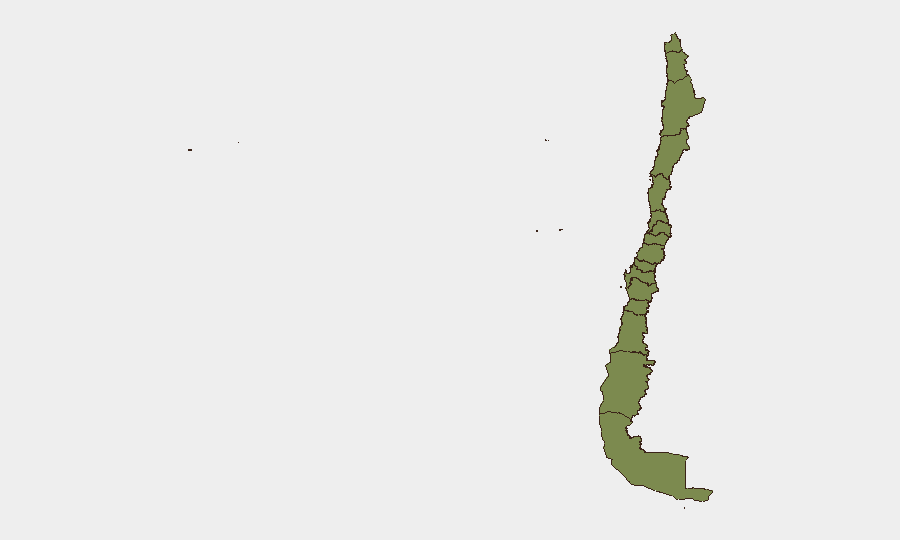
Situation Summary
Chile's overall security environment remains low-risk (composite threat score 12 globally), but sub-national disparities are acute: Coquimbo Region drives 73% of tracked risk (score 31.3) relative to the national composite, while Santiago Metropolitan Region exhibits elevated institutional and civil-order stress. Recent event signals (17–18 June) cluster around judicial disapproval, arrest/detention operations, small-arms incidents, and international diplomatic friction. A M4.8 seismic event near Ovalle (Coquimbo) on an unspecified recent date adds natural-hazard context to the highest-risk region.
Key Developments
- Coquimbo Region / Ovalle area (recent): M4.8 earthquake 26 km WSW of Ovalle; seismic impact on regional infrastructure and emergency-response capacity requires validation of any secondary civil-order or humanitarian consequences.
- Santiago Metropolitan Region (2026-06-17): Superior Court disapproval signal; municipal-level friction (Mayor vs. Chile entity) and broader governmental disapproval events suggest institutional strain or policy/enforcement disputes. Nature of dispute remains opaque from available signals.
- National (2026-06-17–18): Two arrest/detention operations flagged without location specificity; small-arms combat incident on 2026-06-18 (location unconfirmed). Public statements from television entities and military (Lieutenant Colonel statement, 2026-06-18) suggest media and defense-sector engagement in civil-order narrative.
- National (2026-06-18): Diplomatic friction: Chile vs. Spain disapproval signal; contextual cause unknown from provided signals.
- Temuco, Los Araucanía Region (2026-06-18): Antisemitic graffiti (spray-paint defacement of Hanukkiyah on public property) reported by Combat Antisemitism Movement; isolated but indicative of social-tension signaling in the south-central region.
Highest-Risk Areas
Coquimbo Region dominates Chile's risk profile, with a composite score nearly 3.5× that of Santiago and 24× the median of other regions. This concentration reflects either sustained civil-order activity, resource-conflict dynamics, or environmental/seismic vulnerability compounded by institutional response gaps. Santiago's secondary elevation (score 9.2) correlates with the nation's judiciary, executive, and media presence; recent signals suggest inter-agency friction or policy contestation rather than street-level violence. All other regions cluster at 1.3–1.9, indicating diffuse, low-threshold risk. Northern border regions (Antofagasta, Atacama) remain stable despite typical transnational smuggling exposure, suggesting either effective interdiction or data-collection gaps.
How GeoBit Would Assist
Intel Sweep & OSINT Fusion on Coquimbo, Santiago, and Temuco would consolidate fragmented event signals, attribute actors, and cross-reference judicial/institutional statements with civil-order incidents to clarify causality. AOI Monitoring & Early Warning on Coquimbo Region and Santiago would establish persistent watch for escalation in arrest operations, small-arms activity, or institutional breakdown, with automated alerting on defined thresholds. Satellite & Imagery Analysis would validate seismic damage in Ovalle and assess any disruption to critical infrastructure (ports, logistics, utilities) that could secondarily degrade security operations. Multi-language OSINT (X, Telegram, local news, radio SIGINT) would capture institutional, media, and grassroots narratives currently opaque in English-language feeds.
7-Day Outlook
No imminent escalation indicators are present; however, institutional friction in Santiago and concentrated activity in Coquimbo warrant close watch. Seismic aftershock risk in the Ovalle area may trigger secondary civil-order strain if emergency response is perceived as inadequate. Recommend continuous monitoring through 26 June, with particular focus on arrest/detention frequency, military/police public statements, and any further diplomatic tension signals.
Highest-Risk Areas — Ranked
| # | State / Region | Risk |
|---|---|---|
| 1 | Coquimbo Region | 31.3 |
| 2 | Santiago Metropolitan Region | 9.2 |
| 3 | Atacama Region | 3.4 |
| 4 | Los Ríos | 1.9 |
| 5 | Valparaiso Region | 1.3 |
| 6 | Antofagasta Region | 1.3 |
| 7 | Aysen del General Carlos Ibanez del Campo Region | 1.3 |
| 8 | Los Lagos Region | 1.3 |
| 9 | Magallanes and Chilean Antarctica Region | 1.3 |
| 10 | O'Higgins Region | 1.3 |
| 11 | Maule Region | 1.3 |
| 12 | Nuble Region | 1.3 |
Sources
Previous Daily Briefs
A new Chile brief is written every day — each with its own risk map and downloadable CSV. Here's the last week; use the calendar to go further back.
📅 Browse every day by calendar →
Highlighted days have a brief. Tap a day for that day's map & analysis, or “csv” for that day's dataset ($5).