Situation Summary
Ghana remains a stable regional actor (global rank #155, composite threat 4.0) with concentrated vulnerability in Bono East Region, which accounts for approximately 80% of tracked incident risk. The security environment is characterized by localized criminal activity, institutional friction within health and digital sectors, and emerging national-level cybersecurity exposure tied to critical infrastructure. Near-term trajectory is stable with elevated attention to cyber-threat vectors.
Key Developments
- Salaga, Savannah Region (10 June): Police arrested two midwives in connection with theft of a newborn from Salaga Government Hospital. The case was reported via GhanaWeb Crime & Punishment on 11 June and attributed to police sources; it reflects ongoing institutional vulnerabilities in healthcare facility security.
- Accra, national-level cybersecurity breach (9–11 June): The Ministry of Communication, Digital Technology and Innovations disclosed an ongoing investigation into a breach affecting unspecified national digital infrastructure, disclosed in parallel with the 4th ECOWAS Regional Cybersecurity Hackathon (9–11 June). Scope and remediation timeline remain unclear.
- Accra, ECOWAS Cybersecurity Hackathon (9–11 June): A 48-hour regional cyber-combat exercise ran 9 June 13:00 GMT to 11 June 13:00 GMT, convening teams from 12 ECOWAS member states. Challenges included AI-driven cybercrime, deepfake/phishing attacks, and cloud-security defense, coordinated by Ghana Cyber Security Authority and the Ministry.
- Accra, national cyber-posture messaging (9–10 June): Ghana Cyber Security Authority and Ministry officials used the hackathon platform to signal that West African states risk vendor dependence and sovereignty erosion if domestic critical-infrastructure defense remains underdeveloped. This frames cyber defense as a strategic national issue.
- Regional cyber-threat environment (9–11 June): Official statements and regional reporting highlighted emerging digital threats against West African infrastructure, with emphasis on cross-border incident response, vendor diversification, and improved cyber resilience. Ghana is positioned as both a vulnerable node and a regional cyber-governance participant.
Highest-Risk Areas
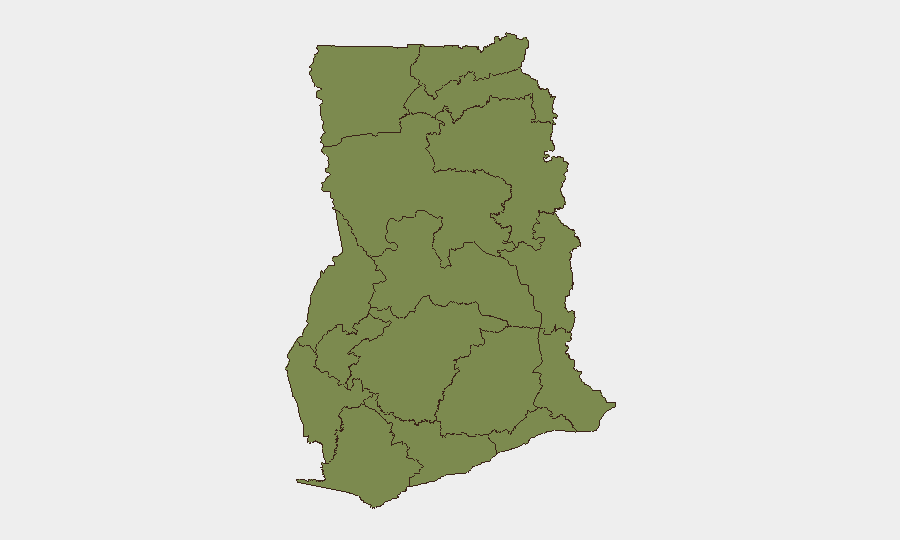
Bono East Region dominates Ghana's threat profile (composite risk 32, approximately 5× Greater Accra's score of 6.7). The region's elevated risk is driven by fragmented incident reporting and localized criminal activity; however, the specific drivers of this disparity warrant clarification via targeted intelligence. Greater Accra (Accra) remains the secondary risk hub, reflecting national-level institutional tensions, cyber vulnerabilities, and concentration of high-profile actors. Eastern, Upper East, Northern, Volta, Ashanti, and Central regions each score 2.5–3.6 and present baseline residual risk. All other regions score ≤2.0.
How GeoBit Would Assist
AOI Monitoring & Early Warning with persistent watch on Bono East Region, Greater Accra, and national-level health/digital sector institutions would provide real-time alerting on emerging criminal, institutional, or cyber incidents before escalation. Intel Sweep and multi-source OSINT fusion (X, Telegram, government statements, tech media, radio SIGINT) would track Ministry cyber-incident disclosure cadence, regional cyber-threat actor activity, and healthcare-sector security vulnerabilities. Risk & Threat Assessment coupled with Network & Actor Analysis would map institutional friction, identify repeat threat actors, and correlate health-sector and digital-infrastructure incidents to establish causal patterns and predict second-order impacts on corporate operations.
7-Day Outlook
Cyber-incident investigation by the Ministry is likely to proceed with limited public disclosure; contractors and critical-infrastructure operators should anticipate potential supply-chain or authentication controls changes. Health-sector institutional friction and localized criminal activity in Bono East and Savannah regions will continue at current tempo. No escalation to regional conflict or systemic instability is forecast; however, cyber-threat visibility gaps merit sustained monitoring.
Highest-Risk Areas — Ranked
| # | State / Region | Risk |
|---|---|---|
| 1 | Bono East Region | 32 |
| 2 | Greater Accra Region | 6.7 |
| 3 | Eastern Region | 3.6 |
| 4 | Upper East Region | 2.5 |
| 5 | Northern Region | 2.5 |
| 6 | Volta Region | 2.5 |
| 7 | Ashanti Region | 2.5 |
| 8 | Central Region | 2.5 |
| 9 | Upper West Region | 2 |
| 10 | Savannah Region | 2 |
| 11 | North East Region | 2 |
| 12 | Oti Region | 2 |
Sources
Previous Daily Briefs
A new Ghana brief is written every day — each with its own risk map and downloadable CSV. Here's the last week; use the calendar to go further back.
📅 Browse every day by calendar →
Highlighted days have a brief. Tap a day for that day's map & analysis, or “csv” for that day's dataset ($5).