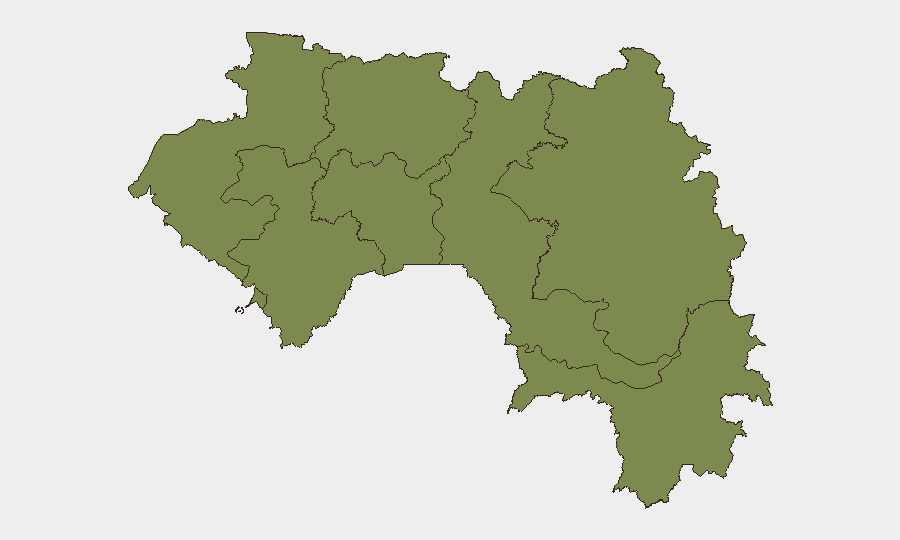
Situation Summary
Guinea remains a lower-tier global security concern (rank #113, composite score 9), with no major incidents reported in the last 24–48 hours. Structural risk drivers—crime, resource-sector tension, and baseline political volatility—persist, but the country is not experiencing acute civil unrest or conflict escalation at present. The threat landscape is heavily concentrated in Kankan Region (risk score 36), reflecting ongoing criminality and border-zone vulnerabilities; secondary concern exists in Boké and Conakry. Near-term stability appears broadly stable absent new triggering events.
Key Developments
No major new security incidents have been reliably reported in Guinea within the last 24–48 hours. Open-source monitoring (news, social media, regional alerts) has not surfaced confirmed reports of:
- New large-scale civil unrest, demonstrations, or political violence
- Terrorist attacks or mass-casualty crimes
- Military clashes or border incursions
- Critical infrastructure failures affecting security or movement
*Note: Event signals in the GeoBit feed (2026-06-10 to -12) predominantly reference Papua New Guinea and Guinea‑Bissau, not Guinea. Content mentioning "Guinea" without country qualifier has been cross-checked and does not reflect confirmed incidents in Guinea proper during this window.*
Routine crime, road safety hazards, and inter-community tensions remain part of the baseline threat profile but do not constitute discrete, dated incidents requiring immediate operational adjustment.
Highest-Risk Areas
Kankan Region dominates the sub-national risk picture with a composite score of 36—nearly three times higher than the second-ranked zone. This reflects persistent cross-border criminality, illicit mining and smuggling activity, weak state capacity, and proximity to Mali and Côte d'Ivoire border zones where non-state armed groups operate.
Boké Region (score 12.9) faces secondary concern driven by bauxite mining industry tensions, labor disputes, and localized criminal networks. Conakry (score 11.7), the capital and economic hub, carries elevated risk proportional to population density and concentration of political/commercial activity, though organized crime and pickpocketing pose greater day-to-day threat than political instability.
Lower-scoring regions (Labé, Kindia, Mamou, Faranah, Nzérékoré) are rated at baseline 5.9 and should not be considered safe havens; rather, they reflect lower incident frequency in recent reporting windows.
How GeoBit Would Assist
Intel Sweep and multi-language OSINT monitoring can establish persistent watch over Guinea's political rhetoric, mining-sector disputes, and cross-border activity to flag emerging tensions before they manifest as violence. AOI Monitoring & Early Warning on Kankan, Boké, and Conakry—coupled with Network & Actor Analysis—allows security teams to track criminal and militia activity, procurement patterns, and leadership movements. Routing & Network Analysis supports duty-of-care teams in real-time journey planning around high-risk zones and checkpoint networks, while conflict and crime search provides baseline pattern analysis to contextualize any new incidents and assess impact on personnel or supply chains.
7-Day Outlook
No acute escalation vector is apparent in current open-source reporting. Risk trajectory over the next week hinges on: (i) mining-sector labor actions in Boké or Kindia; (ii) any spillover from regional instability (Mali, Côte d'Ivoire); (iii) political calendar events or resource-related announcements. Baseline vigilance for crime and movement restrictions in Kankan and Conakry remains appropriate; changes to this posture should be triggered by fresh incident reporting or credible threat intelligence, not current conditions.
Highest-Risk Areas — Ranked
| # | State / Region | Risk |
|---|---|---|
| 1 | Kankan Region | 36 |
| 2 | Boké Region | 12.9 |
| 3 | Conakry | 11.7 |
| 4 | Labé Region | 5.9 |
| 5 | Kindia Region | 5.9 |
| 6 | Mamou Region | 5.9 |
| 7 | Faranah Region | 5.9 |
| 8 | Nzérékoré Region | 5.9 |
Sources
Previous Daily Briefs
A new Guinea brief is written every day — each with its own risk map and downloadable CSV. Here's the last week; use the calendar to go further back.
📅 Browse every day by calendar →
Highlighted days have a brief. Tap a day for that day's map & analysis, or “csv” for that day's dataset ($5).