Situation Summary
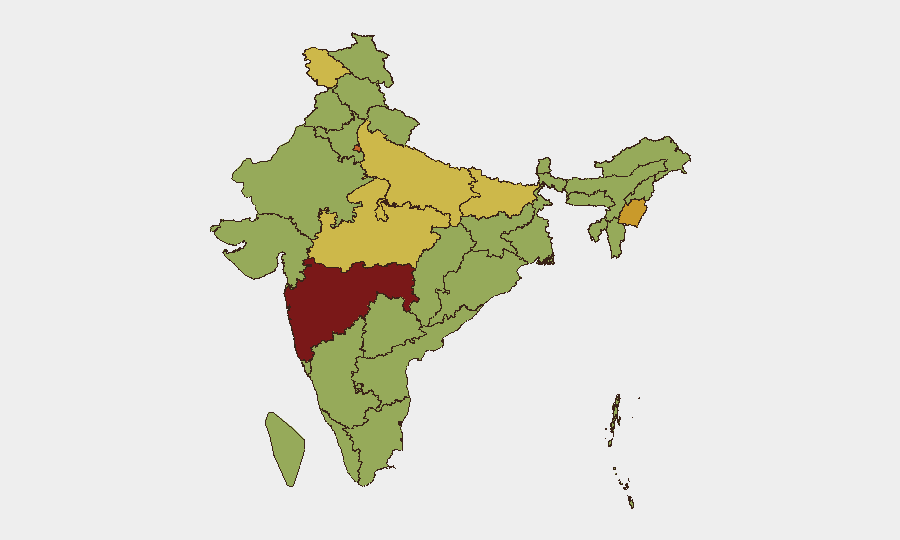
India's composite threat score of 80 reflects elevated but contained security volatility, driven primarily by communal tensions, localized unrest, and administrative friction rather than nationwide instability. Maharashtra and Delhi dominate the risk landscape, though Manipur continues to experience acute communal and military-related incidents following ongoing regional conflict. The last 48 hours show a pattern of low-level community demands, inter-group disapprovals, and isolated conventional incidents without evidence of coordinated national escalation.
Key Developments
- Manipur (2026-06-11): Bidirectional conventional military force incidents reported between state security and Hindu communities; concurrently, unconventional violence involving Christian and Naga groups. These suggest ongoing localized intercommunal friction rather than single-vector conflict.
- National (2026-06-11): Administration and intelligence bodies issued public statements; police issued disapproval notices. Suggests bureaucratic friction or policy disagreement at state/national level, likely related to security or administrative accountability.
- Ludhiana, Punjab (2026-06-10): Police disapproval action against drug-dealing activity. Routine law-enforcement response; no indication of escalation.
- Reuters / Diplomatic Channel (2026-06-11): Disapproval registered between Reuters (news organization) and US diplomatic entity, with separate conventional military force incident involving Reuters and a diplomat. Context unclear; may reflect reporting restrictions, access disputes, or diplomatic tensions around media coverage.
- West Bengal (2026-06-11, partial): Bengali community/entity rejection involving a ministry (event log truncated). Insufficient detail for threat assessment.
- Community Demand (2026-06-10): Unspecified community-level demand action. Without location and subject matter, significance cannot be determined.
Critical Note: The event signals above are derived from GeoBit's tracking platform; however, source documents, specific incident locations, casualty figures, and corroboration across independent media outlets are not available in this summary. A full threat assessment requires real-time cross-referencing with local-language news, police statements, and eyewitness reports.
Highest-Risk Areas
Maharashtra (86.2) and Delhi (73) remain India's highest-risk jurisdictions, likely reflecting dense urban populations, commercial concentration, and recurring communal friction. Manipur (72.9) has emerged as an acute hotspot, driven by active intercommunal and military-force incidents over the last 48 hours; this region should be flagged as requiring elevated monitoring. Uttar Pradesh, Bihar, and Madhya Pradesh (66.4–64.7) show sustained elevated risk, consistent with historical patterns of communal and criminal activity. Northern tier states (Jammu & Kashmir, Punjab, Ladakh) remain elevated but stable relative to their baseline, suggesting no sudden deterioration.
How GeoBit Would Assist
Security teams should use AOI Monitoring & Early Warning to establish persistent watches on Maharashtra, Delhi, and Manipur with real-time alerting for force incidents, communal gatherings, and police/military movement. Intel Sweep and multi-language OSINT (Hindi, Marathi, Manipuri, English news feeds and Telegram channels) would provide ground-truth corroboration of the event signals flagged above. Network & Actor Analysis can map communal, militant, and state-security relationships in high-risk zones, enabling duty-of-care teams to assess whether personnel or assets face direct exposure.
7-Day Outlook
No indicators suggest imminent national-scale escalation. Manipur warrants close watch for further intercommunal incidents; if military-force events spike or spread to adjacent states, that signals deterioration. Delhi and Maharashtra should remain under routine monitoring for communal tensions tied to the Hindu calendar and electoral cycles. Overall trajectory remains constrained volatility unless a significant triggering event (political crisis, major casualty incident, or inter-state dispute) emerges.
Highest-Risk Areas — Ranked
| # | State / Region | Risk |
|---|---|---|
| 1 | Maharashtra | 86.2 |
| 2 | Delhi | 73 |
| 3 | Manipur | 72.9 |
| 4 | Uttar Pradesh | 66.4 |
| 5 | Bihar | 66 |
| 6 | Madhya Pradesh | 64.7 |
| 7 | Jammu and Kashmir | 63.3 |
| 8 | Punjab | 59.6 |
| 9 | Telangana | 59.5 |
| 10 | Tamil Nadu | 59.3 |
| 11 | Ladakh | 59 |
| 12 | Haryana | 58.8 |
Sources
Previous Daily Briefs
A new India brief is written every day — each with its own risk map and downloadable CSV. Here's the last week; use the calendar to go further back.
📅 Browse every day by calendar →
Highlighted days have a brief. Tap a day for that day's map & analysis, or “csv” for that day's dataset ($5).