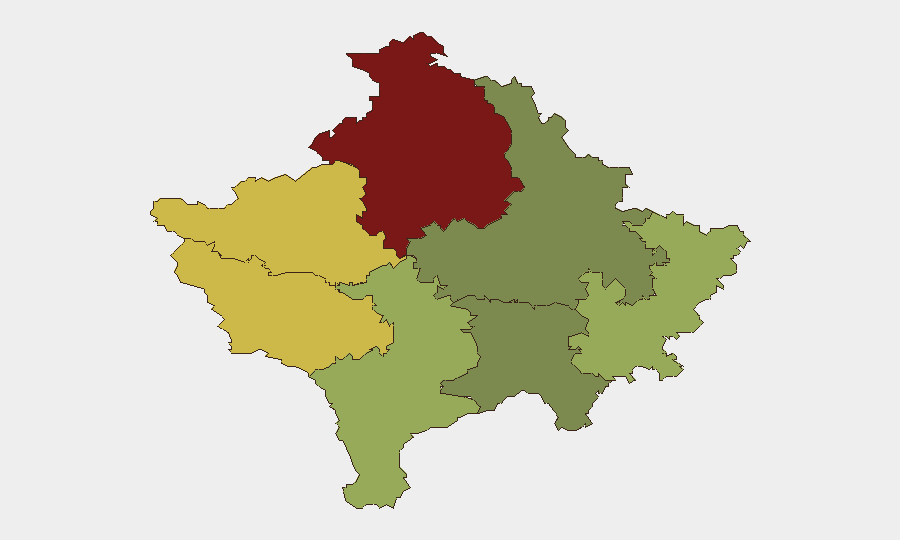
Situation Summary
Kosovo remains a low-threat environment globally (composite score 35) but exhibits significant internal geographic variance, with Mitrovica and Peja districts presenting substantially elevated risk profiles. No discrete security incidents were detected in the last 24–48 hours; the current threat posture reflects underlying inter-ethnic tensions, organized-crime activity, and institutional fragility concentrated in the north and western regions rather than acute events. Political paralysis at the national level continues to constrain security-sector responsiveness and rule-of-law capacity.
Key Developments
Current reporting limitation: Live web research for the 24–48 hour window (21–23 June 2026) yielded no confirmed discrete security incidents, civil unrest events, border crossings, crime-related developments, or travel-impediment reports. The most recent confirmed dated event in available sources is a 19 June 2026 OSCE gender-leadership forum in Prishtinë, which is institutional rather than a security or travel-risk development. A 22 June 2026 opinion piece noted ongoing political dysfunction but did not report a new incident. Clients requiring current-window incident alerts are advised to cross-reference OSCE Mission in Kosovo daily updates, Kosovo Police public statements, and KFOR situational reports for real-time validation.
Highest-Risk Areas
Mitrovica (north, risk 92) and Peja (west, risk 68) drive the majority of Kosovo's internal risk, reflecting unresolved inter-ethnic friction, Serbian-community enclaves with limited state authority, and organized-crime networks tied to cross-border smuggling routes into Serbia and Albania. Gjakova (west, risk 65) and Prizren (south, risk 55) present secondary risk zones linked to trafficking, territorial disputes, and localized political grievance. Prishtina (capital, risk 28) remains the lowest-risk district, reflecting institutional presence and international-community density; however, corporate and diplomatic assets should maintain baseline situational awareness across all regions.
How GeoBit Would Assist
A security team protecting personnel or assets in Kosovo would deploy AOI (Area-of-Interest) Monitoring & Early Warning on Mitrovica and Peja districts to detect escalation signals—demonstrations, police/military movement, or checkpoint activity—with automated alerting. OSINT fusion (X/Telegram, local news, KFOR statements) would provide real-time corroboration of incident reports and fill gaps in official reporting. Routing & Network Analysis would enable identification of alternative routes and safe corridors around high-risk districts, and GIS & Spatial Analysis would support duty-of-care mapping of personnel location relative to live risk zones.
7-Day Outlook
No acute destabilizing events are forecast for the immediate week, but the structural drivers of Mitrovica and Peja risk—political deadlock, inter-ethnic grievance, and transnational crime—remain unresolved. The risk of localized civil unrest, trafficking-related violence, or police action in northern districts should be treated as persistent baseline rather than escalating; however, rapid changes in KFOR posture, Serbian-government messaging toward Kosovo, or organized-crime turf disputes could trigger abrupt localized flare-ups with minimal warning. Corporate teams should maintain current alert settings and refresh personnel routing weekly.
Highest-Risk Areas — Ranked
| # | State / Region | Risk |
|---|---|---|
| 1 | District of Mitrovica | 92 |
| 2 | District of Peja | 68 |
| 3 | District of Gjakova | 65 |
| 4 | District of Prizren | 55 |
| 5 | District of Gjilan | 52 |
| 6 | District of Ferizaj | 38 |
| 7 | District of Prishtina | 28 |
Sources
Previous Daily Briefs
A new Kosovo brief is written every day — each with its own risk map and downloadable CSV. Here's the last week; use the calendar to go further back.
📅 Browse every day by calendar →
Highlighted days have a brief. Tap a day for that day's map & analysis, or “csv” for that day's dataset ($5).