Situation Summary
Kyrgyzstan remains a baseline-risk jurisdiction (global rank #142, composite score 5) with no major security incidents, armed conflict, or civil unrest reported in the last 24–48 hours. Current threat activity is driven by routine law-enforcement operations (anti-corruption raids, counter-extremism detentions), infrastructure disruptions (power outages in Bishkek on July 17), and border-area volatility rather than imminent destabilization. Risk is heavily concentrated in Bishkek City (score 31.8), which accounts for the majority of national threat activity; southern border regions and secondary urban centers remain at baseline levels.
Key Developments
- Bishkek City; July 17, 2026 – Two large-scale power outages occurred (14:30 and 15:05 local time) affecting most of the capital following emergency shutdowns on the "Kara-Balta–Glavnaya" and "Glavnaya–Shu" 220 kV high-voltage lines. The National Electric Grid Company (NESK) confirmed technical faults and initiated same-day restoration; disruptions affected traffic signals, public transport, and service availability but did not trigger civil unrest.
- Kadamjai and Chechme crossings (Kyrgyzstan–Uzbekistan border); mid-July 2026 – Anti-corruption law-enforcement raids resulted in detention of 40+ border guards, customs officers, and officials; gunfire was discharged when two servicemen drew weapons during arrest, with no broader clashes or casualties reported. This represents heightened enforcement activity and localized volatility at the southern border.
- Nationwide; July 15, 2026 – The State Committee for National Security conducted coordinated counter-extremism operations, detaining 12 suspected members of Hizb ut-Tahrir and conducting residential searches. No armed confrontation or casualties were reported; these actions align with routine counter-extremism protocols.
- Nationwide; July 13–17, 2026 – The Cabinet of Ministers enacted fuel-market regulatory changes (relaxed import rules, extended export restrictions) to mitigate domestic supply pressure. These measures are shaping logistics and travel risk rather than triggering unrest.
- Kyrgyzstan-China border region and diplomatic sphere; July 15–16, 2026 – Public statements and arrest/detention events involving China and Shanghai Cooperation Organization officials were recorded; no cross-border military activity or escalation has been confirmed. These developments reflect ongoing diplomatic and administrative activity.
- Multiple regions; mid-July 2026 – Emergency electrical shutdowns on several high-voltage lines caused scheduled and unscheduled outages across multiple districts. Infrastructure and travel-comfort risk remains elevated; no associated civil unrest has been reported.
Highest-Risk Areas
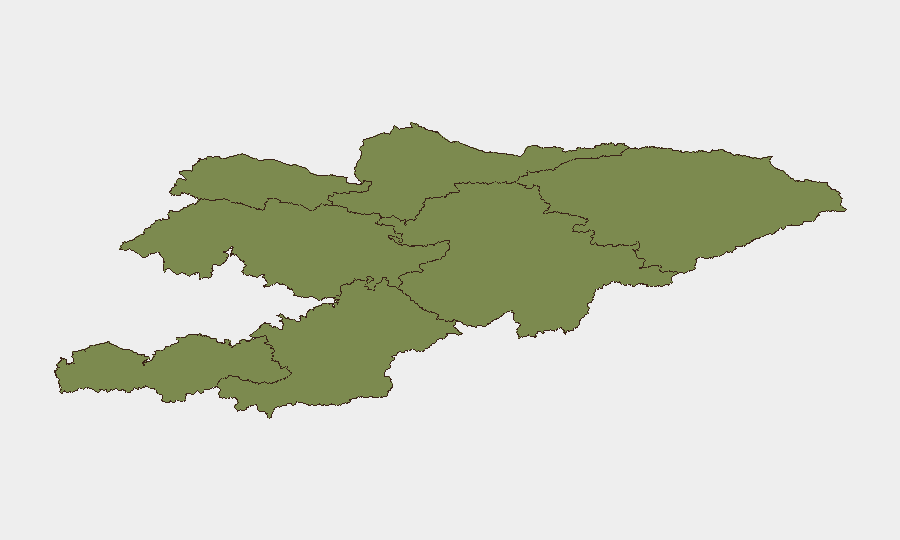
Bishkek City dominates the national risk profile (31.8), reflecting concentrated population, government activity, diplomatic presence, and law-enforcement operations. Naryn Region (4.5) ranks second but at significantly lower absolute risk; all remaining regions cluster at 1.8, indicating distributed, low-level baseline threat activity across southern and eastern areas. The capital's elevated score reflects infrastructure vulnerabilities (recent power disruptions), border-adjacent security operations, and routine administrative detention activity rather than active armed conflict or mass civil unrest.
How GeoBit Would Assist
Teams managing personnel or assets in Kyrgyzstan should deploy AOI Monitoring & Early Warning on Bishkek and key border crossings (Kadamjai, Chechme) to track law-enforcement operations and infrastructure incidents in real time. Intel Sweep, OSINT fusion, and multi-language search capabilities enable continuous tracking of official statements, media reports, and social-media signals across Bishkek, southern regions, and border zones. Routing & Network Analysis supports real-time route planning around infrastructure outages and enforcement cordons; Risk & Threat Assessment informs duty-of-care protocols for staff movement and facility operations.
7-Day Outlook
No major escalation is anticipated in the next 7 days; security posture is expected to remain at baseline with continued routine law-enforcement activity and infrastructure stabilization in Bishkek. Border regions should be monitored for secondary enforcement operations or diplomatic friction, particularly around China–Kyrgyzstan ties. International travel advisories will likely remain at "high caution" pending resolution of fuel-supply and power-grid stabilization efforts.
Highest-Risk Areas — Ranked
| # | State / Region | Risk |
|---|---|---|
| 1 | Bishkek City | 31.8 |
| 2 | Naryn Region | 4.5 |
| 3 | Jalal-Abad Region | 1.8 |
| 4 | Batken Region | 1.8 |
| 5 | Osh City | 1.8 |
| 6 | Osh Region | 1.8 |
| 7 | Issyk-Kul Region | 1.8 |
| 8 | Talas Region | 1.8 |
| 9 | Chuy Region | 1.8 |
Sources
Previous Daily Briefs
A new Kyrgyzstan brief is written every day — each with its own risk map and downloadable CSV. Here's the last week; use the calendar to go further back.
📅 Browse every day by calendar →
Highlighted days have a brief. Tap a day for that day's map & analysis, or “csv” for that day's dataset ($5).
Atlas — our AI intelligence desk — emails them this snapshot personally. Nothing else, no list.