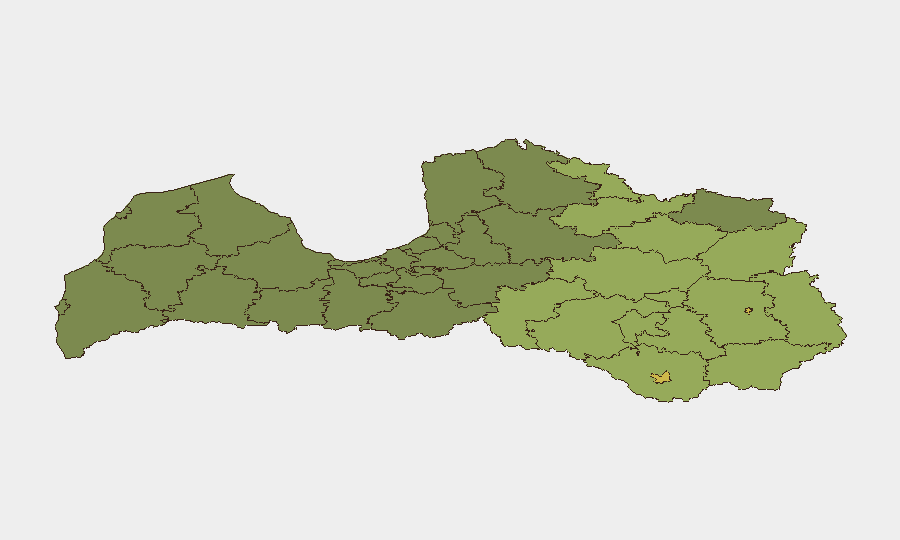
Situation Summary
Latvia remains a low-to-moderate threat environment (global rank #92, composite score 7/10) with concentrated risk in its southeastern border regions. The country faces persistent Russian electronic warfare and airspace incursion activity, most recently manifesting as a drone interception in the Rēzekne region on 8 June. NATO air-policing operations continue to maintain border security, but the frequency and sophistication of probing incidents suggest sustained Russian reconnaissance and signals-intelligence collection efforts.
Key Developments
- Rēzekne region, 8 June 2026 — French Rafale aircraft intercepted and destroyed an unmanned aerial vehicle operating over Latvian airspace; Latvian military assessed the incursion as linked to Russian electronic warfare probing activity. This represents the most recent confirmed airspace violation in the northeastern border zone.
- No additional confirmed security incidents reported in Latvia in the last 24–48 hours — Web research did not yield independently dated, operationally significant events in the last two days. Background reporting confirms that drone incursions, cyber-reconnaissance, and disinformation campaigns remain recurring vectors, but no new incidents have crossed reporting thresholds in the immediate reporting window.
Highest-Risk Areas
Southeastern Latvia, particularly the border districts of Rēzekne, Daugavpils, and Rēzeknes novads (composite risks 68, 65, and 58 respectively), drives the country's overall threat profile. These areas share a Russian-speaking population, proximity to the Belarus–Russia border, and critical NATO infrastructure. Risk concentration reflects Russian state-sponsored electronic warfare, cross-border drone activity, disinformation targeting, and periodic cyber-reconnaissance. Ludzas novads (risk 55) and Balvu novads (risk 52) extend the high-risk corridor along the eastern frontier; western and central regions remain significantly lower-risk.
How GeoBit Would Assist
Security teams with personnel or assets in Latvia should deploy AOI Monitoring & Early Warning on Rēzekne, Daugavpils, and surrounding novads to detect cross-border drone activity, airspace anomalies, and signals-intelligence patterns in near-real time. Satellite & Imagery analysis and Maritime & Aviation tracking capabilities enable persistent watch of border infrastructure and airspace for incursion signatures. Intel Sweep (global event feeds, OSINT fusion, multi-language Telegram and social-media monitoring) provides 24–48-hour forewarning of disinformation campaigns, protest mobilization, or cyberattacks targeting the private sector, allowing proactive communications and network-hardening measures.
7-Day Outlook
No major escalation is forecast, but routine Russian electronic warfare probing and drone reconnaissance will likely continue in the eastern border zone. NATO air-policing posture remains robust, reducing kinetic risk to civilian assets. Organizations with supply chains, data centers, or personnel in Rēzekne and Daugavpils should maintain elevated cyber-hygiene and communications-security protocols, particularly around sensitive infrastructure or cross-border transactions.
Highest-Risk Areas — Ranked
| # | State / Region | Risk |
|---|---|---|
| 1 | Rēzekne | 68 |
| 2 | Daugavpils | 65 |
| 3 | Rēzeknes novads | 58 |
| 4 | Ludzas novads | 55 |
| 5 | Balvu novads | 52 |
| 6 | Preiļu novads | 50 |
| 7 | Krāslavas novads | 48 |
| 8 | Jēkabpils novads | 47 |
| 9 | Augšdaugavas novads | 46 |
| 10 | Aizkraukles novads | 45 |
| 11 | Varakļānu novads | 44 |
| 12 | Līvānu novads | 43 |
Sources
Previous Daily Briefs
A new Latvia brief is written every day — each with its own risk map and downloadable CSV. Here's the last week; use the calendar to go further back.
📅 Browse every day by calendar →
Highlighted days have a brief. Tap a day for that day's map & analysis, or “csv” for that day's dataset ($5).