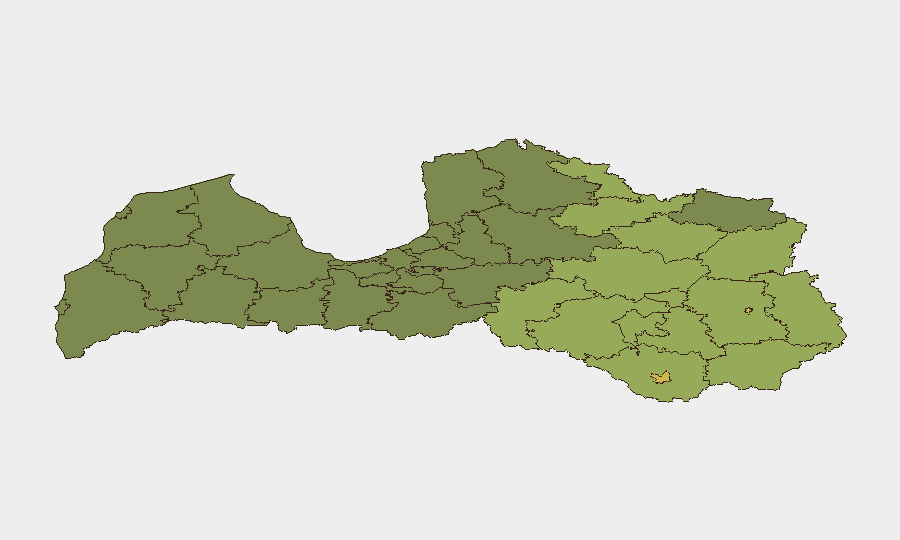
Situation Summary
Latvia remains a low-threat environment globally (rank #151; composite score 9), with no tracked security events during the reporting period. However, the Latvia–Belarus border continues to present elevated operational risk, driven by illegal-crossing attempts, migrant aggression, infrastructure damage, and suspected organized activity. Election-related administrative incidents in early October have subsided, and no major incidents were recorded in the past week. The trajectory is stable, with concentrated risk confined to border regions.
Key Developments
- Latvia–Belarus border, near Matuliški — October 9: Latvia's State Security Service opened criminal proceedings alleging criminal-organization activity linked to a border incident and threats of sabotage against Belarus's neighboring countries.
- Latvia–Belarus border — October 12: The Border Guard reported sustained high illegal-crossing risks, increasing migrant aggression, and ongoing damage to border fencing and surveillance infrastructure.
- Latvia–Belarus border — October 12–13: Open-source analysis assessed that the group claiming responsibility (variously named "Black Russians" or "Chernye Rusy") is likely a front organization rather than an established independent actor; attribution remains unconfirmed.
- Latvia–Belarus border — October 13: The same group claimed responsibility for an attempted migrant push and theft of surveillance equipment; this represents claimed attribution only and has not been independently verified by Latvian authorities.
Note: The armed migrant incursion, territorial penetration, camera theft, and infrastructure damage occurred on October 5–6 and therefore constitute prior-week context rather than current developments.
Highest-Risk Areas
Southeastern Latvia drives the national risk profile, with Rēzekne (risk 68) and Daugavpils (risk 65) the highest-ranked municipalities, followed by Rēzeknes novads, Ludzas novads, and Balvu novads. All top-ranked areas are situated along or near the Belarus border and reflect sustained vulnerability to illegal migration, cross-border trafficking, infrastructure targeting, and potential organized criminal activity. The concentration of risk in the east reflects geography, border exposure, and the operational environment created by persistent migrant-transit activity and alleged state-proxied disruption. Risk does not extend materially into Rīga or western urban centers.
How GeoBit Would Assist
Security teams protecting personnel or assets in Latvia should deploy AOI Monitoring & Early Warning on southeastern border municipalities to detect escalations in illegal-crossing activity, migrant concentrations, or infrastructure incidents in real time. Network & Actor Analysis combined with OSINT (Telegram, X, and multi-language signals intelligence) would corroborate claims of responsibility, distinguish front organizations from genuine actors, and track suspected criminal-organization connections. Border & Disputed-Territory Search plus GIS & Spatial Analysis enable precise routing and situational awareness for personnel traveling in or near Rēzekne, Daugavpils, or other high-risk municipalities, while Conflict & Military tracking would monitor Latvian and allied force posture changes in response to border pressure.
7-Day Outlook
The immediate outlook remains stable. Illegal-crossing attempts and infrastructure damage are expected to persist at current levels, with risk concentrated in the southeast; no escalation to armed conflict or widespread domestic instability is indicated. Latvian and NATO responses will likely remain administrative and force-posture adjustments. Personnel and asset security in Rīga and western regions faces negligible additional risk; teams operating in southeastern municipalities should maintain heightened awareness of border-area volatility and migrant-transit corridors.
Highest-Risk Areas — Ranked
| # | State / Region | Risk |
|---|---|---|
| 1 | Rēzekne | 68 |
| 2 | Daugavpils | 65 |
| 3 | Rēzeknes novads | 58 |
| 4 | Ludzas novads | 55 |
| 5 | Balvu novads | 52 |
| 6 | Preiļu novads | 50 |
| 7 | Krāslavas novads | 48 |
| 8 | Jēkabpils novads | 47 |
| 9 | Augšdaugavas novads | 46 |
| 10 | Aizkraukles novads | 45 |
| 11 | Varakļānu novads | 44 |
| 12 | Līvānu novads | 43 |
Sources
Previous Weekly Briefs
A new Latvia brief is written every Monday, covering the week — each with its own risk map and downloadable CSV. Use the calendar to go further back.
- October 6, 2026
- September 29, 2026
- September 22, 2026
- September 15, 2026
- September 8, 2026
- September 1, 2026
- August 30, 2026
📅 Browse past briefs by calendar →
Highlighted days have a brief. Tap a day for that day's map & analysis, or “csv” for that day's dataset ($5).
Atlas — our AI intelligence desk — emails them this snapshot personally. Nothing else, no list.