Situation Summary
Latvia remains at moderate composite threat risk (rank #144 globally, score 5/10) with active security concern centered on critical infrastructure vulnerability to Russian sabotage. Over the past 48 hours, Latvian authorities have implemented heightened security posture at energy facilities following NATO intelligence assessments of attempted Russian sabotage activity in the Baltic region. A NATO air asset reportedly engaged an unidentified drone in Latvian airspace on 15 July. The threat trajectory reflects ongoing hybrid-warfare pressure rather than acute kinetic escalation.
Key Developments
- Inčukalns underground gas storage facility, Latvia — 17 July: Latvia tightened security at this critical energy asset following intelligence indicating potential Russian sabotage threat, per Reuters reporting.
- Hydroelectric power station (upstream of Riga), Latvia — 17 July: Reinforced security measures implemented at major power generation site as part of coordinated energy-sector precaution package.
- Nationwide energy infrastructure, Latvia — 17 July: Prime Minister announced security strengthening across Latvia's energy sector in response to assessed sabotage and attack risk.
- Latvian airspace, Latvia — 15 July: Latvian Army reported NATO air asset shot down an unidentified drone over Latvian territory; full technical details and attribution remain limited in current reporting.
- Latvia–NATO intelligence sharing, 15–17 July: President Edgars Rinkēvičs stated that NATO member intelligence indicates Russia conducted attempted sabotage operations in Latvia and other Baltic states, corroborating active threat assessment.
Highest-Risk Areas
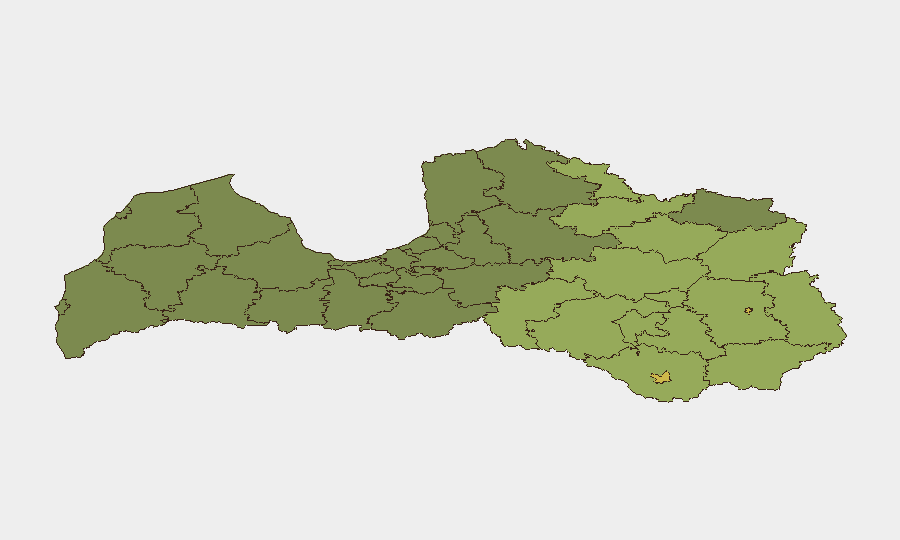
Eastern and southeastern Latvia—specifically Rēzekne (risk 68), Daugavpils (risk 65), and Rēzeknes novads (risk 58)—dominate the sub-national ranking and account for the country's elevated threat profile. These regions' proximity to the Belarus and Russia border, combined with critical infrastructure density (energy transmission, storage, and hydropower assets) and historical Russian-language population concentration, create convergent vulnerability to sabotage, espionage, and hybrid activity. The steep risk gradient from east (68) to west (Riga metropolitan area, unranked but typically lower) reflects geopolitical exposure rather than internal instability; western Latvia and Riga remain comparatively lower-risk for corporate operations.
How GeoBit Would Assist
Corporate security teams operating in Latvia would benefit from AOI Monitoring & Early Warning focused on critical energy infrastructure sites and border regions to detect unusual activity or access attempts; Intel Sweep and OSINT fusion to track Russian military and proxy communications for sabotage indicators; and Conflict & Military force-structure and weapons-capability tracking to contextualize NATO air defense posture and Russian asset positioning. Satellite & Imagery analysis and GIS & Spatial Analysis would support vulnerability mapping of energy assets and alternative route planning for personnel in eastern regions during periods of elevated tension.
7-Day Outlook
Latvian authorities will likely maintain elevated security at energy and critical infrastructure sites through at least late July. No imminent kinetic escalation is signaled, but hybrid-warfare pressure (sabotage attempts, cyber-enabled attacks, or drone incursions) may recur. Corporate duty-of-care teams should brief personnel in eastern Latvia on reporting procedures, avoid non-essential travel to border areas, and confirm continuity of operations for critical business functions dependent on energy supply.
Highest-Risk Areas — Ranked
| # | State / Region | Risk |
|---|---|---|
| 1 | Rēzekne | 68 |
| 2 | Daugavpils | 65 |
| 3 | Rēzeknes novads | 58 |
| 4 | Ludzas novads | 55 |
| 5 | Balvu novads | 52 |
| 6 | Preiļu novads | 50 |
| 7 | Krāslavas novads | 48 |
| 8 | Jēkabpils novads | 47 |
| 9 | Augšdaugavas novads | 46 |
| 10 | Aizkraukles novads | 45 |
| 11 | Varakļānu novads | 44 |
| 12 | Līvānu novads | 43 |
Previous Daily Briefs
A new Latvia brief is written every day — each with its own risk map and downloadable CSV. Here's the last week; use the calendar to go further back.
📅 Browse every day by calendar →
Highlighted days have a brief. Tap a day for that day's map & analysis, or “csv” for that day's dataset ($5).
Atlas — our AI intelligence desk — emails them this snapshot personally. Nothing else, no list.