Situation Summary
Latvia remains stable with no acute security incidents, civil unrest, or infrastructure disruptions in the last 24–48 hours. However, a pattern of elevated strategic tension persists: multiple public statements exchanged between Latvia and Russia on 23 June, coupled with a reported Latvian intelligence warning of potential Russian hybrid attacks against Baltic states, reflect a heightened posture rather than an imminent operational threat. The €3.5 billion defence package announced on 20 June signals a sustained commitment to military readiness, positioning the country in a managed state of strategic elevation rather than crisis response.
Key Developments
- Latvia (national), 23 June 2026 – Multiple public statements exchanged between Latvian and Russian officials; one escalatory threat signal reported between Latvia and Poland. No verified armed incident or physical breach occurred.
- Latvia (national intelligence), 23 June 2026 – Latvian intelligence circulated a forward-looking warning of potential Russian hybrid attacks targeting Baltic states or Poland; assessments indicate this reflects strategic anticipation rather than reporting of an active attack.
- Riga, 20 June 2026 – Latvia's Ministry of Defence announced a €3.5 billion multi-year defence package, with €525 million for near-term military capability and infrastructure hardening. This signals sustained strategic readiness but is not a response to any specific 24–48 hour incident.
- Eastern border municipalities (Rēzekne, Daugavpils regions), ongoing – Continued focused multi-source monitoring confirms no new verified incidents or travel-risk changes in the last 24–48 hours, despite persistent strategic concerns related to Russian activity and NATO posture.
- Countrywide, 22–23 June 2026 – Open-source social media and news aggregation across 100+ sources recorded no reports of civil unrest, protests, politically motivated violence, terrorism, or major crime in the latest 24–48 hour window.
Highest-Risk Areas
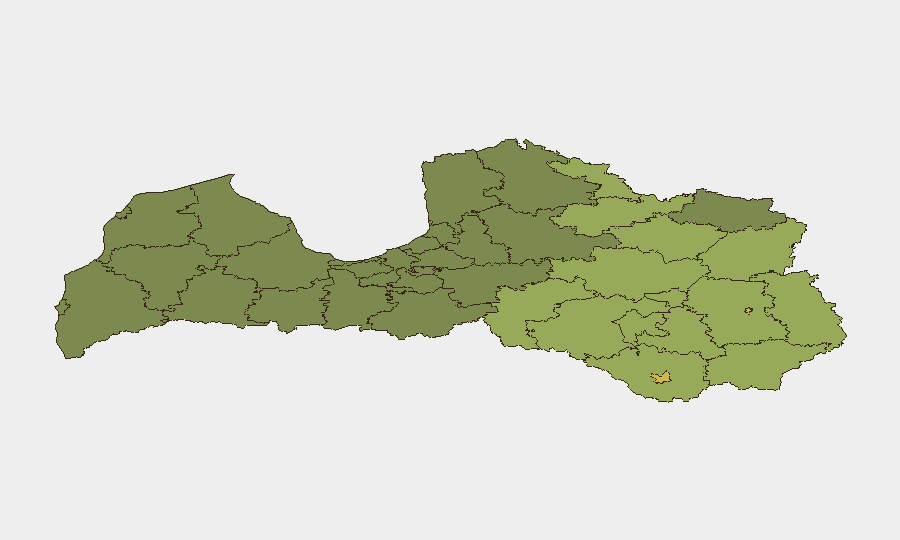
Eastern Latvia—particularly Rēzekne (risk 68), Daugavpils (risk 65), and surrounding municipalities—dominates the sub-national ranking. These regions are classified as highest-risk due to geographic proximity to the Russian border, established NATO strategic focus, and ongoing intelligence assessments of hybrid-threat vectors (disinformation, critical infrastructure targeting, border incursion monitoring). No current incidents are reported in these areas, but the sustained elevated risk score reflects the persistent geopolitical salience of the eastern border and the cumulative weight of strategic monitoring rather than acute events. Risk scores decline moving westward and toward central Latvia, indicating that threat concentration is geographic rather than nation-wide.
How GeoBit Would Assist
Security teams managing personnel or assets in Latvia should employ AOI (Area of Interest) Monitoring & Early Warning on high-risk eastern municipalities to detect emerging incidents in real time. Intel Sweep, X/Twitter & Telegram OSINT, and multi-language news fusion provide continuous detection of public statements, intelligence warnings, and escalatory rhetoric—critical for tracking the hybrid-threat space in which Baltic-Russia tensions typically manifest. Network & Actor Analysis and sentiment & temporal analysis enable teams to distinguish between posturing and genuine operational preparation, supporting duty-of-care escalation decisions.
7-Day Outlook
No imminent acute threat is forecast for the next seven days. The pattern of public statements and intelligence warnings is expected to persist at current elevated levels, with strategic rhetoric and defence posture adjustments likely to remain the dominant risk signal. Travel and business continuity in central and western Latvia remain low-risk; eastern border areas warrant continued background monitoring but show no indicators of near-term operational escalation.
Highest-Risk Areas — Ranked
| # | State / Region | Risk |
|---|---|---|
| 1 | Rēzekne | 68 |
| 2 | Daugavpils | 65 |
| 3 | Rēzeknes novads | 58 |
| 4 | Ludzas novads | 55 |
| 5 | Balvu novads | 52 |
| 6 | Preiļu novads | 50 |
| 7 | Krāslavas novads | 48 |
| 8 | Jēkabpils novads | 47 |
| 9 | Augšdaugavas novads | 46 |
| 10 | Aizkraukles novads | 45 |
| 11 | Varakļānu novads | 44 |
| 12 | Līvānu novads | 43 |
Sources
Previous Daily Briefs
A new Latvia brief is written every day — each with its own risk map and downloadable CSV. Here's the last week; use the calendar to go further back.
📅 Browse every day by calendar →
Highlighted days have a brief. Tap a day for that day's map & analysis, or “csv” for that day's dataset ($5).