Situation Summary
Latvia remains in a heightened state of strategic tension driven by ongoing regional instability and military posturing between NATO allies and Russia. The composite threat score of 14 reflects a volatile but contained security environment, with the bulk of risk concentrated in the Latgale region (eastern Latvia, bordering Russia and Belarus). No imminent security breakdown is evident, but the frequency of military public statements, diplomatic disapprovals from Moscow, and cross-border investigative activity (flagged on 19 June) indicate sustained friction at the state and sub-national levels.
Key Developments
- 19 June, Lithuania–Latvia dispute: An investigation-level event was recorded involving a bilateral matter between Lithuania and Latvia; specifics remain limited, but warrants monitoring as cross-border tensions can escalate quickly in the Baltics.
- 19 June, Latvia domestic investigation: A domestic investigative event was flagged but has not been publicly detailed; corporate security teams should monitor local media and official channels for clarification.
- 18 June, Military statements (multiple): Three separate public statements by military entities directed at Latvia were issued, indicating sustained messaging around military posture or capability; no specific incidents reported.
- 18 June, Latvia–Ukraine alignment: A public statement from Latvia regarding Ukraine suggests continued diplomatic or military coordination with Kyiv, consistent with broader NATO support posture.
- 18 June, Moscow disapproval: Russia issued a formal disapproval statement toward Latvia, typical of Russia's rhetorical response to NATO activity on its periphery.
- 18 June, Latvia–Russia military event: A conventional military force event was recorded involving Latvia and Russia; the nature (exercise, patrol, positioning, or incident) is not yet detailed in public reporting.
*(Background context: Since early 2026, the eastern NATO flank has experienced periodic drone incursions, military exercises, and rhetorical escalation. Latvia has maintained close NATO coordination and upgraded border monitoring.)*
Highest-Risk Areas
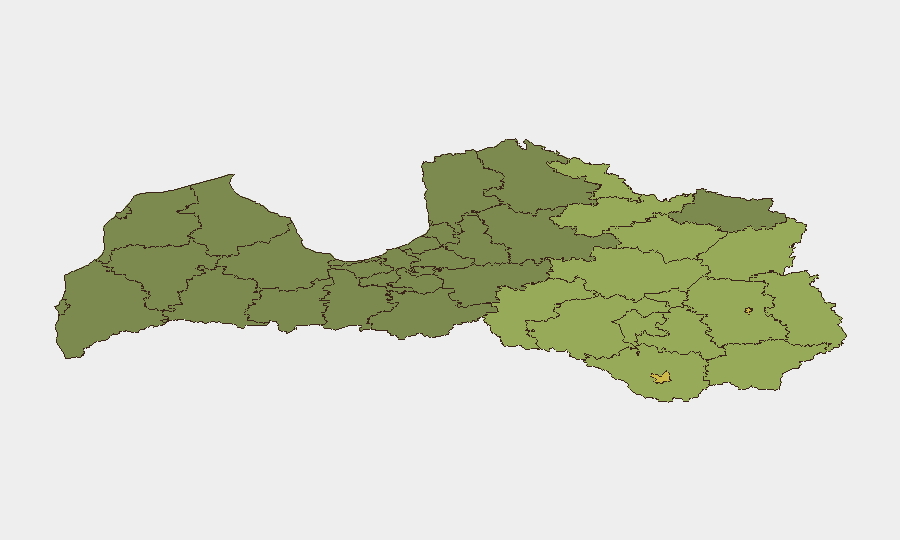
Rēzekne and Daugavpils (risk scores 68 and 65 respectively) are the primary drivers of the national threat ranking, followed by Rēzeknes novads and Ludzas novads. All four highest-risk areas are located in Latgale, the eastern region bordering Russia and Belarus. Risk in these zones stems from proximity to Russian airspace (drone/air activity), cross-border infiltration potential, cyber targeting of border infrastructure, and dependence on fragile transport corridors. Secondary risk extends through Preiļu and Krāslavas novads, forming a contiguous high-risk belt along the eastern frontier. Corporate assets or personnel in these regions should assume elevated exposure to surveillance, restricted movement, and potential rapid-onset incidents.
How GeoBit Would Assist
Security teams should deploy AOI (Area of Interest) Monitoring & Early Warning on Latgale's border regions, with persistent satellite and OSINT watch triggered to alert on unusual military, aviation, or cyber activity. Intel Sweep and multi-language OSINT fusion (social media, Telegram, local media, radio SIGINT) will surface early warning signals ahead of formal announcements. Conflict & Military tracking (force structure, positioning, exercises) and Routing & Network Analysis for alternative travel corridors in Latgale will enable real-time duty-of-care and evacuation planning for corporate personnel.
7-Day Outlook
The near-term trajectory remains one of sustained tension without escalation threshold. The June 18–19 uptick in military statements and investigative events does not yet indicate imminent kinetic action, but signals heightened alert posture on both sides. Corporate security teams should expect continued rhetorical friction, possible additional military exercises or positioning, and intermittent cross-border incidents (drones, cyber probing). Escalation risk remains low to moderate unless a triggering incident (e.g., civilian casualty, major infrastructure breach) occurs.
Highest-Risk Areas — Ranked
| # | State / Region | Risk |
|---|---|---|
| 1 | Rēzekne | 68 |
| 2 | Daugavpils | 65 |
| 3 | Rēzeknes novads | 58 |
| 4 | Ludzas novads | 55 |
| 5 | Balvu novads | 52 |
| 6 | Preiļu novads | 50 |
| 7 | Krāslavas novads | 48 |
| 8 | Jēkabpils novads | 47 |
| 9 | Augšdaugavas novads | 46 |
| 10 | Aizkraukles novads | 45 |
| 11 | Varakļānu novads | 44 |
| 12 | Līvānu novads | 43 |
Sources
Previous Daily Briefs
A new Latvia brief is written every day — each with its own risk map and downloadable CSV. Here's the last week; use the calendar to go further back.
📅 Browse every day by calendar →
Highlighted days have a brief. Tap a day for that day's map & analysis, or “csv” for that day's dataset ($5).