Situation Summary
Latvia maintains a composite threat score of 2 (rank #117 globally) with no active major security incidents reported in the past 24–48 hours. The security environment remains stable at the national level, though eastern border regions and economically disadvantaged municipalities continue to exhibit elevated risk scores. NATO membership, robust border infrastructure, and EU integration continue to anchor Latvia's overall security posture.
Key Developments
No confirmed security incidents in Latvia have been identified in the past 24–48 hours meeting criteria for specific location, date, and event type.
*Note: Available open-source material reflects either longer-term trend analysis (e.g., cyber-attack patterns over multiple months), institutional policy updates without incident triggers, or regional/NATO-level strategic discussions rather than time-stamped discrete events in Latvia in the last two days. Persistent monitoring of Latvian State Security Service (VDD) statements, national police (Valsts Policija) incident logs, and domestic news outlets (LSM, Delfi Latvia) is recommended to surface developments as they emerge.*
Highest-Risk Areas
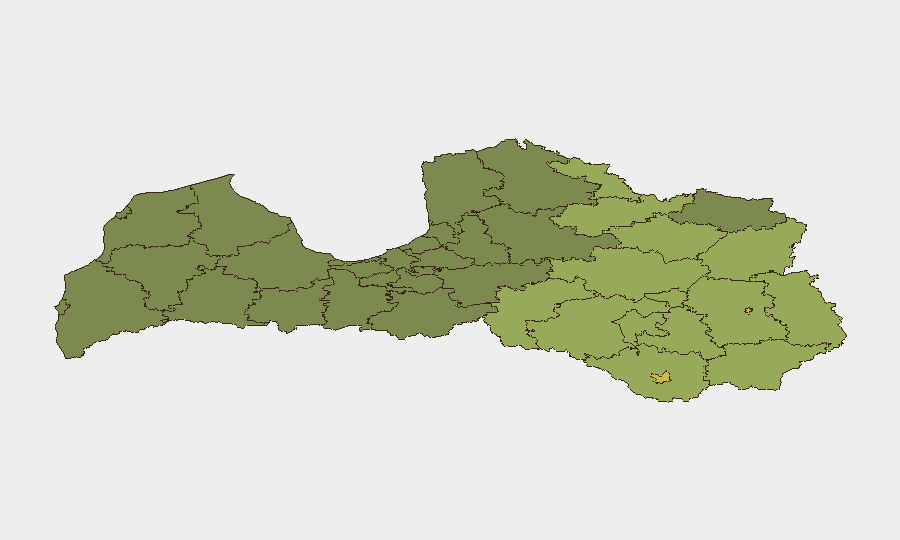
Eastern Latvian municipalities dominate the sub-national risk ranking, with Rēzekne city (risk 68) and Daugavpils (risk 65) substantially exceeding all other regions. These areas share common drivers: proximity to the Russian Federation and Belarus borders, lower economic development indices, smaller populations with limited institutional capacity, and historical demographic volatility. The concentration of risk in the Latgale region (municipalities ranked 1–12 all lie east of the Daugava River) reflects border security pressures, cross-border crime vectors (smuggling, trafficking), and geopolitical proximity effects rather than active conflict or instability. Duty-of-care teams with personnel or logistics nodes in Rēzekne, Daugavpils, or surrounding novads should maintain heightened situational awareness and contingency routing options.
How GeoBit Would Assist
Security teams operating in Latvia would benefit from AOI (Area-of-Interest) Monitoring & Early Warning on Rēzekne, Daugavpils, and the eastern border zone to detect emerging incidents in real time. Multi-language OSINT fusion (Intel Sweep, social media OSINT, and Latvian-language news aggregation) would surface localized threats—smuggling activity, cross-border security incidents, or administrative enforcement actions—before they escalate. Routing & Network Analysis would enable security and logistics teams to model alternative corridors and supply chains that avoid high-risk municipalities while maintaining operational tempo.
7-Day Outlook
No acute threat escalation is forecast for the next seven days. Baseline monitoring should continue for cross-border smuggling activity, cyber operations targeting critical infrastructure, and any NATO exercise or Russian military signaling that might trigger secondary alerts in border regions. Winter weather, seasonal tourism patterns, and the ongoing EU/NATO calendar remain the principal near-term drivers of operational risk rather than active security deterioration.
Highest-Risk Areas — Ranked
| # | State / Region | Risk |
|---|---|---|
| 1 | Rēzekne | 68 |
| 2 | Daugavpils | 65 |
| 3 | Rēzeknes novads | 58 |
| 4 | Ludzas novads | 55 |
| 5 | Balvu novads | 52 |
| 6 | Preiļu novads | 50 |
| 7 | Krāslavas novads | 48 |
| 8 | Jēkabpils novads | 47 |
| 9 | Augšdaugavas novads | 46 |
| 10 | Aizkraukles novads | 45 |
| 11 | Varakļānu novads | 44 |
| 12 | Līvānu novads | 43 |
Sources
Previous Daily Briefs
A new Latvia brief is written every day — each with its own risk map and downloadable CSV. Here's the last week; use the calendar to go further back.
📅 Browse every day by calendar →
Highlighted days have a brief. Tap a day for that day's map & analysis, or “csv” for that day's dataset ($5).