Situation Summary
Latvia remains a low-threat country globally (#148, composite score 9) with no confirmed security incidents during the past week. However, heightened NATO defensive posture, repeated foreign-drone incursions, and a reported pro-Kremlin terrorist threat against defence contractors underscore persistent regional tensions tied to Ukraine support and proximity to the Russian border. The country's October 3 parliamentary election and continued critical-infrastructure exposure in border areas sustain operational vigilance.
Key Developments
- Rīga (Jaunā Teika, Petersala–Andrejsala, Brasa, Čiekurkalns, Mežciems, Torņakalns, Ziepniekkalns, Bolderāja, Daugavgrīva, Salas) — September 16–20: Latvia's national-defence exercise Namejs 2026 entered active urban phase, deploying troops, military vehicles, drones, checkpoints, and anti-mobility barriers across the capital and surrounding districts.
- Rīga (Jaunā Teika, Ropažu Street 6) — September 16, ~20:00: Exercise personnel installed a simulated checkpoint and anti-mobility position as part of Namejs urban-security training.
- Rīga (Daugavgrīva, Dzintaru Street 60) — September 18: Namejs included a critical-infrastructure protection drill at a biological wastewater-treatment facility, testing security response protocols.
- Latvia-wide — September 16: Regional bus services experienced substantial disruption due to a strike affecting scheduled passenger transport across the country.
- Latgale / Eastern border — September 16: Foreign ambassadors visited Latvia's eastern border region, reflecting diplomatic attention to border security and regional stability ahead of the October 3 election.
- Lielvārde Air Base — late September–early October: Germany announced deployment of four Eurofighter aircraft to strengthen NATO air policing. The stated rationale included repeated foreign-drone incursions in Latvian airspace and airspace of neighbouring NATO members.
- Latvian airspace — September 21: Latvia's National Armed Forces reported a possible air threat and subsequently announced its conclusion; available details did not confirm object identity, location, or origin.
- Latvia-wide — September 18 (reported): A pro-Kremlin group allegedly threatened terrorist attacks against Latvian, Polish, and Portuguese defence companies supporting Ukraine. Latvia's State Security Service opened a terrorism investigation and detained one suspect; the underlying criminal case began September 9.
Highest-Risk Areas
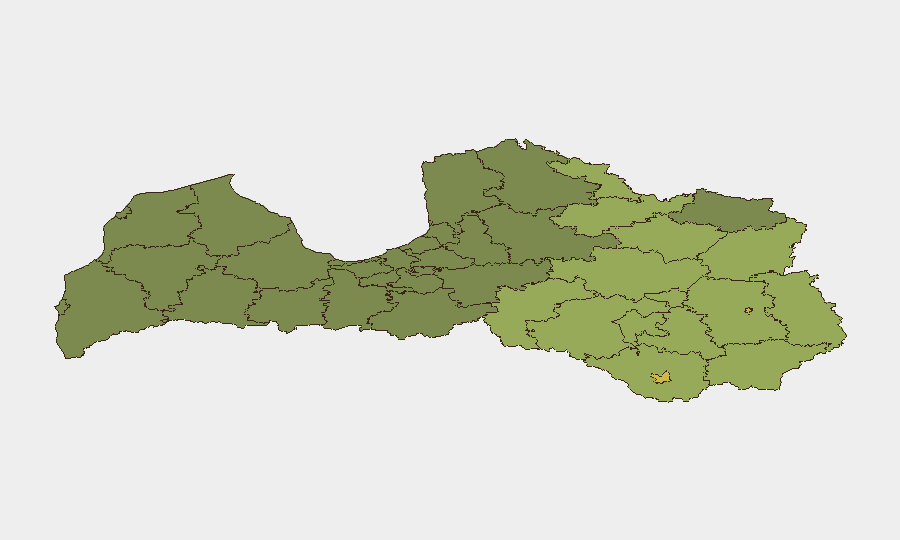
Rēzekne (risk 68) and Daugavpils (risk 65) dominate the sub-national ranking, followed by Rēzeknes novads (58), Ludzas novads (55), and Balvu novads (52). All top-ranked areas are located in Latgale, Latvia's eastern region bordering Russia and Belarus. Risk elevation in these districts reflects proximity to international borders, historically sparse population density, limited infrastructure redundancy, and sustained foreign-drone activity. Economic and social vulnerability in border municipalities compounds exposure to cross-border security incidents and hybrid threats.
How GeoBit Would Assist
Security teams operating in Latvia should employ AOI Monitoring & Early Warning on Rēzekne, Daugavpils, and other border municipalities to detect cross-border activity and anomalous movement patterns; Aviation & Maritime tracking to correlate drone sightings and NATO air-policing operations with broader regional activity; and OSINT fusion (X/Twitter, Telegram, multi-language search, entity extraction, sentiment analysis) to track pro-Kremlin threat actors, extremist rhetoric, and election-related disinformation ahead of October 3. Routing & Network Analysis supports alternative-journey planning for personnel in high-risk border areas during periods of heightened military exercise or alert.
7-Day Outlook
Namejs 2026 will likely conclude by late September, reducing visible military activity in and around Rīga. German Eurofighter deployment and NATO air-policing operations will persist into early October, and foreign-drone incursions remain probable given historical patterns. Election-period vigilance against disinformation and extremist activity will intensify as October 3 approaches.
Highest-Risk Areas — Ranked
| # | State / Region | Risk |
|---|---|---|
| 1 | Rēzekne | 68 |
| 2 | Daugavpils | 65 |
| 3 | Rēzeknes novads | 58 |
| 4 | Ludzas novads | 55 |
| 5 | Balvu novads | 52 |
| 6 | Preiļu novads | 50 |
| 7 | Krāslavas novads | 48 |
| 8 | Jēkabpils novads | 47 |
| 9 | Augšdaugavas novads | 46 |
| 10 | Aizkraukles novads | 45 |
| 11 | Varakļānu novads | 44 |
| 12 | Līvānu novads | 43 |
Sources
Previous Weekly Briefs
A new Latvia brief is written every Monday, covering the week — each with its own risk map and downloadable CSV. Use the calendar to go further back.
- September 15, 2026
- September 8, 2026
- September 1, 2026
- August 30, 2026
- August 28, 2026
- August 26, 2026
- August 24, 2026
📅 Browse past briefs by calendar →
Highlighted days have a brief. Tap a day for that day's map & analysis, or “csv” for that day's dataset ($5).
Atlas — our AI intelligence desk — emails them this snapshot personally. Nothing else, no list.