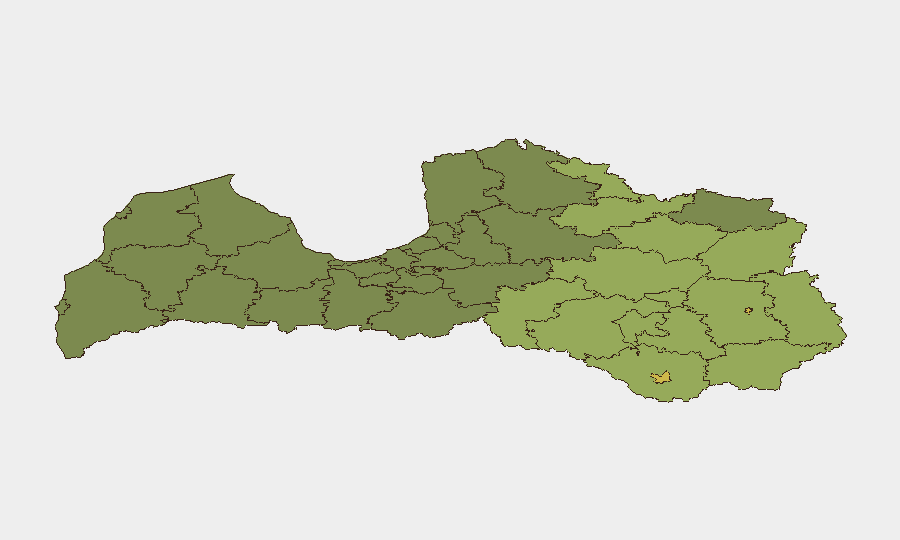
Situation Summary
Latvia remains at low overall threat globally (rank #128, composite score 9) with no tracked discrete security events in the current cycle. However, a foreign drone incursion over eastern Latvia on August 14—shot down by NATO jets—has triggered sustained elevated air-defense posture along the Belarus border and renewed focus on hybrid threats and airspace violations. Recent reporting also surfaces low-level online separatist agitation linked to Daugavpils and routine border-area security incidents, but no mass unrest, civil violence, or acute physical security crises are reported as of August 17.
Key Developments
- Balvi municipality, eastern Latvia – drone attribution confirmed (Aug 14 incident, statement Aug 17). Latvia's defense minister confirmed that the NATO-intercepted drone entered Latvian airspace from Belarus; technical investigation into ownership and payload ongoing. Underscores cross-border airspace vulnerability and potential Russian electronic warfare or reconnaissance activity.
- Eastern border airspace – intensified surveillance and air-defense posture (Aug 16–17). Additional air-defense units deployed and continuous monitoring activated across Balvi, Augšdaugava, Preili, Rēzekne, and Alūksne districts following the Aug 14 incident; authorities report specific threats have been contained but posture remains elevated.
- Riga – presidential security response (Aug 16–17). President of Latvia cut short vacation in response to airspace incursion, signaling political sensitivity to hybrid threats and potential escalation indicators; no new incident but demonstrates heightened national alert level.
- Daugavpils – separatist propaganda case (criminal referral Aug 17). State Security Service (VDD) referred a non-citizen to prosecutors for systematic promotion of Daugavpils separation and creation of a "new republic" via multi-account TikTok campaign; charged under Article 81 (territorial integrity). Indicates active information-space threat and political-instability concerns in the region, but no ground-level unrest reported.
- Border area – police conduct investigation (incident Aug 14, announcement Aug 16). Interior Ministry initiated internal investigation into police patrol following an encounter with two unidentified men who addressed National Armed Forces personnel in Russian; reflects border-area linguistic and political sensitivities and scrutiny of state response.
Highest-Risk Areas
Eastern and southeastern districts—Rēzekne (risk 68), Daugavpils (risk 65), and surrounding novads (Rēzeknes, Ludzas, Balvu, Preiļu)—dominate the sub-national ranking. These border-proximate regions face compounded exposure to airspace violations, cross-border hybrid activities, information warfare (including online separatist content), and international tensions. Daugavpils' elevated risk reflects both geographic proximity to Belarus and recent documented online agitation targeting territorial integrity, while Rēzekne and Balvi directly experienced the August 14 drone incident and subsequent air-defense mobilization.
How GeoBit Would Assist
Security teams in Latvia would employ AOI Monitoring & Early Warning on eastern border regions and airspace corridors to detect and alert on recurrent drone or aircraft incursions. OSINT fusion and multi-language social-media search (X, Telegram, TikTok) would track separatist, pro-Russian, or hybrid-threat narratives in Russian and Latvian to anticipate information-warfare escalation, particularly in high-risk novads. Conflict & Military tracking combined with Aviation tracking would provide real-time situational awareness of NATO/Latvian defense posture and foreign airspace activity, enabling duty-of-care teams to adjust travel and asset-protection protocols for personnel in border regions.
7-Day Outlook
The airspace incursion and political response suggest sustained but not acute threat elevation over the next week. Expect continued elevated air-defense deployment, intensified border monitoring, and ongoing technical investigation of the drone; no immediate escalation to ground-level violence or civil unrest is anticipated. Information-warfare operations (online separatism, hybrid messaging) will likely persist at low intensity, requiring persistent monitoring of social platforms.
Highest-Risk Areas — Ranked
| # | State / Region | Risk |
|---|---|---|
| 1 | Rēzekne | 68 |
| 2 | Daugavpils | 65 |
| 3 | Rēzeknes novads | 58 |
| 4 | Ludzas novads | 55 |
| 5 | Balvu novads | 52 |
| 6 | Preiļu novads | 50 |
| 7 | Krāslavas novads | 48 |
| 8 | Jēkabpils novads | 47 |
| 9 | Augšdaugavas novads | 46 |
| 10 | Aizkraukles novads | 45 |
| 11 | Varakļānu novads | 44 |
| 12 | Līvānu novads | 43 |
Sources
Previous Daily Briefs
A new Latvia brief is written every day — each with its own risk map and downloadable CSV. Here's the last week; use the calendar to go further back.
- August 15, 2026
- August 13, 2026
- August 11, 2026
- August 9, 2026
- August 8, 2026
- August 6, 2026
- August 5, 2026
📅 Browse every day by calendar →
Highlighted days have a brief. Tap a day for that day's map & analysis, or “csv” for that day's dataset ($5).
Atlas — our AI intelligence desk — emails them this snapshot personally. Nothing else, no list.