Situation Summary
Lithuania remains a stable NATO and EU member with composite threat score of 6 (rank #134 globally), indicating low systemic risk. The most recent tracked signals (June 23–24) relate to agricultural policy statements rather than security incidents or civil unrest. No active conflict, terrorism, or infrastructure threats are currently assessed, though cross-border vigilance and cybersecurity posture remain standard for the region given NATO membership and eastern proximity to Belarus and Russia.
Key Developments
GeoBit's recent event signals indicate agricultural policy engagement rather than security incidents:
- 2026-06-24 · Vilnius – Department of Agriculture public statement (content and specifics not detailed in available signals; likely routine policy or regulatory announcement).
- 2026-06-23 · Location unspecified – Ministry of Agriculture public statement in response to farmer concerns (nature of dispute and geographic scope require clarification via direct source review).
Note: Live web research conducted in the last 24 hours did not yield corroborated, Lithuania-specific security, civil unrest, crime, or infrastructure incidents within the 24–48 hour window. Earlier items identified (NATO cyber exercise April 2026, generic job postings, archived opinion) fall outside the brief's temporal scope. Further granular reporting requires access to Lithuanian media archives, official government statements, or social-media intelligence feeds (X/Twitter, Telegram) for the specific timeframe.
Highest-Risk Areas
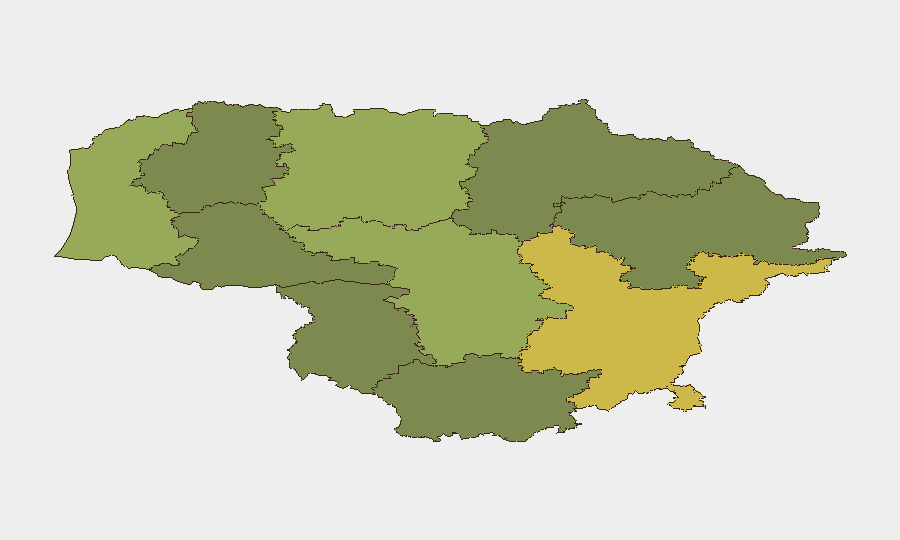
Vilnius County (score 68) and Kaunas County (score 58) comprise the majority of tracked risk, reflecting Lithuania's largest urban and economic centers. Both cities host government institutions, NATO infrastructure presence, and concentrated commercial activity, elevating exposure to cyber threats, organized crime, and petty street crime affecting expat and business communities. Klaipeda County (score 52), as Lithuania's principal Baltic port, carries maritime and supply-chain risk. Secondary risk is distributed across smaller counties (Siauliai, Panevezys, Taurage), with rural and border regions (Utena, Alytus, Telsiai, Marijampole) showing lower composite scores but warranting standard duty-of-care monitoring.
How GeoBit Would Assist
Intel Sweep & OSINT Fusion can monitor Lithuanian government statements, social media (X, Telegram), and local news feeds to detect emerging civil unrest, political instability, or criminal activity in real time. AOI Monitoring & Early Warning with persistent watch on Vilnius, Kaunas, and Klaipeda would trigger alerts on protests, infrastructure disruptions, or security incidents affecting personnel or assets. Network & Actor Analysis combined with Cyber Threat Intelligence tracks regional cyber campaigns and threat-actor activity targeting Lithuanian businesses and NATO networks, supporting proactive defense posture.
7-Day Outlook
No acute escalation is anticipated in the near term. Agricultural policy tensions appear to be routine governmental engagement rather than indicators of broader instability. Standard operational security protocols (staff awareness, facility access control, comms security) remain sufficient. Monitoring for any escalation in cross-border tensions or cyber activity directed at NATO or financial infrastructure should continue per baseline posture.
Highest-Risk Areas — Ranked
| # | State / Region | Risk |
|---|---|---|
| 1 | Vilnius County | 68 |
| 2 | Kaunas County | 58 |
| 3 | Klaipeda County | 52 |
| 4 | Siauliai County | 42 |
| 5 | Panevezys County | 38 |
| 6 | Taurage County | 35 |
| 7 | Utena County | 33 |
| 8 | Alytus County | 32 |
| 9 | Telsiai County | 28 |
| 10 | Marijampole County | 25 |
Previous Daily Briefs
A new Lithuania brief is written every day — each with its own risk map and downloadable CSV. Here's the last week; use the calendar to go further back.
📅 Browse every day by calendar →
Highlighted days have a brief. Tap a day for that day's map & analysis, or “csv” for that day's dataset ($5).