Situation Summary
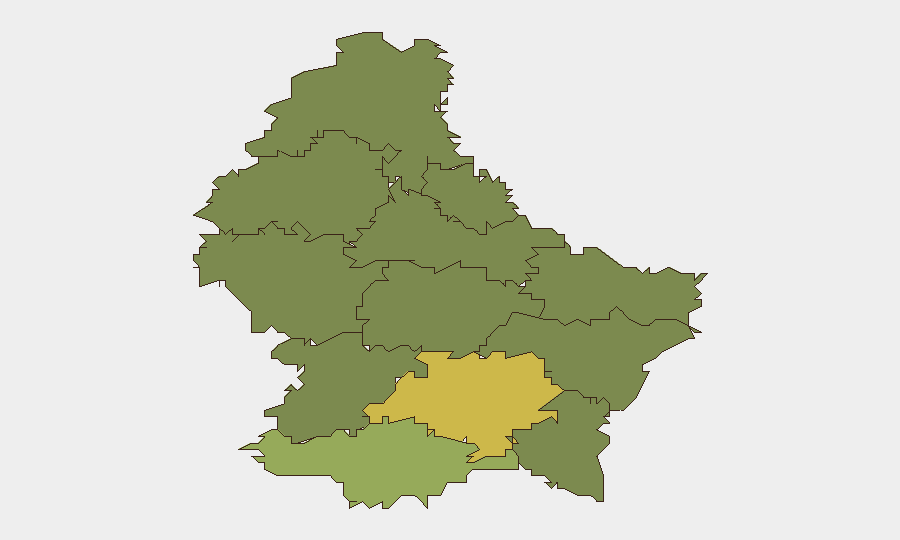
Luxembourg maintains a very low absolute security threat profile (global rank #199, composite score 2) with no tracked discrete security events in the current reporting window. The country's stable governance, strong rule of law, and integrated EU/NATO posture continue to underpin a benign baseline risk environment. However, sub-national variation is material: Luxembourg Canton (risk score 68) significantly outranks all other cantons, reflecting urban concentration, cross-border traffic, and financial-sector density in and around Luxembourg City.
Key Developments
No discrete security, civil-unrest, crime, infrastructure, or travel-disruption events have been verified in Luxembourg in the last 24–48 hours. Live web research (last 24h) returned no Luxembourg-specific incidents meeting threshold for inclusion in this brief. Monitoring of Luxembourg City, Esch-sur-Alzette, and other primary urban centers has not surfaced police, emergency, or transport-related alerts. Border crossing operations (France, Belgium, Germany) remain routine; no delays or security alerts reported. No cyber incidents affecting Luxembourg's banking, telecom, or public-sector infrastructure have been disclosed in the current window. No protest activity, government security alerts, or political instability indicators are present in available open-source channels.
Highest-Risk Areas
Luxembourg Canton dominates the sub-national risk profile with a score of 68—more than 20 points above the second-ranked Esch Canton (55). This reflects the concentration of Luxembourg City, the capital and financial hub, alongside high cross-border commuter and transit traffic, and the presence of critical financial infrastructure and EU institutions. Esch Canton (55) follows as a secondary risk node, driven by industrial legacy, urban density, and proximity to French and Belgian borders. The remaining nine cantons present materially lower risk (scores 8–32), with rural and border-adjacent areas such as Vianden, Clervaux, and Wiltz showing the lowest exposure. Risk gradation correlates closely with urbanization and international connectivity rather than with discrete current threats.
How GeoBit Would Assist
A Luxembourg-based security team would benefit from Intel Sweep and OSINT fusion to maintain persistent visibility on Luxembourg City's financial sector, EU institutional operations, and cross-border labor and supply-chain flows. AOI Monitoring & Early Warning with persistent watch zones at Luxembourg Airport, major rail hubs (CFL), motorway junctions, and border crossing points would provide real-time alerting for transport disruptions, congestion, or security incidents affecting duty-of-care obligations. Network & Actor Analysis combined with multi-language search and Telegram/X OSINT would surface emerging protest, labor, or transnational criminal activity before escalation.
7-Day Outlook
No material change in Luxembourg's security posture is anticipated over the next seven days. The country's structural stability, EU/NATO integration, and absence of active conflict, civil unrest, or resource stress will sustain the current low-threat baseline. Seasonal summer travel and cross-border commuting will proceed routinely; security teams should maintain standard monitoring of financial-sector cyber activity and transport infrastructure as ordinary operational practice.
Next brief: 2026-07-09 | Contact: GeoBit Analysis Team
Highest-Risk Areas — Ranked
| # | State / Region | Risk |
|---|---|---|
| 1 | Luxembourg Canton | 68 |
| 2 | Esch Canton | 55 |
| 3 | Mersch Canton | 32 |
| 4 | Capellen Canton | 28 |
| 5 | Grevenmacher Canton | 22 |
| 6 | Diekirch Canton | 18 |
| 7 | Echternach Canton | 16 |
| 8 | Redange Canton | 15 |
| 9 | Remich Canton | 14 |
| 10 | Wiltz Canton | 12 |
| 11 | Clervaux Canton | 10 |
| 12 | Vianden Canton | 8 |
Previous Daily Briefs
A new Luxembourg brief is written every day — each with its own risk map and downloadable CSV. Here's the last week; use the calendar to go further back.
📅 Browse every day by calendar →
Highlighted days have a brief. Tap a day for that day's map & analysis, or “csv” for that day's dataset ($5).
Atlas — our AI intelligence desk — emails them this snapshot personally. Nothing else, no list.