Situation Summary
Malta remains a low-threat environment globally (rank #155, composite threat score 4) with no confirmed security incidents in the current 24–48-hour window. However, sub-national risk concentration in Valletta, Sliema, and Saint Julian's reflects urban density, tourism density, and financial-sector activity rather than active instability. The overall security trajectory is stable; no emerging conflict, civil unrest, or infrastructure failure is evident.
Key Developments
- No discrete security incidents reported in Malta in the last 24–48 hours. Web research identified historical and recycled misinformation (including a June 1 firework-factory blast in Naxxar being falsely circulated as Iran-strike footage) but no current security events requiring immediate corporate response.
- Misinformation circulation around older incidents. A Naxxar explosion video from early June 2026 continues to be reused in false claims about Middle East strikes, indicating potential for confusion in open-source reporting. This does not indicate a Malta security threat but underscores the importance of source corroboration.
- Regional aviation disruption persists. KLM and other carriers maintain reroutes around Iran, Iraq, Israel, and Gulf airspace, which may marginally affect flight routing to/from Malta but does not constitute a Malta-specific threat.
- No political, infrastructure, or civil-unrest developments. Government operations, critical infrastructure, and public order remain uncompromised. No labor actions, transport strikes, or security-force incidents are current.
Highest-Risk Areas
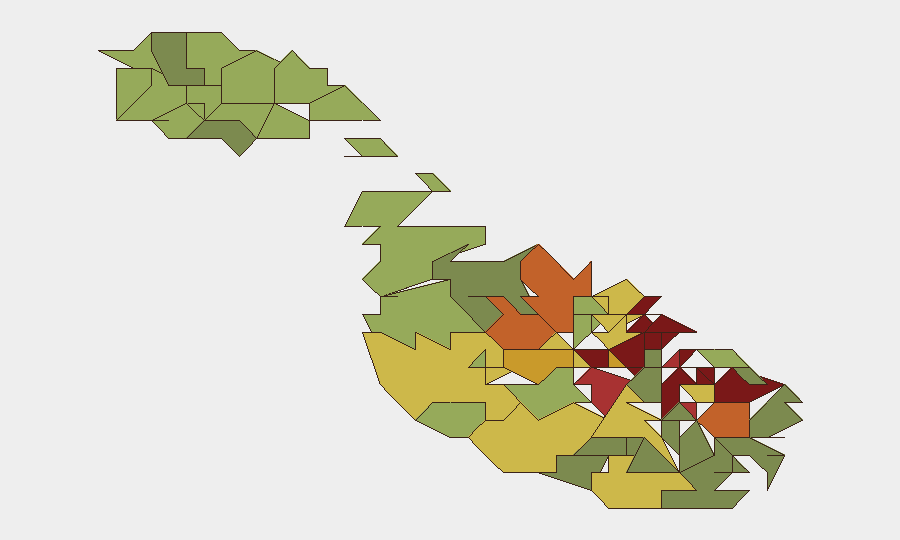
Valletta (95), Sliema (92), and Saint Julian's (90) dominate the sub-national ranking due to their role as Malta's commercial, administrative, and tourism hubs. These areas concentrate banking, diplomatic missions, hospitality, and high-net-worth residences, elevating baseline exposure to financial crime, petty theft, and social friction rather than organized violence or terrorism. The eastern harbor corridor (Valletta–Sliema–Gżira–Msida) accounts for the majority of foreign direct investment and expatriate population; risk scores reflect operational complexity and attractiveness to opportunistic crime, not active insurgency or state-level threat.
How GeoBit Would Assist
Corporate security teams with Malta operations should leverage Intel Sweep and multi-language OSINT fusion to monitor Telegram, X, and local media for emerging labor disputes, regulatory changes, or criminal activity affecting their sector. AOI (Area-of-Interest) Monitoring and Early Warning on Valletta's financial district and Sliema's expatriate neighborhoods enables persistent alerting if political tension, infrastructure incidents, or protest activity emerges. Routing & Network Analysis supports real-time journey-planning for staff and assets moving between Valletta, Saint Julian's, and the airport, and contingency routing if demonstrations or transport disruption occur.
7-Day Outlook
No material change in Malta's threat posture is anticipated over the next seven days. Seasonal tourism (June peak) may increase petty crime and congestion in Valletta and Sliema, but no security incident or policy disruption is forecast. Continued monitoring of regional Middle East developments (Iran, Iraq, Israel) remains relevant for aviation and maritime routing but does not elevate Malta's domestic threat level.
Highest-Risk Areas — Ranked
| # | State / Region | Risk |
|---|---|---|
| 1 | Valletta | 95 |
| 2 | Sliema | 92 |
| 3 | Saint Julian's | 90 |
| 4 | Gżira | 88 |
| 5 | Hamrun | 87 |
| 6 | Paola | 86 |
| 7 | Msida | 85 |
| 8 | Birkirkara | 84 |
| 9 | Birgu | 83 |
| 10 | Senglea | 82 |
| 11 | Cospicua | 81 |
| 12 | Żabbar | 80 |
Sources
Previous Daily Briefs
A new Malta brief is written every day — each with its own risk map and downloadable CSV. Here's the last week; use the calendar to go further back.
📅 Browse every day by calendar →
Highlighted days have a brief. Tap a day for that day's map & analysis, or “csv” for that day's dataset ($5).