Situation Summary
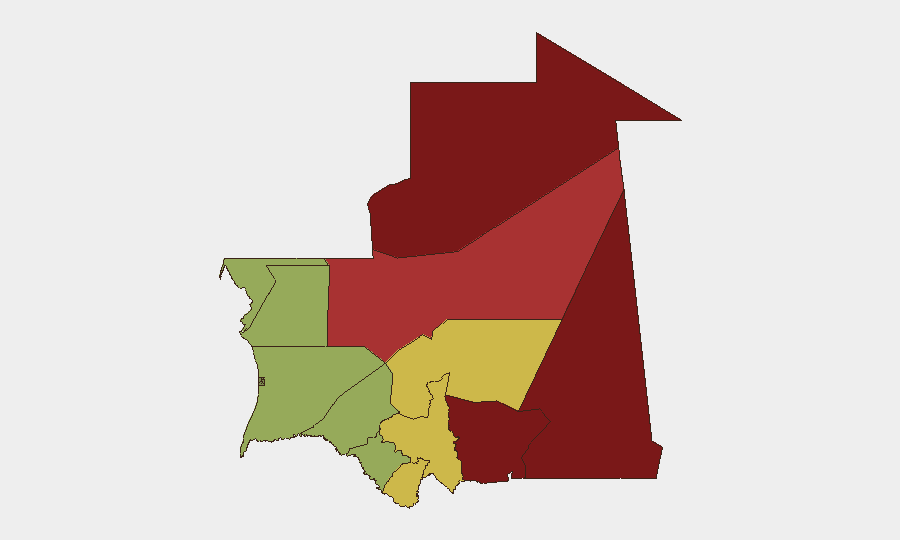
Mauritania remains a fragmented security environment with persistent instability concentrated in the eastern and northern regions, driven by militant activity, border porosity, and sporadic civil unrest. The composite threat score of 7 reflects moderate systemic risk; however, sub-national variation is extreme, with Tiris Zemmour (risk 95) and Hodh Ech Chargui (risk 85) presenting substantially elevated danger relative to coastal and southern zones. Recent event signals include ministerial public statements (24–25 July), student disapproval, and an active Rift Valley fever outbreak spanning Mauritania and Senegal. No major security incident has been substantiated within the last 24–48 hours; the most recent verified incidents (marine migrant emergencies and a road accident involving Tiris Zemmour's regional governor) date to mid-to-late July and fall outside the immediate reporting window.
Key Developments
- No new major security incidents verified in the last 24–48 hours. Recent ministerial public statements (24–25 July) and student/citizen disapproval signals are present in event feeds but lack specific operational or threat detail; verification pending.
- Rift Valley fever outbreak (ongoing). A zoonotic disease outbreak spanning Mauritania and Senegal remains active; surveillance and containment measures are ongoing. Humanitarian and health-sector operations may face movement restrictions or personnel constraints.
- Regional governance disruption (Tiris Zemmour, 23 July). The wali (governor) of Tiris Zemmour and accompanying driver sustained minor injuries in a road accident on the Atar–Akjoujt corridor, signaling operational friction within the highest-risk region.
- Alleged assault on activist-politician (Nouadhibou, 23 July). An alleged attempted vehicle attack against Biram Dah Abeid was reported by civil-rights sources; the alleged perpetrator vehicle was claimed to have police links. No official confirmation or casualty report available.
- Persistent maritime migrant crisis (14–18 July context). Prior week saw 144 dead or missing and 387 rescued across multiple boat incidents off Nouakchott waters; while outside the 48-hour window, maritime risk remains endemic and relevant to supply-chain and personnel-movement planning.
- Cyber-threat detection (H1 2026 aggregate). Over 10,000 cyber threats detected and 470 removed in the first half of 2026; no fresh incident in the last 48 hours, but indicative of persistent digital targeting of critical infrastructure and government systems.
Highest-Risk Areas
Tiris Zemmour and Hodh Ech Chargui dominate the risk profile, together accounting for the majority of militant activity, cross-border infiltration, and governance instability. Tiris Zemmour's extreme risk (95) reflects its position as a primary staging ground for AQIM-affiliated and ISIS-affiliated operations; Hodh Ech Chargui (85) faces sustained pressure from Mali-based armed groups and smuggling networks. Hodh El Gharbi (80) and Adrar (78) present secondary but significant risks tied to border porosity and resource-scarcity drivers. By contrast, Dakhlet Nouadhibou (45) and Brakna (48) remain lower-risk, though maritime migrant emergencies and petty criminality persist.
How GeoBit Would Assist
Intel Sweep and OSINT fusion across X/Twitter, Telegram, and regional media would establish real-time awareness of ministerial announcements and civil unrest; AOI monitoring with alerting on Tiris Zemmour and Hodh Ech Chargui would provide early warning of militant activity escalation. Network & actor analysis applied to published ministerial and security-service statements would clarify the current political-security nexus. Conflict mapping and border-crossing analytics would support route-planning and supply-chain resilience for operations in the eastern regions.
7-Day Outlook
No imminent security escalation is signaled; however, the persistence of ministerial tension, ongoing disease outbreak, and endemic eastern-region instability suggest continued operational friction. Personnel and asset protection in Tiris Zemmour and Hodh Ech Chargui should remain at elevated vigilance.
Highest-Risk Areas — Ranked
| # | State / Region | Risk |
|---|---|---|
| 1 | Tiris Zemmour | 95 |
| 2 | Hodh Ech Chargui | 85 |
| 3 | Hodh El Gharbi | 80 |
| 4 | Adrar | 78 |
| 5 | Tagant | 68 |
| 6 | Guidimaka | 65 |
| 7 | Assaba | 62 |
| 8 | Gorgol | 58 |
| 9 | Trarza | 55 |
| 10 | Inchiri | 52 |
| 11 | Brakna | 48 |
| 12 | Dakhlet Nouadhibou | 45 |
Sources
Previous Daily Briefs
A new Mauritania brief is written every day — each with its own risk map and downloadable CSV. Here's the last week; use the calendar to go further back.
📅 Browse every day by calendar →
Highlighted days have a brief. Tap a day for that day's map & analysis, or “csv” for that day's dataset ($5).
Atlas — our AI intelligence desk — emails them this snapshot personally. Nothing else, no list.