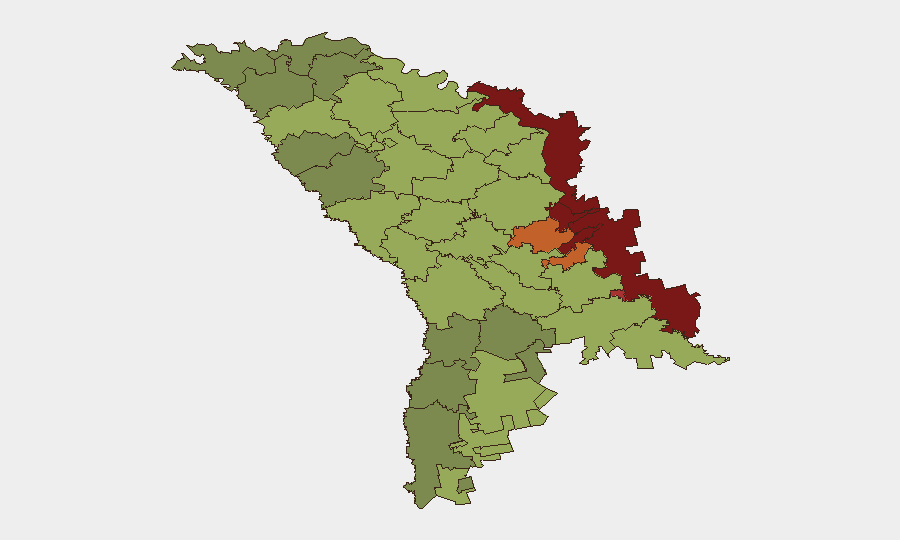
Situation Summary
Moldova remains a low-to-moderate global threat environment (rank #128, composite score 7), but exhibits acute subnational polarization driven by Russian intelligence activity, Transnistrian separatism, and competing information operations. The country's western orientation and NATO/EU integration pathway have intensified Russian counter-intelligence and destabilization efforts, with particular volatility concentrated in breakaway regions and Dniester-adjacent administrative units. No major security incidents or civil unrest have been clearly documented within the last 24–48 hours in open sources; however, ongoing counter-intelligence operations and intelligence-related arrests indicate sustained Russian operational presence and Moldovan counter-measures.
Key Developments
- Chișinău, Moldova – 24 June 2026 – UNICRI-supported capacity-building activity focused on strengthening Moldova's ability to investigate, prosecute, and adjudicate CBRN (chemical, biological, radiological, nuclear) crimes across regions and municipalities. Reflects international effort to harden Moldova's institutional response to weapons-of-mass-effect and terrorism risks. *(Note: 6 days prior to report date; no more recent CBRN-specific incident found.)*
- Moldova (entry point unspecified, likely Chișinău) – recent days, date not precisely confirmed – Moldovan security sources reported arrest of an individual alleged to be a Russian FSB officer who entered Moldova posing as a tourist for intelligence-gathering purposes. Indicates continued Russian human-intelligence (HUMINT) activity targeting Moldovan state and infrastructure. *(Timing cannot be narrowed to 24–48h window; appears recent but undated in open sources.)*
- Transnistria/Moldova information environment – recent days, exact date unconfirmed – Transnistrian "security ministry" publicly alleged that Moldova's SIS (Intelligence and Security Service) is coordinating Telegram channels and media outlets in information operations against Russia. Reflects ongoing information-warfare and propaganda tensions along the separatist boundary. *(No major incident materialized; statement reflects routine disinformation cycle.)*
- Moldova–Russia bilateral – 30 June 2026 – GEOBIT event signals indicate formal disapproval and investigative posture between Moldova and Russia on unspecified matter; likely related to intelligence or sovereignty concerns. Consistent with structural tension.
- No documented major security, unrest, crime, or infrastructure incidents in Moldova in the last 24–48 hours – Open-source and social media searches yield no multi-source confirmed, precisely-dated security or civil-disorder events meeting incident-reporting criteria for the reporting window.
Highest-Risk Areas
The Left Bank of the Dniester (administrative-territorial units, risk 85) and Dubăsari (82) dominate subnational risk, followed by Bender (79) and Criuleni (75). These areas overlap with separatist-controlled or separatist-adjacent territories where Russian military, intelligence, and proxy presence is heaviest, formal Moldovan authority is contested or absent, and cross-border contraband, weapons trafficking, and unvetted personnel movement are highest. Chișinău itself (rank 49) carries moderate risk tied to intelligence operations and political volatility, while Gagauzia (54) and Taraclia (55) remain secondary concerns due to pro-Russian sentiment and limited central-government oversight. Risk is almost entirely concentrated in the east and south; western and central Moldova remain comparatively stable.
How GeoBit Would Assist
Intel Sweep and multi-language OSINT fusion would provide real-time monitoring of Russian intelligence activity, Transnistrian rhetoric, and cross-border security incidents. AOI Monitoring & Early Warning with persistent watch on Dniester-adjacent and breakaway-region checkpoints, combined with entity extraction and network & actor analysis, would detect personnel movements, smuggling routes, and organized-crime linkages. Satellite & imagery analysis and border & disputed-territory search capabilities would enable asset-protection teams to track infrastructure vulnerabilities and identify secure routing away from high-risk zones.
7-Day Outlook
No imminent major security escalation is forecasted, but baseline tension and counter-intelligence activity will persist. Russian HUMINT and disinformation operations are expected to continue; Moldovan counter-measures will remain reactive. Monitoring for any shift in Transnistrian military posture or rapid-onset incidents (pipeline sabotage, border clashes, arrests of high-profile figures) is warranted.
Highest-Risk Areas — Ranked
| # | State / Region | Risk |
|---|---|---|
| 1 | Administrative-Territorial Units of the Left Bank of the Dniester | 85 |
| 2 | Dubăsari | 82 |
| 3 | Bender | 79 |
| 4 | Criuleni | 75 |
| 5 | Rezina | 58 |
| 6 | Taraclia | 55 |
| 7 | Gagauzia | 54 |
| 8 | Căușeni | 53 |
| 9 | Soroca | 52 |
| 10 | Ștefan Vodă | 51 |
| 11 | Orhei | 50 |
| 12 | Chișinău | 49 |
Sources
Previous Daily Briefs
A new Moldova brief is written every day — each with its own risk map and downloadable CSV. Here's the last week; use the calendar to go further back.
📅 Browse every day by calendar →
Highlighted days have a brief. Tap a day for that day's map & analysis, or “csv” for that day's dataset ($5).