Situation Summary
Montenegro remains a low-threat-index country (global rank #150, composite score 6) with no tracked ongoing major incidents as of 2026-08-11. However, a concentrated spike in criminal and civil-order events on 2026-08-06—including a fatal assault in Bar, organized crime grenade attack, xenophobic riots in Podgorica, and multiple bomb threats—signals localized volatility in the capital and coastal areas. Northern municipalities (Plav, Gusinje, Rožaje) maintain structurally elevated risk profiles, likely linked to organized crime and weapons trafficking; coastal and capital-region incidents suggest secondary risk concentration. The security environment is stable but fragmented by geography and crime type.
Key Developments
- Podgorica & Kolašin (2026-08-10/11): Police conducted targeted property searches linked to wanted persons as part of criminal investigation operations; details on charges and custody status remain limited in available reporting.
- Nationwide traffic incidents (2026-08-10/11): 24 road crashes recorded in 24 hours with one fatality and 840 traffic fines issued, indicating sustained enforcement activity and accident frequency in high-circulation areas.
- Multiple active fires (2026-08-10/11, provisional): Evacuations reported in Gornji Rogami, Čanj, and Piperi; timing and containment status require corroboration; fire-season pressure on emergency resources likely ongoing.
- Bar, fatal assault (2026-08-06): One death; brothers Dragoslav and Duško Ivanović arrested on murder charges within hours—resolution was rapid but indicative of violent-crime persistence in coastal municipalities.
- Podgorica, organized crime grenade attack (2026-08-06): Hand grenade detonated in residential yard with minor structural damage; police attributed to organized crime rivalry; no casualties reported.
- Podgorica, xenophobic riot & vandalism (2026-08-06): Crowd marching through Turkish neighborhood chanted xenophobic slogans and damaged Turkish-owned businesses and vehicles, reflecting escalating intercommunal tension in the capital.
- Podgorica & Bar, bomb threats (2026-08-06): Anonymous threats triggered mass evacuations at airport, multiple schools, and secondary school; police completed detailed inspections with no devices found; hoax impact on public confidence and emergency-services capacity.
- Coastal anti-crime enforcement (2026-08-07): Police seized four rifles, two pistols, and 300+ rounds of ammunition in enhanced checks across coastal municipalities.
Highest-Risk Areas
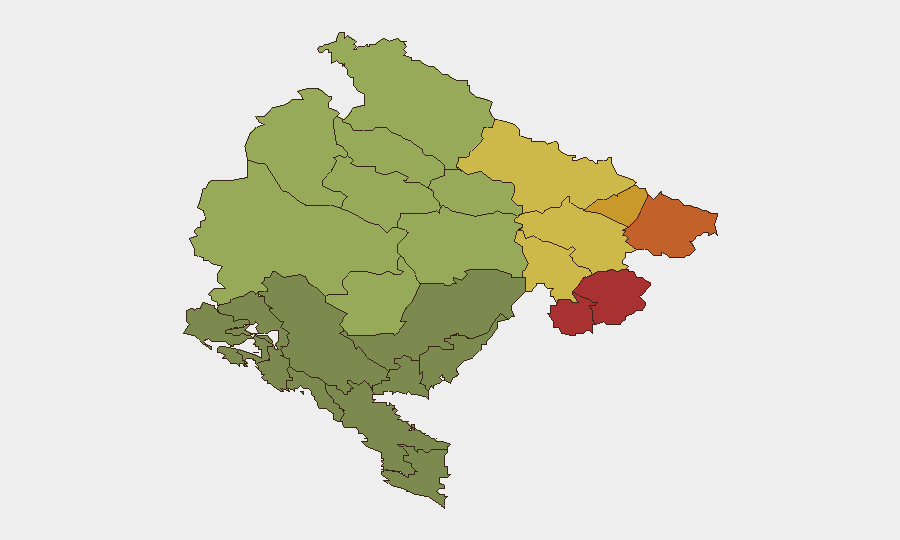
Northern border municipalities—Plav (risk 78), Gusinje (76), Rožaje (74), Petnjica (72), and Andrijevica (68)—dominate the sub-national ranking and are consistently linked to organized crime networks, weapons trafficking, and inter-clan tensions. Coastal and capital-region municipalities (Podgorica, Bar) show secondary but acute risk driven by violent crime, xenophobic disorder, and organized crime activity. The north–south divide reflects both legacy organized crime infrastructure in border zones and emerging civil-order volatility in urban centers; corporate presence in Podgorica and Kotor should assume elevated situational awareness in both zones.
How GeoBit Would Assist
Security teams monitoring Montenegro should use Intel Sweep and global event feeds to track organized crime and weapons-trafficking signals in the northern municipalities in real time. AOI Monitoring & Early Warning on Podgorica, Bar, and Kotor would provide persistent alerting for crowd disorder, xenophobic mobilization, and criminal incidents affecting expatriate communities. Network & Actor Analysis combined with OSINT fusion on organized crime figures and clan structures would contextualize grenade and firearm incidents and inform travel-risk decisions for personnel in high-risk zones.
7-Day Outlook
No imminent escalation is indicated; however, the 2026-08-06 event cluster (bomb threats, riots, assault, grenade attack) suggests a volatile baseline in Podgorica and coastal areas that could recur without notice. Northern municipalities remain endemic organized-crime zones with seasonal weapons-trafficking activity. Security posture should assume steady-state localized risk with periodic acute incidents, particularly in summer months and around public gatherings.
Highest-Risk Areas — Ranked
| # | State / Region | Risk |
|---|---|---|
| 1 | Plav Municipality | 78 |
| 2 | Gusinje Municipality | 76 |
| 3 | Rožaje Municipality | 74 |
| 4 | Petnjica Municipality | 72 |
| 5 | Andrijevica Municipality | 68 |
| 6 | Bijelo Polje Municipality | 65 |
| 7 | Berane Municipality | 62 |
| 8 | Plužine Municipality | 58 |
| 9 | Pljevlja Municipality | 55 |
| 10 | Šavnik Municipality | 52 |
| 11 | Žabljak Municipality | 50 |
| 12 | Kolašin Municipality | 48 |
Sources
Previous Daily Briefs
A new Montenegro brief is written every day — each with its own risk map and downloadable CSV. Here's the last week; use the calendar to go further back.
📅 Browse every day by calendar →
Highlighted days have a brief. Tap a day for that day's map & analysis, or “csv” for that day's dataset ($5).
Atlas — our AI intelligence desk — emails them this snapshot personally. Nothing else, no list.