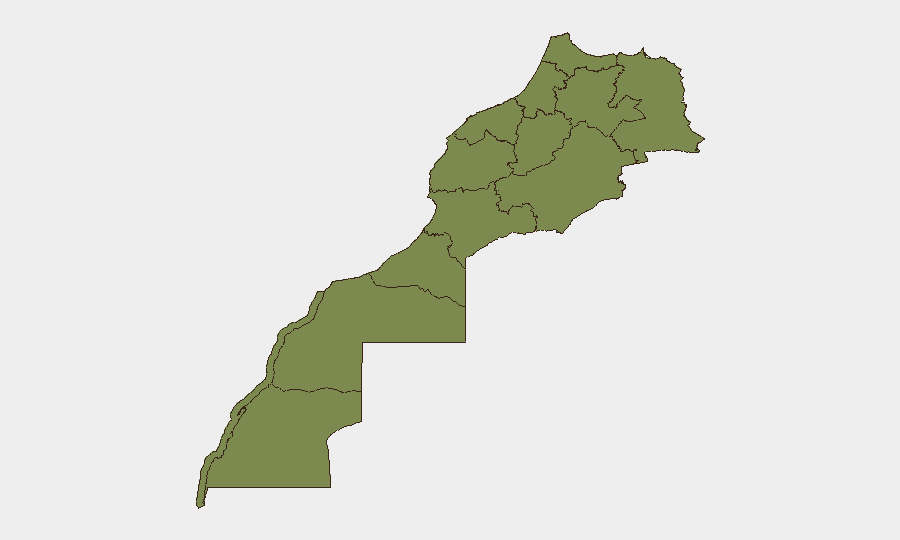
Situation Summary
Morocco remains a low-threat environment globally (rank #100, composite score 9) with 67 tracked events. However, sub-national disparities are significant: Drâa-Tafilalet region carries substantially elevated risk (31.5), while most other regions cluster at baseline (1.5–12). Recent diplomatic and investigative signals across July 8–10 suggest political friction and active law-enforcement activity, but no credible security incidents within the last 24–48 hours inside Morocco have been confirmed through open sources. The security posture is stable but warrants region-specific attention.
Key Developments
No verified security, civil-unrest, crime, or infrastructure incidents originating in Morocco during July 9–10, 2026, could be confirmed through available open-source research. Recent signals (July 8–10) include diplomatic disapprovals involving Saudi Arabia, France, and Morocco's Ministry of Foreign Affairs; investigative activity flagged by security services (July 10); and public statements by government and tourist-sector actors. These indicators do not yet point to acute operational threats but reflect ongoing political and administrative attention. World Cup–related fan clashes involving Moroccan supporters have been documented in European cities (London, Paris, The Hague) during earlier tournament phases, but these are not domestic security events and lack precise recent timestamps.
Highest-Risk Areas
Drâa-Tafilalet dominates national risk with a composite score of 31.5—more than 2.5× the next-highest region (Rabat-Salé-Kénitra, 12). This southeastern region's elevation reflects historical militant-recruitment activity, cross-border trafficking networks from Algeria, and sparse state presence in remote areas. Rabat-Salé-Kénitra and Casablanca-Settat, which contain the capital and largest economic hub respectively, show moderate risk (12 and 10.5) consistent with urban density, diplomatic presence, and potential protest activity. All remaining regions—including major tourist zones (Souss-Massa, Tangier-Tetouan-Al Hoceima) and southern provinces—remain at baseline or minimal risk (1.5–2.3).
How GeoBit Would Assist
Security teams can use AOI Monitoring & Early Warning to maintain persistent watch on Drâa-Tafilalet and Rabat-Salé-Kénitra for emerging unrest, militant activity, or infrastructure disruption, with automated alerting on threshold breach. Multi-language OSINT, X/Twitter & Telegram OSINT, and sentiment analysis enable continuous tracking of diplomatic signals, protest sentiment, and security-force communications to detect shifting risk posture. Network & Actor Analysis combined with border & disputed-territory search supports mapping of cross-border trafficking and recruitment networks, particularly relevant to Drâa-Tafilalet's vulnerability. Alternative route planning protects supply chains and personnel movements in high-risk regions.
7-Day Outlook
No acute deterioration is anticipated over the next seven days based on current trajectory. Diplomatic friction (Saudi Arabia, France) and investigative activity warrant monitoring for secondary civil-order effects, particularly in Rabat and Casablanca, but have not cascaded into public unrest. Drâa-Tafilalet remains a persistent low-frequency risk requiring structural monitoring rather than tactical alert posture. Routine duty-of-care protocols remain appropriate; escalation will depend on verified developments in the capital region or cross-border indicators.
Highest-Risk Areas — Ranked
| # | State / Region | Risk |
|---|---|---|
| 1 | Drâa-Tafilalet | 31.5 |
| 2 | Rabat-Salé-Kénitra | 12 |
| 3 | Casablanca-Settat | 10.5 |
| 4 | Souss-Massa | 2.3 |
| 5 | Western Sahara | 1.5 |
| 6 | Laâyoune-Sakia El Hamra | 1.5 |
| 7 | Guelmim-Oued Noun | 1.5 |
| 8 | Dakhla-Oued Ed-Dahab | 1.5 |
| 9 | Béni Mellal-Khénifra | 1.5 |
| 10 | Tangier-Tetouan-Al Hoceima | 1.5 |
| 11 | Fez-Meknes | 1.5 |
| 12 | Oriental | 1.5 |
Sources
Previous Daily Briefs
A new Morocco brief is written every day — each with its own risk map and downloadable CSV. Here's the last week; use the calendar to go further back.
📅 Browse every day by calendar →
Highlighted days have a brief. Tap a day for that day's map & analysis, or “csv” for that day's dataset ($5).
Atlas — our AI intelligence desk — emails them this snapshot personally. Nothing else, no list.