Situation Summary
Nepal remains a low-intensity security environment with a composite threat score of 10 and 58 tracked events, though risk is heavily concentrated in Gandaki Province (31.3), which accounts for roughly half the national score. Current activity signals reflect governance and policy discourse rather than acute violence: recent developments center on public administration transparency (asset destruction in Siraha), border-security advocacy, and diplomatic coordination with neighboring states. The overall trajectory is stable but fragmented by local administrative credibility challenges and persistent border-management concerns.
Key Developments
- Siraha District, Madhesh Province, 9–10 June 2026 – Viral video documentation of approximately 500 mobile phones and smartwatches (valued over NPR 1 crore) destroyed by authorities in water. Social-media backlash on Instagram and Facebook signals public-trust erosion in local law-enforcement asset-management practices; no violence reported but governance legitimacy at issue.
- Nationwide, 9–10 June 2026 – Political figure Harka Raj Rai (Sampang) called for Nepal Army deployment along national borders to strengthen security. Circulating on Facebook; reflects domestic security-policy debate but no confirmed operational changes reported.
- Foreign Ministry statement, 9–10 June 2026 – Nepal's Foreign Minister Shisir Khanal announced plans to activate cross-border security and trade-facilitation mechanisms with neighboring countries over "the next few months," indicating diplomatic priority on regional coordination.
- India–Nepal border region, within 48 hours – Bengal police arrested individual identified as Jahangir Khan near the India–Nepal border; no further detail on charges or precise location, but indicates ongoing law-enforcement activity in border zone.
- Multiple government and parliamentary statements, 8–10 June 2026 – Recent public statements from Prime Minister, Parliament, and government bodies recorded in event feeds; specific content unavailable but consistent with governance-level communication on current issues.
Highest-Risk Areas
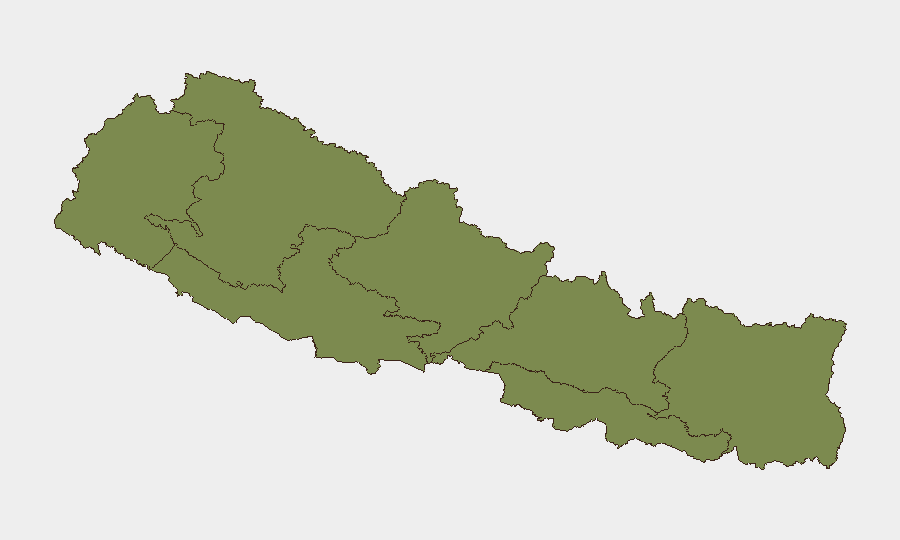
Gandaki Province dominates national risk (31.3 of 58 total tracked events), with Bagamati Province (19.3) as secondary concern. Together these two provinces represent approximately 86% of tracked Nepal security events. The remaining five provinces—Koshi, Karnali, Sudurpashchim, Lumbini, and Madhesh—each score below 5, indicating risk is geographically concentrated in the central and western highlands. The Siraha incident in Madhesh, though low-intensity, highlights that governance and administrative transparency issues can trigger social-media amplification and public-trust degradation even in formally lower-risk zones.
How GeoBit Would Assist
Organizations with personnel or assets in Nepal should employ AOI Monitoring & Early Warning on Gandaki and Bagamati provinces to track escalation in event frequency or severity. OSINT Fusion & Corroboration (combining X/Twitter, Facebook, Instagram, and local news sources with sentiment analysis) can detect emerging governance or social-stability issues—such as the Siraha asset-destruction backlash—before they mature into operational risks. Network & Actor Analysis and Border & Disputed-Territory Search are valuable for tracking cross-border criminal activity and diplomatic coordination mechanisms relevant to India–Nepal boundary management.
7-Day Outlook
No acute security escalation is forecast for the next 7 days. Governance and border-security policy discussions will likely continue at political and diplomatic levels; social-media sentiment around administrative conduct (asset management, law enforcement) may remain elevated in affected districts. Risk profile is expected to remain stable unless a new trigger event (violence, major policy announcement, or external incident) emerges in Gandaki or Bagamati provinces.
Highest-Risk Areas — Ranked
| # | State / Region | Risk |
|---|---|---|
| 1 | Gandaki Province | 31.3 |
| 2 | Bagamati Province | 19.3 |
| 3 | Koshi Province | 4.6 |
| 4 | Karnali Province | 2.7 |
| 5 | Sudurpashchim Province | 1.8 |
| 6 | Lumbini Province | 1.8 |
| 7 | Madhesh Province | 1.3 |
Sources
Previous Daily Briefs
A new Nepal brief is written every day — each with its own risk map and downloadable CSV. Here's the last week; use the calendar to go further back.
📅 Browse every day by calendar →
Highlighted days have a brief. Tap a day for that day's map & analysis, or “csv” for that day's dataset ($5).