Situation Summary
Panama experienced a significant natural-disaster event on 9 October when a magnitude-7.7 earthquake struck the central region, injuring at least 27 people and triggering nationwide emergency response, power disruptions, transport delays, and school closures. Concurrent criminal and protest activity remained moderate; joint Colombian-Panamanian counter-narcotics operations yielded arrests, while teacher-led labour protests and transport-sector demonstrations continued over employment and subsidy disputes. The overall national threat score remains at 35 (rank #56 globally), driven by endemic crime and gang activity concentrated in border and coastal regions rather than acute national instability.
Key Developments
- Penonomé, Coclé — 9 October: A magnitude-7.7 earthquake caused building damage, including collapse or severe structural damage to a hotel and historic cathedral; 27+ injuries reported. Significant aftershocks continued through 11 October.
- Panama City, nationwide — 9–10 October: Earthquake triggered power outages, metro service suspension, flight diversions at Tocumen International Airport, and widespread transport disruptions. Copa Airlines resumed operations after airport reopened.
- Panama nationwide — 10–12 October: Government declared national emergency; nationwide school closures announced for Monday, 12 October, due to damage assessment and ongoing aftershock risk.
- Colombian-Panamanian border — 8 October: Joint operation against Clan del Golfo resulted in one member killed and 16 arrests, continuing regular counter-narcotics coordination.
- Panama City — 9–10 October: Multiple aftershocks (magnitude unspecified) followed the main earthquake; authorities conducting urgent assessments of roads, buildings, power infrastructure, and water systems.
- Panama City, Coclé, Azuero Peninsula — 9 October: Earthquake-triggered evacuations and public alarm across multiple provinces; residents fled buildings during strong shaking.
- Condado del Rey, Panama City — 5 October: National Police arrested former BAC vice president Salgado during residential search in DGI (tax authority) fraud case; pretrial detention ordered.
- Panama City — 3–4 October: Three separate civilian casualties reported (14-year-old killed, 9-year-old wounded, 31-year-old male found shot); no organized-crime attribution established in available reporting.
- Panama City, national scale — 29 September–4 October: Ongoing labour protests by dismissed teachers (295 educators) at Defensoría del Pueblo; one protester chained herself to building on 1 October. Separate transport-worker and allied-organization marches protested police infiltration of unions and fuel-subsidy policy.
Highest-Risk Areas
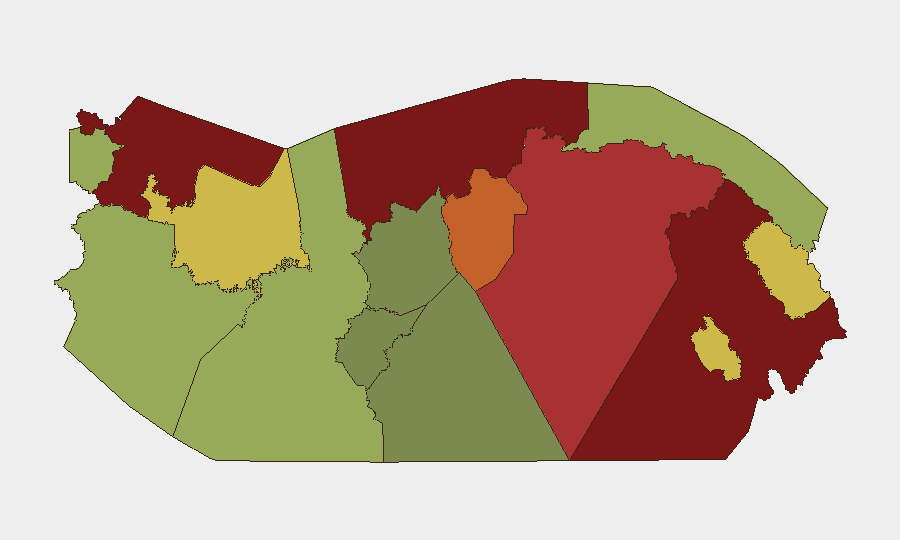
Darién (risk 95), Colón (88), and Bocas del Toro (82) comprise the top-three highest-risk regions and are driven by gang/cartel activity, migrant-trafficking networks, and transnational organized crime centred on border porosity and maritime transit. Panamá Province and Panamá Oeste (78, 75) carry elevated risk due to proximity to the capital, gang territorial disputes, and logistical importance to criminal supply chains. Interior provinces (Coclé, Chiriquí, Veraguas) show moderate-to-lower risk, though the 9 October earthquake may disrupt local security posture temporarily via infrastructure damage and resource diversion.
How GeoBit Would Assist
AOI Monitoring & Early Warning on Darién, Colón, and maritime zones would provide persistent detection of trafficking, border incursions, and emerging criminal activity. Maritime & Aviation Tracking applied to inter-provincial shipping, aviation, and informal port activity would flag anomalies in cartel logistics. Intel Sweep with OSINT fusion on labour-protest and state-security developments would alert teams to escalation in police tactics or political instability affecting personnel safety.
7-Day Outlook
Infrastructure damage from the earthquake is expected to dominate government response, potentially reducing police and emergency capacity in high-crime zones over the short term. Criminal activity in border regions will likely persist at baseline; labour protests may continue if wage/reinstatement demands remain unmet, creating crowded urban environments and transport bottlenecks through mid-October.
Highest-Risk Areas — Ranked
| # | State / Region | Risk |
|---|---|---|
| 1 | Darién | 95 |
| 2 | Colón | 88 |
| 3 | Bocas del Toro | 82 |
| 4 | Panamá Province | 78 |
| 5 | Panamá Oeste | 75 |
| 6 | Ngäbe-Buglé | 68 |
| 7 | Emberá-Wounaan | 62 |
| 8 | Veraguas | 58 |
| 9 | Chiriquí | 48 |
| 10 | Naso Tjër Di | 45 |
| 11 | Guna Yala | 42 |
| 12 | Coclé | 35 |
Sources
Previous Weekly Briefs
A new Panama brief is written every Monday, covering the week — each with its own risk map and downloadable CSV. Use the calendar to go further back.
- October 5, 2026
- September 28, 2026
- September 21, 2026
- September 14, 2026
- September 7, 2026
- September 1, 2026
- August 31, 2026
📅 Browse past briefs by calendar →
Highlighted days have a brief. Tap a day for that day's map & analysis, or “csv” for that day's dataset ($5).
Atlas — our AI intelligence desk — emails them this snapshot personally. Nothing else, no list.