Situation Summary
Sierra Leone remains a low-to-moderate global security concern (rank #137) but faces acute near-term diplomatic and governance risks stemming from a high-profile cocaine-trafficking and extradition standoff with European partners. The government's recent passage of a broad National Security and Central Intelligence Act—framed domestically as a counter-organised-crime measure but criticized as potentially repressive—has intensified debate over civil liberties and state capacity. Economic vulnerability is heightened by EU threats to suspend development aid over non-cooperation on extradition, while transnational organised-crime networks continue to exploit Sierra Leone as a transit hub, attracting external law-enforcement pressure and reputational risk.
Key Developments
- Freetown, 11 June 2026 – European Parliament members (Dutch and Belgian) have formally called on the European Commission to suspend development aid to Sierra Leone and increase pressure unless the government extradites alleged drug kingpin Jos Leijdekkers. This represents active diplomatic escalation directly linked to the cocaine-trafficking crisis.
- Freetown, 10–11 June 2026 – Opposition parliamentary leader Hon. Abdul Kargbo and media outlets (Epic Radio 99.3 FM) highlighted the imminent risk of EU aid cuts, framing potential loss of development funding as a near-term threat to economic stability and government capacity for security and infrastructure programmes.
- Freetown, 11 June 2026 – The newly signed National Security and Central Intelligence Act drew intensified public debate, with critics on social media characterising it as a move toward a "police state" and warning of privacy and free-speech erosion, while government messaging emphasises counter-organised-crime and counter-terrorism benefits.
- National, 11 June 2026 – Government messaging campaign ("Sierra Leone's Invisible War") circulated on social media, repositioning anti-organised-crime efforts as a national-security priority and signalling active attempts to build public support for more assertive security and intelligence operations.
- National, 10–11 June 2026 – Social-media discussions characterised Sierra Leone's cocaine and drug-trafficking crisis as a "global security concern," amplifying narratives of Sierra Leone as a node in transnational organised-crime networks and heightening expectations of external law-enforcement cooperation demands.
- National, 10–11 June 2026 – Government launched a "Regional Emergency Solar Power Intervention" event under the "Mission 300" energy programme, underscoring continued infrastructure vulnerabilities and authorities' efforts to mitigate power-outage risks that could degrade security operations or trigger social frustration.
Highest-Risk Areas
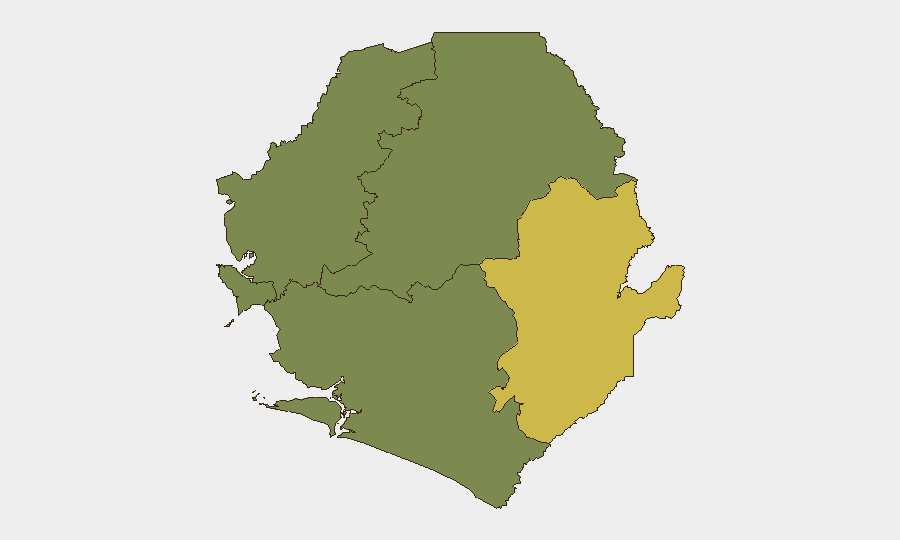
Eastern Province is by far the dominant risk driver (composite score 68), substantially higher than all other regions. Western Area ranks second (score 35), reflecting Freetown's role as the capital and the epicentre of political, diplomatic, and governance pressures. The remaining provinces (Northern, North West, and Southern) register minimal risk in current tracking. Risk in the East and West is concentrated in governance instability, transnational organised-crime activity, and the ripple effects of diplomatic friction with European partners; it does not reflect active armed conflict or large-scale civil unrest, but rather state-capacity and economic vulnerabilities tied to aid dependency and law-enforcement pressure.
How GeoBit Would Assist
Security teams should employ Intel Sweep and X/Twitter OSINT to monitor real-time political and diplomatic developments affecting aid flows and government capacity, and entity extraction and network analysis to track organised-crime actors and external law-enforcement pressures. AOI Monitoring & Early Warning focused on Freetown and Eastern Province would provide persistent alerting on political unrest, civil-society reactions to the new security law, or law-enforcement operations that could affect movement or business operations. Regime-stability search and sentiment analysis of local media and social platforms would flag escalation in civil-liberties criticism or economic-hardship narratives that could precede broader instability.
7-Day Outlook
Diplomatic and aid-suspension threats are likely to intensify over the next week as EU pressure mounts on extradition; this will dominate local political discourse and may begin to affect currency stability or government spending on salaries and security operations. Implementation of the new security law could trigger civil-society or opposition mobilisation, particularly if enforcement appears arbitrary or targets journalists or opposition figures. Economic stress from potential aid loss, combined with ongoing transnational organised-crime activity, poses medium-term risk to governance capacity and social cohesion.
Highest-Risk Areas — Ranked
| # | State / Region | Risk |
|---|---|---|
| 1 | Eastern Province | 68 |
| 2 | Western Area | 35 |
| 3 | North West Province, Sierra Leone | 0 |
| 4 | Northern Province, Sierra Leone | 0 |
| 5 | Southern Province, Sierra Leone | 0 |
Sources
Previous Daily Briefs
A new Sierra Leone brief is written every day — each with its own risk map and downloadable CSV. Here's the last week; use the calendar to go further back.
📅 Browse every day by calendar →
Highlighted days have a brief. Tap a day for that day's map & analysis, or “csv” for that day's dataset ($5).