Situation Summary
Slovakia remains in a low-threat security environment with no significant incidents reported in the last 24–48 hours. However, a confirmed Russian cyber operation targeting critical infrastructure and key industrial sectors (arms, energy, automotive) has triggered political calls for enhanced security-council coordination. Eastern regions—particularly Košice and Prešov—carry elevated composite risk scores, though no acute operational disruptions have been reported in those areas during the current reporting window.
Key Developments
- Russian Cyberattack & Critical Infrastructure (National; 2026-07-27/28)
Slovakia's Foreign Affairs Ministry confirmed that an elite Russian hacking group targeted critical infrastructure and major industrial sectors. Opposition parties (Progressive Slovakia, Za ľudí, Democrats) publicly demanded that Prime Minister Robert Fico convene the Security Council to address the incident. No specific operational outages have been disclosed, but the incident signals sustained state-level cyber targeting of Slovakia's strategic assets.
- Large-Scale Anti-Drug Law Enforcement Operation (Bratislava Region; last 48 hours)
Slovak police conducted a targeted, large-scale anti-drug operation across multiple parts of the Bratislava region. Operational details and results remain unreleased. No reports of collateral unrest, service disruptions, or public-order incidents associated with the operation.
- Rail Sector Governance Risk (National; last 24–48 hours)
Opposition figures criticized a high-ranking Železnice Slovenskej republiky (Slovak Railways) manager's trip to Russia, raising geopolitical governance concerns. This represents a political-risk and reputational issue rather than an operational rail disruption, but highlights sensitivity around critical-infrastructure personnel engagement in the current regional environment.
- National Digital Transport Infrastructure Criticism (Nationwide; last 24–48 hours)
The SaS opposition party criticized the Transport Ministry's multi-million-euro integrated ticketing app "Cyril," which remains unavailable despite significant investment. While not a security incident, this underscores potential vulnerabilities in digital service rollouts affecting national transport infrastructure.
- General Threat Environment Assessment (Countrywide; current reporting window)
Comprehensive monitoring across 193 tracked events over 7 days and multiple regional threat feeds confirm no significant security incidents, civil unrest, conflict, or infrastructure failures in the last 24–48 hours. The security environment is assessed as stable with low incident levels.
Highest-Risk Areas
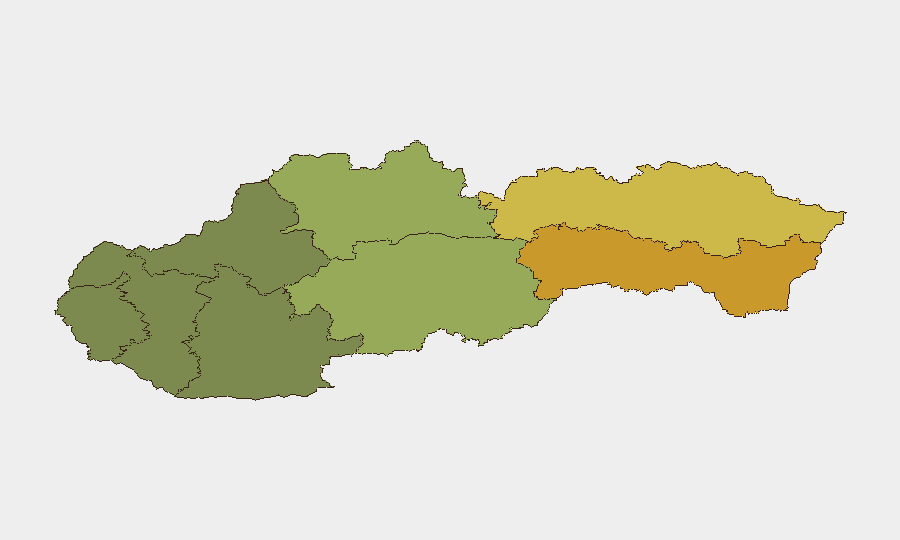
Eastern Slovakia drives the sub-national risk profile, with Košice (risk 72) and Prešov (risk 68) substantially exceeding national and western-region scores. Banská Bystrica (55) and Žilina (42) similarly elevate central and northern risk profiles, while Bratislava (28)—despite being the capital and site of the current anti-drug operation—ranks in the lower half. The eastern concentration likely reflects historical organized-crime activity, cross-border trafficking, and logistical vulnerabilities along Hungary and Ukraine borders, though the cyber threat to critical infrastructure is national in scope.
How GeoBit Would Assist
Corporate security teams managing Slovak operations should deploy Intel Sweep and multi-language OSINT feeds for persistent monitoring of cyber-threat trends, particularly Russian and regional actor activity affecting industrial sectors. AOI Monitoring with alerting on critical infrastructure and eastern-region logistics nodes would provide early warning of emerging threats. Network & Actor Analysis of Russian and Hungarian threat groups, combined with Routing & Network Analysis for supply-chain and personnel movement planning, would support real-time risk navigation in high-risk eastern regions.
7-Day Outlook
No escalation in security incidents is anticipated in the immediate term. The Russian cyber campaign is likely to remain active but non-disruptive absent operational exploitation. Political pressure for security-council engagement may result in public statements and procedural meetings but is unlikely to alter operational threat levels within 7 days.
Highest-Risk Areas — Ranked
| # | State / Region | Risk |
|---|---|---|
| 1 | Region of Košice | 72 |
| 2 | Region of Prešov | 68 |
| 3 | Region of Banská Bystrica | 55 |
| 4 | Region of Žilina | 42 |
| 5 | Region of Nitra | 35 |
| 6 | Region of Bratislava | 28 |
| 7 | Region of Trenčín | 22 |
| 8 | Region of Trnava | 18 |
Sources
Previous Daily Briefs
A new Slovakia brief is written every day — each with its own risk map and downloadable CSV. Here's the last week; use the calendar to go further back.
📅 Browse every day by calendar →
Highlighted days have a brief. Tap a day for that day's map & analysis, or “csv” for that day's dataset ($5).
Atlas — our AI intelligence desk — emails them this snapshot personally. Nothing else, no list.