Situation Summary
Spain remains a low-threat environment globally (rank #154) with a composite threat score of 5 across 227 tracked events. However, recent signal activity—including investigations, police and military mobilizations, and inter-governmental statements spanning 26–28 June—suggests elevated domestic political tension and administrative friction. The geographic distribution of risk is highly concentrated: Castile-La Mancha alone accounts for a disproportionate share of national threat weight, while most autonomous communities remain in the low-risk band, indicating localized rather than nationwide instability drivers.
Key Developments
- 28 June, Spain (national): Investigation initiated; Spain engaged in formal dispute with media outlets over coverage.
- 28 June, Spain (national): Government demand issued to a political figure, signaling institutional pressure or accountability action.
- 27 June, Spain–Portugal border: Police mobilization reported along the frontier, coinciding with Frontex's deployment of a new Lisbon-based command unit covering Portuguese and Spanish borders with expected Canary Islands presence.
- 27 June, Spain (national): Military mobilization activity noted; separate to routine training, suggests operational posture adjustment.
- 27 June, Spain (national): Threat issued to Spanish authorities or interests; specific actor and target remain under investigation.
- 26 June, Spain (national): Parliament, Secretariat, and government each issued formal public statements, consistent with legislative and administrative response cycle.
- 27 June, Ireland–Spain: Irish government public statement regarding Spain, indicating bilateral engagement or dispute.
*Note*: Live web research (last 24 h) confirmed Frontex border operations and a 25 June policy announcement on mobile network resilience during power outages; no verified violent incidents, mass protest, or critical infrastructure failure in the 24–48 hour window.
Highest-Risk Areas
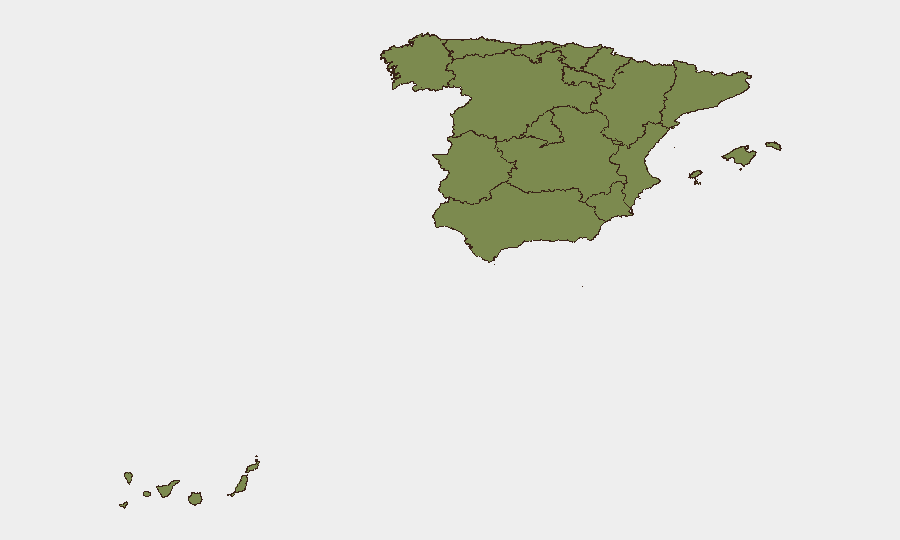
Castile-La Mancha dominates the sub-national risk picture with a score of 31.9—more than double Andalusia (14.3)—and warrants dedicated monitoring. Andalusia and Madrid follow at 14.3 and 8.4, respectively, representing the urban and economic centers where political tension is most likely to manifest. Catalonia (4.8) and Galicia (4.1) retain elevated but secondary profiles, consistent with historical autonomy and separatist sensitivities. The sharp drop-off below the top five regions suggests that risk is concentrated in central and southern Spain, with northern and insular regions relatively insulated; however, cross-border sensitivity (police mobilization on the Portuguese frontier) indicates that border-zone security and migration pressures may be co-drivers.
How GeoBit Would Assist
Intel Sweep and multi-language OSINT fusion across Spanish media, parliamentary proceedings, and Telegram/X channels would provide real-time sentiment and actor mapping around the ongoing political and administrative friction. AOI Monitoring & Early Warning applied to Castile-La Mancha, Andalusia, and the Spanish–Portuguese frontier would generate persistent alerting on protest activity, law-enforcement response, and cross-border movement anomalies. Election monitoring and regime-stability assessment capabilities would help distinguish tactical political disputes from systemic instability and flag early-warning indicators of escalation (rhetoric shift, force mobilization patterns, or institutional breakdown).
7-Day Outlook
The cluster of investigative, mobilization, and statement events across 26–28 June suggests an acute political or administrative crisis cycle rather than sustained unrest. Resolution or de-escalation is likely within 7–14 days if institutional mechanisms (parliamentary process, government response) absorb the friction; sustained threat elevation would require evidence of mass mobilization, violence, or cross-regional coordination. Frontex border operations should be monitored as a potential proxy for migration or smuggling pressure that could amplify instability in the southern and eastern regions.
Highest-Risk Areas — Ranked
| # | State / Region | Risk |
|---|---|---|
| 1 | Castile-La Mancha | 31.9 |
| 2 | Andalusia | 14.3 |
| 3 | Community of Madrid | 8.4 |
| 4 | Catalonia | 4.8 |
| 5 | Galicia | 4.1 |
| 6 | Autonomous Community of the Basque Country | 3.5 |
| 7 | Canary Islands | 2 |
| 8 | Balearic Islands | 1.9 |
| 9 | Aragon | 1.9 |
| 10 | Valencian Community | 1.9 |
| 11 | Castile and León | 1.9 |
| 12 | Extremadura | 1.9 |
Sources
Previous Daily Briefs
A new Spain brief is written every day — each with its own risk map and downloadable CSV. Here's the last week; use the calendar to go further back.
📅 Browse every day by calendar →
Highlighted days have a brief. Tap a day for that day's map & analysis, or “csv” for that day's dataset ($5).