Situation Summary
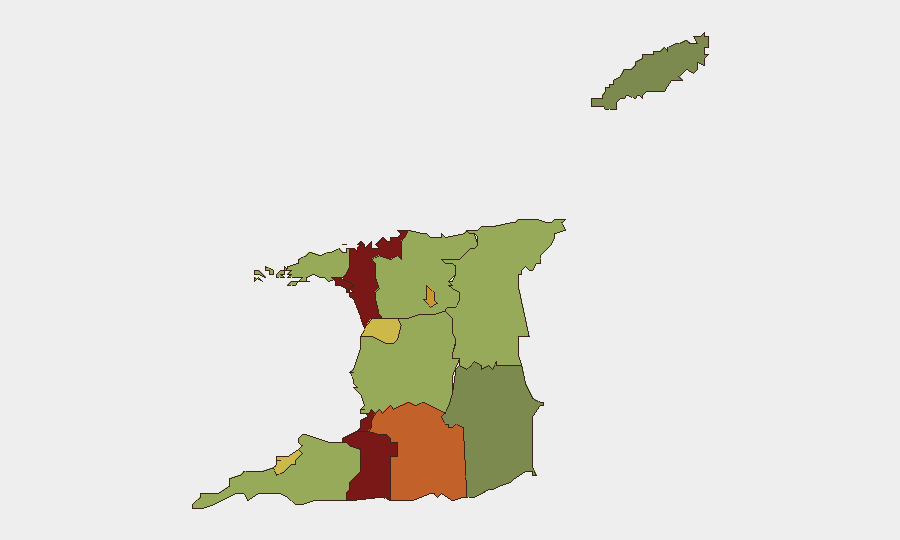
Trinidad and Tobago maintains a composite threat score of 15 with no tracked acute events in the last 24–48 hours, though underlying criminality and governance pressures remain endemic. Sub-national risk concentration is acute: San Juan-Laventille (95), Port of Spain (88), and Penal-Debe (82) register substantially elevated threat profiles, driven by organized crime, gang activity, and firearms trafficking. Recent event signals involving U.S.–Trinidad and Tobago diplomatic and judicial friction (July 29) warrant monitoring for potential downstream impacts on security cooperation and bilateral relations.
Key Developments
- No validated acute security or travel incidents confirmed within the last 24–48 hours based on open-source verification. Recent reporting (July 22–28) falls outside the immediate window but provides relevant context.
- U.S.–Trinidad and Tobago relations stressed (July 29). Event signals flag a "Reduce Relations" signal and an arrest/detain action by Texas agents against Trinidad and Tobago nationals, alongside a judicial demand. Details remain limited in open sources; monitor for statements from the Ministry of Foreign Affairs or statements from affected parties over the next 24–72 hours.
- Multi-agency human-trafficking operation concluded (July 22–25). The Counter Trafficking Unit detained three individuals, including a Defence Force member, under Preventive Detention Orders in what officials described as a major intelligence-led exercise. Suggests ongoing transnational smuggling vulnerability despite law-enforcement pressure.
- Preventive detention of high-profile businessman and wife revoked (July 23). Dominic and Genevieve Hadeed were released after approximately one month in custody on alleged assassination-plot charges; criminal investigation continues. Indicates potential legal/procedural challenges to prolonged detention frameworks.
- Targeted killing in Chaguanas (July 23). A 33-year-old taxi driver was shot in what police assessed as a targeted attack, reinforcing the pattern of organized and gang-related homicide in central Trinidad.
- Suspected arson attack on journalist's vehicle, Tobago (July 24). A TV6 reporter's van was deliberately set ablaze outside her residence in Lowlands. Underscores press-safety and investigative-journalism pressure in both islands.
Highest-Risk Areas
San Juan-Laventille and Port of Spain together account for the highest composite risk (95 and 88, respectively), reflecting dense gang presence, firearms circulation, and territorial disputes. Penal-Debe, San Fernando, and Princes Town (82, 80, and 75) form a secondary high-risk corridor in central and southern Trinidad, historically linked to narcotics trafficking and organized-crime supply chains. These areas drive the national threat profile; organizations with personnel or assets in or transiting these municipalities should maintain heightened due diligence and layered security protocols.
How GeoBit Would Assist
Security teams should deploy Area-of-Interest (AOI) Monitoring & Early Warning on high-risk municipalities (San Juan-Laventille, Port of Spain, central-southern corridor) to detect emerging crime spikes, gang activity changes, or political friction. OSINT Fusion & Corroboration (X/Twitter, Telegram, YouTube, radio SIGINT, multi-language search) will track bilateral U.S.–Trinidad and Tobago statements, law-enforcement announcements, and civil-society reporting to provide 24–48-hour early signals of policy shifts or security cooperation changes. Network & Actor Analysis supports mapping of trafficking, narcotics, and gang networks to assess threat proximity to specific corporate or diplomatic assets.
7-Day Outlook
No imminent escalation is forecast based on current signals, though the U.S.–Trinidad and Tobago diplomatic tension (July 29) warrants close monitoring for reciprocal enforcement actions or statements that could affect binational law-enforcement cooperation. Underlying crime drivers (gang activity, firearms trafficking, narcotics transit) will likely persist at endemic levels; organized violence in high-risk municipalities should be expected to continue. Journalists and civil-society actors may face increased pressure as investigations into trafficking and alleged assassination plots progress.
Highest-Risk Areas — Ranked
| # | State / Region | Risk |
|---|---|---|
| 1 | San Juan-Laventille | 95 |
| 2 | Port of Spain | 88 |
| 3 | Penal-Debe | 82 |
| 4 | San Fernando | 80 |
| 5 | Princes Town | 75 |
| 6 | Arima | 72 |
| 7 | Chaguanas | 68 |
| 8 | Point Fortin | 65 |
| 9 | Diego Martin | 58 |
| 10 | Siparia | 55 |
| 11 | Couva-Tabaquite-Talparo | 52 |
| 12 | Sangre Grande | 48 |
Sources
Previous Daily Briefs
A new Trinidad and Tobago brief is written every day — each with its own risk map and downloadable CSV. Here's the last week; use the calendar to go further back.
📅 Browse every day by calendar →
Highlighted days have a brief. Tap a day for that day's map & analysis, or “csv” for that day's dataset ($5).
Atlas — our AI intelligence desk — emails them this snapshot personally. Nothing else, no list.