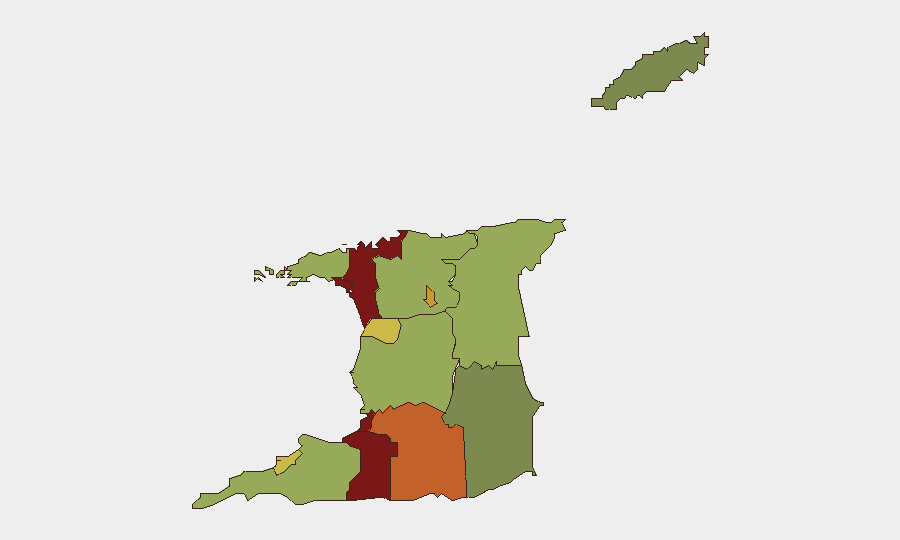
Situation Summary
Trinidad and Tobago remains a moderate-threat environment (global rank #91, composite score 21) with a stabilizing homicide trend but persistent organized-crime activity and emerging industrial-sector vulnerabilities. The past week saw intensified government security operations under new legislation, a significant private-sector shutdown with employment implications, and two police-involved fatal shootings in Tobago. The overall security posture is defined by localized gang and street-crime concentration in the capital region and western industrial zones, now subject to enhanced police powers and visible deployment.
Key Developments
- Port Lisas, Couva–Tabaquite–Talparo (5 Oct): Nutrien announced indefinite shutdown of its nitrogen complex due to restricted port access and unreliable natural-gas supply, raising concerns over energy-sector employment and industrial continuity in a key economic zone.
- Trinidad and Tobago nationwide (6 Oct): The Special Operations Act, 2026 came into force, granting police enhanced powers including checkpoints, cordons, movement restrictions, searches, seizures, and possible curfews in designated areas.
- Trinidad and Tobago nationwide (7 Oct): Prime Minister Kamla Persad-Bissessar publicly warned criminals to vacate communities selected for special operations and pledged "hard policing measures" under the new legislation.
- Buccoo, Tobago (night of 7 Oct): Police killed two suspected gunmen during a shootout; one police officer was injured. Reported as Tobago's first fatal police shooting of 2026.
- Trinidad and Tobago nationwide (7 Oct): Government announced 30 new police posts targeting major roads, transport routes, junctions, and strategic locations to increase visible policing presence.
- Trinidad and Tobago nationwide (7 Oct): Public Utilities Minister confirmed Trinidad and Tobago Electricity Commission debt to National Gas Company has exceeded TT$10 billion, with government intervention planned in the upcoming budget.
- Trinidad and Tobago nationwide (9 Oct): Police reported 265 homicides during January–September 2026, down from 275 in the same 2025 period; serious reported crime and road-traffic accidents also declined year-on-year.
- Unspecified location (7 Oct): A 22-year-old university student and 84-year-old grandmother were reportedly locked in a bathroom during a home invasion and robbery, illustrating vulnerability of residential targets.
- Trinidad and Tobago nationwide (10 Oct): Opposition politician Stuart Young warned of potential energy-sector collapse following Nutrien shutdown and reports that Proman had sent workers home, linking developments to industrial job losses and economic instability.
Highest-Risk Areas
San Juan-Laventille (risk 95), Port of Spain (88), and Penal-Debe (82) drive the country's composite threat profile, reflecting entrenched gang presence, street-level violent crime, and organized-crime supply chains in the capital region and central-southern industrial corridor. Western zones (San Fernando, Point Fortin) and central towns (Arima, Chaguanas) present elevated but secondary risk, correlating with drug-trafficking routes and informal-economy employment. Deployment of new police posts and special-operations authority will likely concentrate enforcement in these identified hotspots.
How GeoBit Would Assist
Security teams would deploy AOI Monitoring & Early Warning to track police operations, gang activity, and transport-route disruptions in San Juan-Laventille and Port of Spain with real-time alerting. Network & Actor Analysis and OSINT fusion would monitor industrial-sector workforce disruptions and criminal-enterprise adaptation to new policing powers. Routing & Network Analysis would provide alternative route planning around police checkpoints and cordoned areas to enable safe staff and asset movement.
7-Day Outlook
Enhanced police operations under the Special Operations Act will likely produce continued visible enforcement activity and intermittent clashes with armed groups, particularly in the capital and western zones. Industrial-sector contraction following Nutrien's closure may trigger secondary economic and employment pressures, indirectly affecting community stability and crime patterns over weeks ahead.
Highest-Risk Areas — Ranked
| # | State / Region | Risk |
|---|---|---|
| 1 | San Juan-Laventille | 95 |
| 2 | Port of Spain | 88 |
| 3 | Penal-Debe | 82 |
| 4 | San Fernando | 80 |
| 5 | Princes Town | 75 |
| 6 | Arima | 72 |
| 7 | Chaguanas | 68 |
| 8 | Point Fortin | 65 |
| 9 | Diego Martin | 58 |
| 10 | Siparia | 55 |
| 11 | Couva-Tabaquite-Talparo | 52 |
| 12 | Sangre Grande | 48 |
Sources
Previous Weekly Briefs
A new Trinidad and Tobago brief is written every Monday, covering the week — each with its own risk map and downloadable CSV. Use the calendar to go further back.
- October 5, 2026
- September 28, 2026
- September 21, 2026
- September 14, 2026
- September 7, 2026
- September 2, 2026
- September 1, 2026
📅 Browse past briefs by calendar →
Highlighted days have a brief. Tap a day for that day's map & analysis, or “csv” for that day's dataset ($5).
Atlas — our AI intelligence desk — emails them this snapshot personally. Nothing else, no list.