Situation Summary
Trinidad and Tobago remains classified as a moderate-threat jurisdiction (global rank #91, composite score 21), with gang violence and street crime as the primary drivers. Homicide data for January–September 2026 show a modest 3.6% decline year-on-year (265 vs. 275 cases), and serious reported crime is down 13.3%, suggesting marginal stabilization. However, localized violence in Port of Spain, San Juan–Laventille, and southern urban centers persists, and prison-security breaches (drone interdiction on 2026-09-20) indicate organized smuggling networks remain active.
Key Developments
- Caroni Cremation Site, October 1: Police destroyed 8.3 tonnes of seized narcotics (cocaine, marijuana, synthetics) valued at approximately TT$1.68 billion, reflecting continued drug-supply-chain enforcement activity and the scale of trafficking through the country.
- National Crime Statistics, October 2: TTPS reported 265 homicides January–September 2026, a 3.6% decrease from 275 in the same 2025 period; serious reported crime declined 13.3% year-on-year, indicating limited improvement in headline security metrics.
- San Juan North Secondary School, September 21: Police continued intervention following an unspecified security incident at the school; incident scope and outcome remain unclear.
- George Street (Port of Spain), September 20: A 27-year-old male was fatally shot; motive and perpetrator identity unconfirmed, consistent with ongoing gang-related violence in the capital.
- Taxi Area Robbery, September 23: A 56-year-old male was beaten and robbed of a gold chain (TT$15,000 value) while seeking transport; perpetrators unidentified, typical of street-level crime in high-density urban zones.
- Prison Facility, September 20: Officers intercepted a drone believed to carry prohibited items intended for facility introduction; indicates ongoing organized smuggling attempts and security vulnerabilities.
- Micro-Policing Units, reported September 29: Three units activated in Eddie Hart Savannah, Grand Bazaar, and Tarouba conducted 387 mobile and 78 foot patrols, resulting in 8 arrests and 16 fixed-penalty notices; a Tarouba anti-crime exercise was described as successful by the police commissioner.
- House of Representatives, October 1: Legislation passed (23–10) raising the legal age for alcohol and tobacco to 21, and cannabis and gambling to 25; implementation timeline and enforcement mechanisms not yet detailed.
- Caribbean Airlines Route Resumption, October 2 announcement: Commercial passenger flights to Caracas will resume October 31 after suspension exceeding one year; airline cited security-concern resolution but Venezuela route remains subject to political volatility.
- Pax Vale, Santa Cruz, October 1: A fallen tree downed T&TEC power lines and blocked road access; crews cleared obstruction; incident resolved without reported injuries or cascading service disruptions.
Highest-Risk Areas
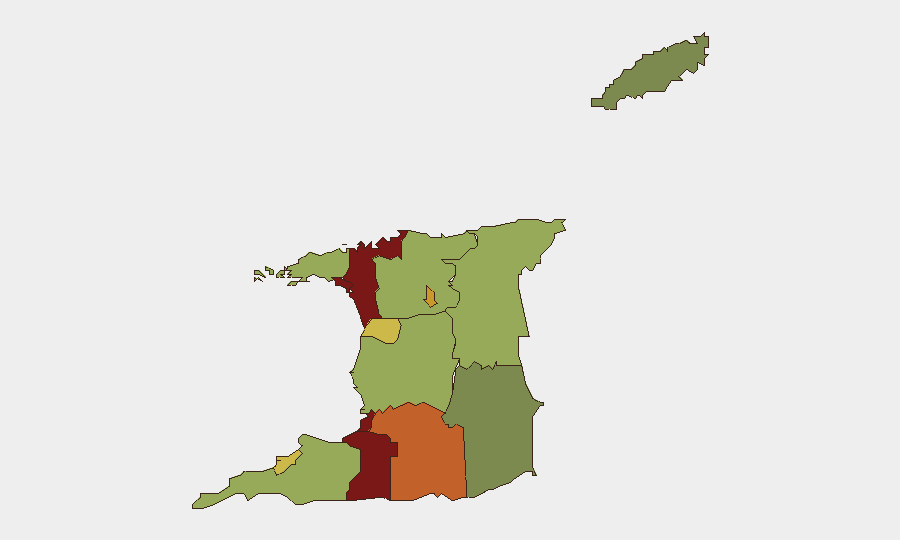
San Juan–Laventille (risk 95) and Port of Spain (risk 88) dominate the threat landscape, driven by entrenched gang activity, turf disputes, and armed robbery. Southern urban centers—Penal-Debe (82), San Fernando (80), and Princes Town (75)—reflect secondary but significant concentrations of violence and organized crime. These areas account for the majority of reported homicides and street-level crime; organizations with personnel or assets in these zones should apply heightened protective protocols.
How GeoBit Would Assist
Security teams should deploy AOI Monitoring & Early Warning to track violence incidents in Port of Spain and San Juan–Laventille in real time, enabling rapid duty-of-care response. Intel Sweep and multi-language OSINT (X, Telegram, local media feeds) provide early signals of gang activity, prison-security breaches, and emerging disputes. GIS & Spatial Analysis and Risk & Threat Assessment allow organizations to map personnel/asset exposure against sub-national risk rankings and route staff away from highest-risk corridors.
7-Day Outlook
Homicide and serious-crime rates are trending downward but remain volatile, particularly in Port of Spain and southern urban centers. Organized smuggling and prison-security incidents are likely to persist. No major security deterioration is anticipated in the near term, but street-level crime and gang violence will remain endemic risks for high-density urban operations.
Highest-Risk Areas — Ranked
| # | State / Region | Risk |
|---|---|---|
| 1 | San Juan-Laventille | 95 |
| 2 | Port of Spain | 88 |
| 3 | Penal-Debe | 82 |
| 4 | San Fernando | 80 |
| 5 | Princes Town | 75 |
| 6 | Arima | 72 |
| 7 | Chaguanas | 68 |
| 8 | Point Fortin | 65 |
| 9 | Diego Martin | 58 |
| 10 | Siparia | 55 |
| 11 | Couva-Tabaquite-Talparo | 52 |
| 12 | Sangre Grande | 48 |
Sources
Previous Weekly Briefs
A new Trinidad and Tobago brief is written every Monday, covering the week — each with its own risk map and downloadable CSV. Use the calendar to go further back.
- September 28, 2026
- September 21, 2026
- September 14, 2026
- September 7, 2026
- September 2, 2026
- September 1, 2026
- August 31, 2026
📅 Browse past briefs by calendar →
Highlighted days have a brief. Tap a day for that day's map & analysis, or “csv” for that day's dataset ($5).
Atlas — our AI intelligence desk — emails them this snapshot personally. Nothing else, no list.