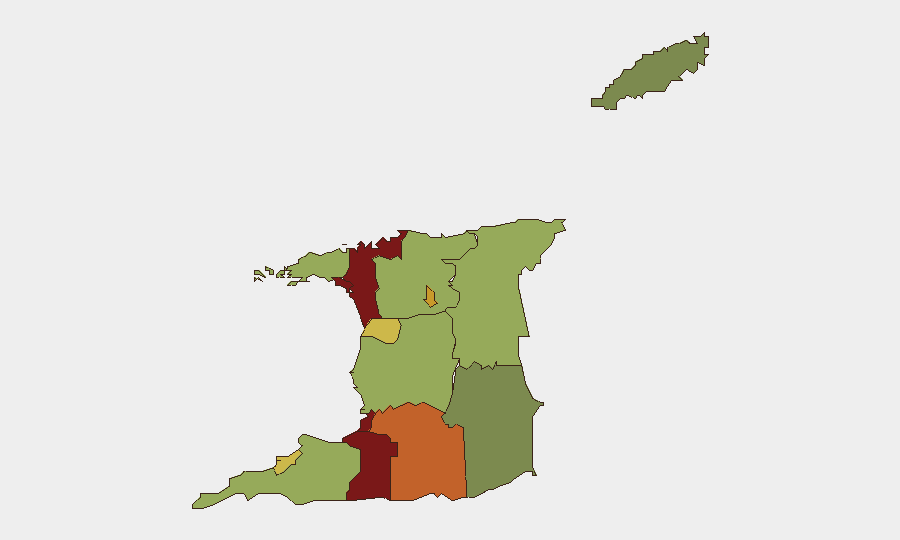
Situation Summary
Trinidad and Tobago remains a moderate-threat environment (global rank #89) where gang-related crime and narcotics trafficking are the primary security drivers. The state of emergency, which had defined the threat landscape since its declaration, formally ended on September 17, and the UK government's removal of emergency-related travel warnings on September 21 signals cautious normalization. However, underlying criminal networks—particularly those engaged in firearms smuggling and drug transit—continue to pose a direct threat to stability, as underscored by Prime Minister remarks at the United Nations on September 23.
Key Developments
- Nationwide (September 21): UK government removed state-of-emergency language from its Trinidad and Tobago travel advisory, following the emergency's reported conclusion on September 17. The formal mechanism for ending the declaration remains unclarified.
- San Juan (September 21): Police intervention continued at San Juan North Secondary School following an unspecified security incident. The Victim and Witness Support Unit deployed psychosocial support to affected staff, indicating a trauma response.
- Parliament (September 21–24): The Special Operations Bill, 2026 advanced through legislative debate. The proposed framework would authorize curfews, cordoned zones, expanded search powers, and Defence Force deployment across seven designated policing districts—a significant expansion of state operational authority.
- Nationwide (September 23): Prime Minister Persad-Bissessar identified transnational criminal networks—specifically illicit firearms and narcotics transit—as an existential threat to Trinidad and Tobago and regional stability during UN General Assembly remarks.
- Port of Spain/Treasury (September 25): An electrical transformer fault temporarily disrupted critical services at the Treasury Division, including government-cheque processing. Operations were subsequently restored; the incident reflects infrastructure vulnerability rather than a security breach.
- Nationwide (September 24): The Meteorological Service issued the country's first Hot Spell Alert for 2026, effective through October 31, with potential secondary impacts on public order and service delivery.
Highest-Risk Areas
San Juan-Laventille and Port of Spain dominate the sub-national ranking (risk scores 95 and 88 respectively), reflecting entrenched gang activity and turf-related violence in the capital region. Penal-Debe (82) and San Fernando (80) in the south-central corridor emerge as secondary hotspots, likely driven by narcotics transit infrastructure and rival distribution networks. The concentration of risk in urban and semi-urban corridors—particularly those with historical gang territorial disputes and proximity to major transport arteries—suggests that threat intensity correlates with supply-chain geography and gang consolidation rather than random dispersal.
How GeoBit Would Assist
Security teams should employ AOI Monitoring & Early Warning on the highest-risk jurisdictions (San Juan-Laventille, Port of Spain, Penal-Debe) to detect upticks in gang signaling, violent incidents, and police/Defence Force mobilization. Intel Sweep and X/Twitter OSINT capabilities would capture emerging gang communications, criminal-network developments, and unofficial public reporting ahead of formal government announcements—critical for duty-of-care teams protecting staff in or transiting these zones. Routing & Network Analysis would enable alternative journey planning for personnel in high-risk areas during periods of heightened enforcement or criminal activity.
7-Day Outlook
The passage of the Special Operations Bill is likely to intensify police and Defence Force presence in designated zones over the coming weeks, potentially displacing criminal activity rather than reducing underlying supply-chain vulnerabilities. Extreme heat through October may exacerbate public-order strain in densely populated areas; combined with ongoing gang competition and narcotics transit, secondary incidents (minor civil unrest, opportunistic criminality) cannot be ruled out.
Highest-Risk Areas — Ranked
| # | State / Region | Risk |
|---|---|---|
| 1 | San Juan-Laventille | 95 |
| 2 | Port of Spain | 88 |
| 3 | Penal-Debe | 82 |
| 4 | San Fernando | 80 |
| 5 | Princes Town | 75 |
| 6 | Arima | 72 |
| 7 | Chaguanas | 68 |
| 8 | Point Fortin | 65 |
| 9 | Diego Martin | 58 |
| 10 | Siparia | 55 |
| 11 | Couva-Tabaquite-Talparo | 52 |
| 12 | Sangre Grande | 48 |
Sources
Previous Weekly Briefs
A new Trinidad and Tobago brief is written every Monday, covering the week — each with its own risk map and downloadable CSV. Use the calendar to go further back.
- September 21, 2026
- September 14, 2026
- September 7, 2026
- September 2, 2026
- September 1, 2026
- August 31, 2026
- August 30, 2026
📅 Browse past briefs by calendar →
Highlighted days have a brief. Tap a day for that day's map & analysis, or “csv” for that day's dataset ($5).
Atlas — our AI intelligence desk — emails them this snapshot personally. Nothing else, no list.