Situation Summary
Trinidad and Tobago remains at moderate composite threat level (rank 97 globally; score 18) but faces a concentrated surge in violent crime, particularly homicides and gun violence, during the week of 8–14 September. A national state of emergency—set to expire 17 September—remains in effect, enabling enhanced police powers and special operations, yet firearm-related offences and targeted killings have persisted. The security environment is volatile in specific urban pockets, especially San Juan-Laventille and Port of Spain, where gang-related and interpersonal violence continues to dominate incident patterns.
Key Developments
- Morvant cluster homicides (8–11 September): At least four fatal shootings occurred in Morvant over four days, including a 62-year-old man (Steve Griffith) killed in Second Caledonia on 9 September with multiple 5.56 and 9mm casings recovered, and a 21-year-old fatally shot by 11 September. This concentration signals either gang escalation or retaliatory violence cycles in the area.
- State of emergency extension decision (10–11 September): Authorities debated whether to extend emergency powers beyond the 17 September expiry date, reflecting policy uncertainty and a tacit acknowledgment that crime reduction targets have not been met, despite lower homicide counts than in prior years.
- Anti-crime operation, Siparia/Santa Flora/Erin (9 September): Police executed Operation R.E.S.O.L.U.T.E. Shield across three southern districts under Emergency Powers Regulations, arresting six people and seizing marijuana and an air rifle, reinforcing enforcement tempo.
- Targeted killing, Malabar, Arima (11 September): A 36-year-old interior company owner was shot dead inside his vehicle during what was framed as a setup ("deadly trap"), suggesting business-related or targeted violence in Arima.
- Shooting, Orangefield Road, Carapachima (12 September): Two men (Joel Charles and another) were wounded in a central Trinidad shooting, underlining continued gun violence outside the capital region.
- Cutlass attack, Moruga (8 September): A 33-year-old labourer was critically injured in a dispute-escalated cutlass attack, demonstrating interpersonal violence remains significant despite the firearm focus.
- Acid attack, Sea Trace, Maraval (9 September, reported 12 September): A 19-year-old woman was injured in an alleged acid attack by a family member, indicating domestic violence and assault using corrosive substances continue.
- Inquest decision, Sea Lots (10 September): An inquest was ordered into the 26 August stabbing death of Edwin Richardson, signalling sustained legal and police attention to violent crime clusters in high-risk Port of Spain areas.
- School violence policy (8–9 September): Prime Minister Persad-Bissessar publicly defended removal of violent students from schools, reflecting institutional concern over education-sector security and disruptive behaviour.
- Crime statistics snapshot (13 September): National reporting indicated 2,154 serious crimes recorded year-to-date, including 558 firearm/ammunition possession cases, 256 robberies, 225 break-ins, and 24 narcotics-trafficking cases.
Highest-Risk Areas
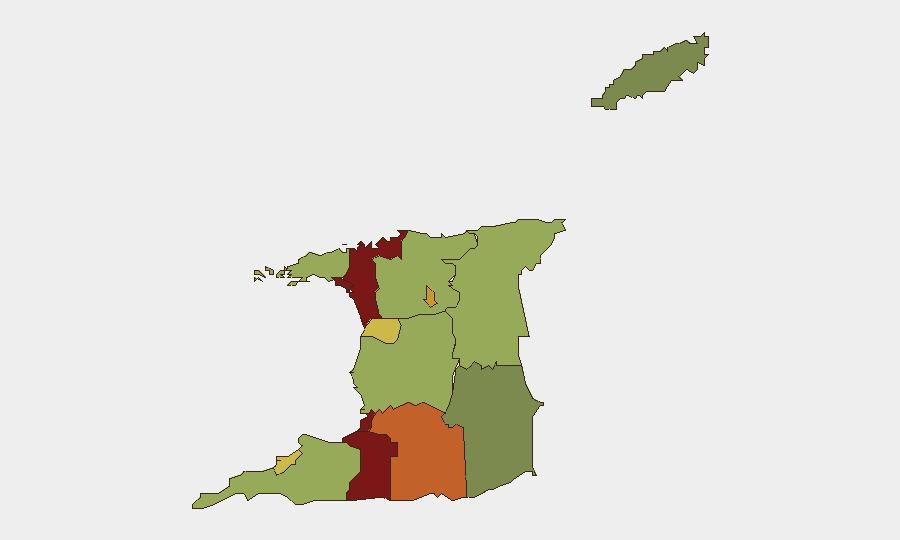
San Juan-Laventille (risk 95) and Port of Spain (risk 88) dominate the sub-national threat landscape, followed by Penal-Debe (82) and San Fernando (80). The top four regions collectively represent gang strongholds, informal settlements, and commercial hubs where interpersonal disputes, firearm availability, and limited police presence converge. Morvant's week-long shooting cluster, while falling within San Juan-Laventille's broader geography, exemplifies rapid violence escalation in specific micro-zones. Southern districts (Siparia, Princes Town) remain elevated due to drug trafficking and organized-crime activity, as evidenced by the Operation R.E.S.O.L.U.T.E. Shield sweep.
How GeoBit Would Assist
Security teams should deploy AOI Monitoring & Early Warning on Morvant, Sea Lots, and San Juan-Laventille to detect shooting clusters and retaliatory cycles in near-real time. OSINT feeds and social/Telegram monitoring capture gang communications, dispute escalation signals, and planned violence before incidents occur. Routing & Network Analysis enables staff to identify safe transit corridors around known violence hotspots and assess business-appointment risk in areas like Malabar and Arima.
7-Day Outlook
The state of emergency decision by 17 September will shape enforcement capacity and travel restrictions over the coming week. If extended, police powers remain broadened; if allowed to lapse, reactive policing may increase response times in high-risk zones. Morvant and Port of Spain require heightened vigilance given the clustering pattern, and targeted violence against business owners (Malabar incident) suggests occupational and enterprise risk warrants mitigation review.
Highest-Risk Areas — Ranked
| # | State / Region | Risk |
|---|---|---|
| 1 | San Juan-Laventille | 95 |
| 2 | Port of Spain | 88 |
| 3 | Penal-Debe | 82 |
| 4 | San Fernando | 80 |
| 5 | Princes Town | 75 |
| 6 | Arima | 72 |
| 7 | Chaguanas | 68 |
| 8 | Point Fortin | 65 |
| 9 | Diego Martin | 58 |
| 10 | Siparia | 55 |
| 11 | Couva-Tabaquite-Talparo | 52 |
| 12 | Sangre Grande | 48 |
Sources
Previous Weekly Briefs
A new Trinidad and Tobago brief is written every Monday, covering the week — each with its own risk map and downloadable CSV. Use the calendar to go further back.
- September 7, 2026
- September 2, 2026
- September 1, 2026
- August 31, 2026
- August 30, 2026
- August 29, 2026
- August 28, 2026
📅 Browse past briefs by calendar →
Highlighted days have a brief. Tap a day for that day's map & analysis, or “csv” for that day's dataset ($5).
Atlas — our AI intelligence desk — emails them this snapshot personally. Nothing else, no list.