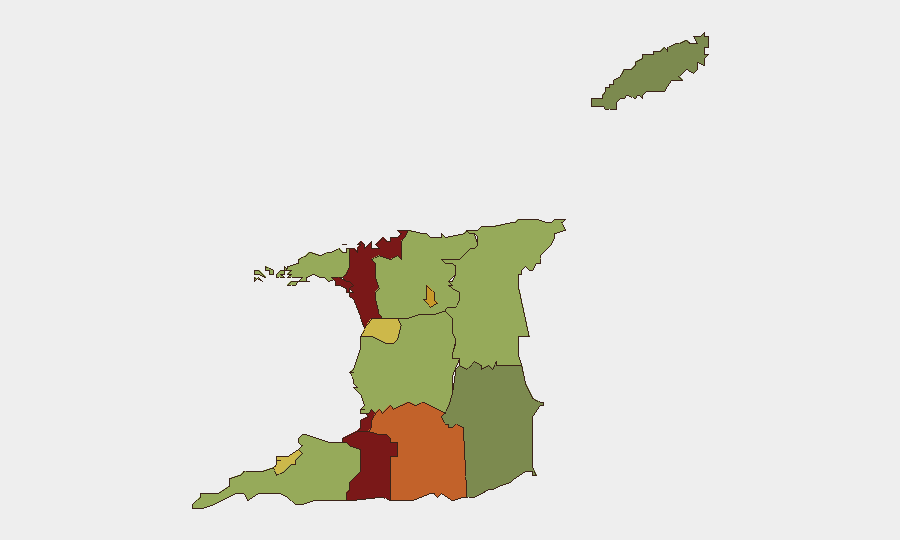
Situation Summary
Trinidad and Tobago faces persistent violent crime and property-crime pressure, with a nationwide State of Emergency in effect targeting gang activity, shootings, and larceny. Recent law-enforcement operations (July 27–29) yielded firearm seizures, ammunition interdiction, and arrests across the Central Division and Port of Spain jurisdiction, indicating active criminal networks and weapons circulation. Concurrent cyber incidents affecting multiple government ministries represent an emerging administrative disruption risk. Overall threat trajectory remains elevated but operationally managed through sustained police enforcement.
Key Developments
- July 29, 2026 – Port of Spain & Tunapuna: TTPS reported anti-crime operations yielding two firearm seizures, ammunition and narcotics confiscation, two arrests following a larceny incident, and cash recovery—reflecting heightened enforcement under the State of Emergency.
- July 28, 2026 – Monos Island (north-west maritime zone): Trinidad and Tobago Coast Guard intercepted a pirogue carrying seven Venezuelan nationals during routine maritime patrol, indicating ongoing irregular migration and potential smuggling activity along maritime entry routes.
- July 28, 2026 – Valencia (north-eastern Trinidad): Two murders reported within a 48-hour window preceding this date, contributing to localized gun-violence escalation in the north-eastern corridor.
- July 27, 2026 – Central Division (Chaguanas/Couva corridor): TTPS conducted intelligence-led anti-crime exercise resulting in suspected firearm seizure, 240 rounds of high-powered ammunition, narcotics confiscation, and arrests of priority offenders engaged in violent crime and gang activity.
- Late July 2026 (ongoing) – Nationwide government entities: Multiple ministries and state entities investigating active cyber incidents causing service disruptions and outages; remediation and investigation continuing as of early August.
- Late July 2026 – Mc Bean, Couva: Vehicle theft reported (white Honda City, PDS 1993) from UNIPET Gas Station on Southern Main Road, part of recent property-crime incident pattern in central Trinidad.
Highest-Risk Areas
San Juan-Laventille (risk 95) and Port of Spain (risk 88) remain the dominant drivers of national threat, reflecting concentration of gang activity, violent crime, and weapons trafficking in the Port of Spain metropolitan area. Penal-Debe (82), San Fernando (80), and Princes Town (75) sustain elevated risk through secondary criminal networks and rural gun violence. Central Division corridors—Chaguanas (68), Couva-Tabaquite-Talparo (52)—show persistent property crime and narcotics activity despite recent police operations. Collectively, these twelve zones account for organized crime infrastructure, ammunition supply chains, and gang territorial disputes; risk remains highest in urban centers and their immediate hinterlands.
How GeoBit Would Assist
Security teams would deploy AOI Monitoring & Early Warning to track persistent activity in San Juan-Laventille, Port of Spain, and the Central Division, with real-time alerting on arrests, weapons seizures, and incident clustering. OSINT & Intel Sweep capabilities—including X/Twitter and social-media monitoring, multi-language search, and sentiment analysis—would enable early detection of emerging gang disputes, maritime smuggling coordination, and cyber-incident attribution. Network & Actor Analysis would map criminal organization structure, weapons-supply routes, and irregular-migration networks, informing duty-of-care planning for staff in high-risk zones.
7-Day Outlook
Violent crime and property larceny are expected to persist at current levels under sustained State of Emergency operations; police enforcement cycles will likely continue yielding periodic firearm and ammunition seizures. Cyber incidents affecting government services may experience resolution or escalation depending on attribution and remediation pace. Maritime irregular migration and smuggling activity will remain routine, absent significant Coast Guard surge or international coordination.
Highest-Risk Areas — Ranked
| # | State / Region | Risk |
|---|---|---|
| 1 | San Juan-Laventille | 95 |
| 2 | Port of Spain | 88 |
| 3 | Penal-Debe | 82 |
| 4 | San Fernando | 80 |
| 5 | Princes Town | 75 |
| 6 | Arima | 72 |
| 7 | Chaguanas | 68 |
| 8 | Point Fortin | 65 |
| 9 | Diego Martin | 58 |
| 10 | Siparia | 55 |
| 11 | Couva-Tabaquite-Talparo | 52 |
| 12 | Sangre Grande | 48 |
Sources
Previous Daily Briefs
A new Trinidad and Tobago brief is written every day — each with its own risk map and downloadable CSV. Here's the last week; use the calendar to go further back.
📅 Browse every day by calendar →
Highlighted days have a brief. Tap a day for that day's map & analysis, or “csv” for that day's dataset ($5).
Atlas — our AI intelligence desk — emails them this snapshot personally. Nothing else, no list.